
There are many routes for immigration to Canada, and applicants come with different goals: a Canadian study permit, a job in Canada, a start-up, a business to run, skilled worker selection, or a provincial nominee program.
One of those routes is the Canadian work permit, and this guide covers the types, the steps, the documents and the extension process. Understand one thing at the outset: a work permit is temporary authorisation to work. It does not grant permanent residence and it does not turn into permanent residence on its own. What it can do is give you Canadian work experience, which several permanent residence programs value.
What is a Canadian work permit?
A Canadian work permit is the document that authorises a foreign national to work in Canada for a defined period. It is temporary work authorisation, issued by Immigration, Refugees and Citizenship Canada.
With a permit you can hold a real, specific job with a Canadian employer under the conditions written on the permit itself: the employer, the occupation, the location and the expiry date. Many people who later apply for Canadian permanent residence started with a work permit, but the two are separate applications with separate tests. Every year people enter Canada through a job offer, as the accompanying spouse of a student or worker, or through a provincial program, and work under a permit. Below are the categories the government issues.
Types of Canadian work permit
Work permits fall into the following groups:
| Work permit type | Details | Notes |
|---|---|---|
| Open Work Permit | Open permit; no restriction on choice of employer | For spouses of international students, protected persons, eligible graduates |
| Closed Work Permit (employer-specific) | Valid for one named employer and position only | For those with a valid job offer from a Canadian employer |
| PGWP | Post-Graduation Work Permit for graduates of Canadian institutions | International students |
| BOWP | Bridging Open Work Permit for those who have applied for permanent residence and are awaiting a decision | For PR applicants with an application in process |
| SOWP | Spousal Open Work Permit for spouses of eligible students or valid work permit holders | For the spouse of a student or foreign worker |
| IEC | International Experience Canada; for citizens of countries with a youth mobility agreement with Canada | For young people aged 18 to 30, or 18 to 35 depending on country of citizenship |
How to apply for a Canadian work visa
If you are applying from outside Canada for a Canadian work visa, the usual route is an employer-specific work permit, often called a closed work permit. That requires a genuine job offer from a Canadian employer before you apply.
In most cases the employer must first obtain a positive Labour Market Impact Assessment (LMIA) from Employment and Social Development Canada, showing that no Canadian citizen or permanent resident was available to fill the role. Some jobs are LMIA-exempt under the International Mobility Program, including intra-company transferees, professionals covered by CUSMA and other trade agreements, and certain research and academic positions. Which stream applies changes the paperwork, the timeline and the cost, so establish it before anything else.
Once the offer and, where required, the LMIA are in place, you complete the forms, upload the documents, pay the fee and give biometrics. An employer-specific permit ties you to that employer.
Under that permit you cannot simply change jobs or move to another employer. The permit is issued for those conditions and for a fixed period, typically matching the length of the offer or the LMIA. To change employers you need a new work permit, and in most cases you can start the new job only once it is approved.
After a year of skilled work in Canada you may become eligible to apply for permanent residence through the Canadian Experience Class or a provincial stream. Eligibility is not the same as approval, and applying for a work permit from abroad is rarely straightforward.

Points to watch when applying from abroad
You need a genuine Canadian job offer from a real employer, and the offer letter should set out the duties, the wage, the occupation and the skill level along with any benefits. The permit is normally issued for the length of the contract, and it is extended only if the underlying job and authorisation are extended.
One point is often misunderstood. Foreign nationals can and do take jobs in health care, in schools and in childcare. What those occupations require is an immigration medical examination, because the work involves close contact with patients, children or vulnerable people. The requirement is an extra step, not a bar.
The examination must be done by a physician on IRCC’s panel list (a Panel Physician). Your own doctor cannot do it. The purpose is to establish that you are not a danger to public health or safety and that your care would not place excessive demand on Canadian health services. A medical examination is also required for anyone who will be in Canada for more than six months and has spent time in a country IRCC designates, whatever the occupation. Applicants for an open work permit who plan to work in these fields must complete the examination too, even though they do not need a job offer.
Results go directly from the panel physician to IRCC. Without them, the permit will not be issued, or will be issued with a condition barring work in those occupations. The same examination requirement applies to most permanent residence applications. The government sets out the details in the medical examination section of its website.
How to extend a Canadian work permit
If you are already in Canada on a work permit, the extension process runs as follows. Apply before the current permit expires; that timing is what protects your ability to keep working.
| Step | Details | Documents |
|---|---|---|
| Check the work permit expiry date | Apply at least 30 days before expiry | UCI number and expiry date on the current work permit |
| Sign in to your IRCC account | Sign in to your IRCC online account | Your username and password |
| Select the application type | Select "Extend or change conditions on your work permit" | Complete form IMM5710 |
| Complete the forms and upload documents | Fill in the online forms and upload supporting documents | As set out in the documents section |
| Pay the fees | CAD 155 | Payment receipt |
| Complete biometrics (if required) | CAD 85 | Payment receipt |
| Wait for a decision | Under implied status you may generally stay in Canada and keep working under the same conditions while the application is pending | IRCC acknowledgement of receipt |
Documents for a work permit application or extension
Because accurate, current documents decide these applications, prepare and, where needed, translate the items in the table below before you upload anything to the IRCC portal:
| Document | Work permit application | Work permit extension |
|---|---|---|
| Application form | Form IMM 1295 | Form IMM 5710 |
| Valid passport | At least 6 months' validity and two blank pages | At least 6 months' validity and two blank pages |
| Job offer letter | Required | Required for a closed (employer-specific) work permit |
| LMIA approval or LMIA-exemption letter | Depends on the permit type | If required |
| Language test results | Required | Not required |
| Proof of funds letter | To cover costs for the first few months | Not required |
| Medical exam | Required if the job is in a listed occupation, or if you lived 6 months or more in a designated country in the year before applying | Not required |
| Police certificate | Required | In certain cases |
| Fee payment receipt | Required | Required |
| Family-related documents | For a spouse and children | If extending for family members |
From a work permit to permanent residence
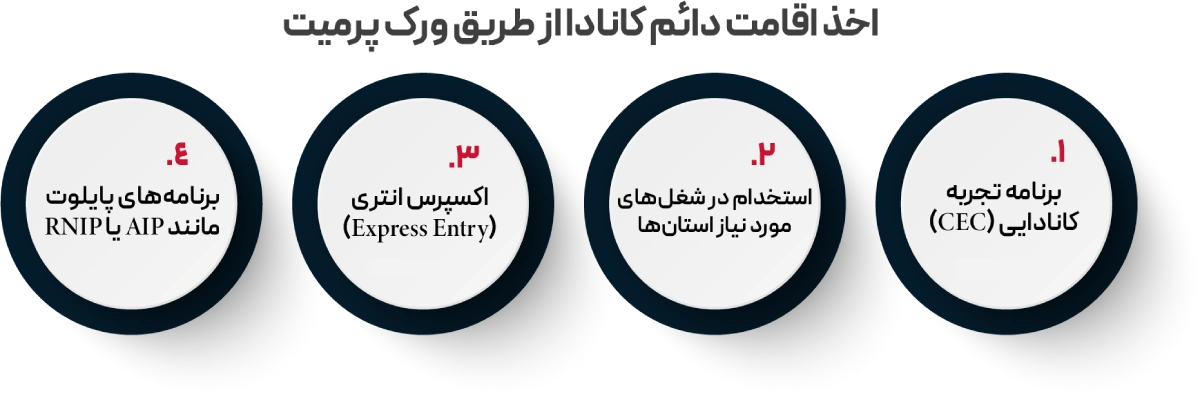
Canadian work experience feeds into several permanent residence programs:
- The Canadian Experience Class (CEC), for people who have worked in Canada
- Provincial Nominee Programs (PNP), for occupations a province is short of
- Express Entry, which manages the federal economic programs
- Pilot programs, including the Atlantic Immigration Program and the Rural Community Immigration Pilot and the Francophone Community Immigration Pilot, both launched in January 2025, which replaced the Rural and Northern Immigration Pilot after it closed to new applications on 31 August 2024
Many people who arrive on a temporary work permit later apply for permanent residence. There are defined routes for doing so, but none of them is automatic and none is guaranteed.
The most common is the Canadian Experience Class, managed through Express Entry. It requires at least one year of skilled full-time work in Canada within the previous three years, plus language results at CLB 7 for TEER 0 and TEER 1 occupations, or CLB 5 for TEER 2 and TEER 3. Provincial Nominee Programs are the other common route: if you have worked and lived in a province, that province may have a stream built for you, and a nomination adds 600 points to your Express Entry score.
Work in an occupation classified as TEER 0, 1, 2 or 3 under the National Occupational Classification is what counts as skilled experience. The older NOC 0, A, B labels were replaced by the TEER system, and using the old categories is a common source of error. Canadian experience and strong English or French results are the two factors that move a Comprehensive Ranking System score most. Note that a job offer no longer earns CRS points; that changed in spring 2025.
Work permit help from Aval Visa
Aval Visa is the practice of Hadi Imani, a Regulated Canadian Immigration Consultant (RCIC #R522575) regulated by the College of Immigration and Citizenship Consultants. We work on work permit applications, spousal open work permits and work permit extensions. If you are in Canada and your permit is approaching expiry, contact the Toronto office or complete the free assessment form and we will get back to you.
Applying to extend in good time, at least 30 days before the expiry date and preferably earlier, is what keeps your status intact and your work authorisation continuous. Nobody can promise you a permit or permanent residence. Those decisions belong to IRCC. What a licensed representative does is assess whether you qualify, tell you plainly if you do not, and file a complete and accurate application.
Frequently asked questions
- Can I still apply after my Canadian work permit has expired? Track the expiry date and apply before it. If the permit has already expired, you have lost your status and must stop working immediately. You then have 90 days to apply to restore your status, paying both the restoration fee and the work permit fee. Restoration is discretionary, not automatic, and you cannot work while it is pending.
- How long does a work permit extension take? It depends on the type of application and where you apply from. Check the current figure in IRCC’s processing times tool before you plan around it, and apply well ahead of expiry so the timeline does not matter.
- Can I keep working while my extension is assessed? Yes, if you applied before your current permit expired and you stay in Canada. That is maintained status, sometimes called implied status, and you may keep working under the conditions of the old permit until a decision is made. If you leave Canada while the application is pending, maintained status ends and you may not be able to resume work on return.