If you are a physician or a specialist and you want to move to a prosperous European country, Italy is worth considering. Quality of life, the earnings available to specialists, and job and social security are the main arguments for moving to Italy as a doctor.
This guide covers the documents and conditions, the process itself, and above all how a foreign medical degree is recognised so that you can practise and settle in Italy.
If Canada is also under consideration, see the Nova Scotia Defined licence in Canada — a provincial route built for internationally trained physicians.
Advantages of moving to Italy
The route is not simple. Doctors have to get their qualifications recognised, reach a solid level of Italian, show sufficient funds, and in some cases sit and pass an entrance examination if they are entering through study. With that said, the case for Italy is strong.
Beyond a varied job market with good pay for specialists, the main advantages of working as a doctor in Italy include:
-
- A high standard of clinical care
- A universal healthcare system, the Servizio Sanitario Nazionale
- Equal access to healthcare for all residents
- A wide range of roles for specialists
- An attractive country with a deep cultural life
- Stable long-term employment
Routes for doctors to move to Italy
There are two main routes. Qualified physicians and specialists apply to have their existing degrees recognised. Those still at the study stage apply through an Italy student visa, obtain a place at a medical faculty and train there. The recognition route is covered first.

Recognition of a foreign medical degree
Doctors from outside the EU who want to practise in Italy start by applying for recognition of their qualification (riconoscimento) at the Italian Ministry of Health (Ministero della Salute).
For this, the applicant needs to book an appointment at the Italian consulate and obtain a document called the Dichiarazione di valore, submitting certified translations of every academic and university record. Once the formal application reaches the Ministry of Health, the file is assessed. Depending on how closely the training matches Italian standards, the Ministry may recognise the qualification outright or require compensation measures, such as an aptitude test or a period of supervised practice; the Esame di Stato, Italy’s state licensing examination, is part of this picture for many applicants.
The purpose is to give the Ministry confidence that a doctor trained abroad has the knowledge and clinical competence to work in Italian teaching hospitals, clinics and health services. Recognition is followed by registration with the provincial medical board, the Ordine dei Medici, which is what actually allows you to practise.
Entering through specialist training
Doctors who have completed a general medical degree can compete for a place in Italian specialist training. Entry is through the national residency competition, the concorso nazionale SSM, which is the exam that leads into a specialty school at an Italian medical faculty. Entry to the six-year single-cycle degrees in Medicine and Surgery, Dentistry and Veterinary Medicine is a different route: it no longer runs through the IMAT admissions test but through an open first semester (“semestre aperto”), in which applicants enrol through the national portal and places are allocated on the results of national examinations sat during that semester. Residency places are filled only through the national SSM competition, so check which route applies to your stage before you plan. Successful candidates hold a study residence permit for the duration of the programme.
At the end of training, a doctor can move onto a work permit and towards Italian residence, and take up posts in hospitals and health services across Italy. The requirements and stages are set out below.
Requirements for doctors moving to Italy
| Requirements for doctors | Migration steps | Qualification recognition steps |
|---|---|---|
| Holding a medical degree | Prepare and translate documents | Obtain diploma verification from the Italian embassy |
| Sit the recognition or specialty exam | Submit documents to the Italian Ministry of Health | Certified translation of documents, submitted to the embassy |
| Italian language proficiency (level set by the Ordine dei Medici where you register) | Sit the Esame di Stato | Forward the file to the Ministry of Health |
| Health certificate and clean criminal record | Register with the medical council (Ordine dei Medici) | Sit the academic and practical assessment |
| Medical liability insurance | Complete recognition and start practising officially | Receive official authorisation from the Italian medical council |
The highest-earning medical specialties in Italy
Earnings vary considerably between specialties:
| Medical specialty | Average annual income in EUR |
|---|---|
| Neurosurgery | Varies by country and year; check the national pay scale for the country concerned |
| Cardiology | Varies by country and year; check the national pay scale for the country concerned |
| General surgery | Varies by country and year; check the national pay scale for the country concerned |
| Radiology | Varies by country and year; check the national pay scale for the country concerned |
| Orthopaedics and bone surgery | Varies by country and year; check the national pay scale for the country concerned |
| Ophthalmology | Varies by country and year; check the national pay scale for the country concerned |
| Obstetrics and gynaecology | Varies by country and year; check the national pay scale for the country concerned |
The best Italian cities for doctors moving from abroad
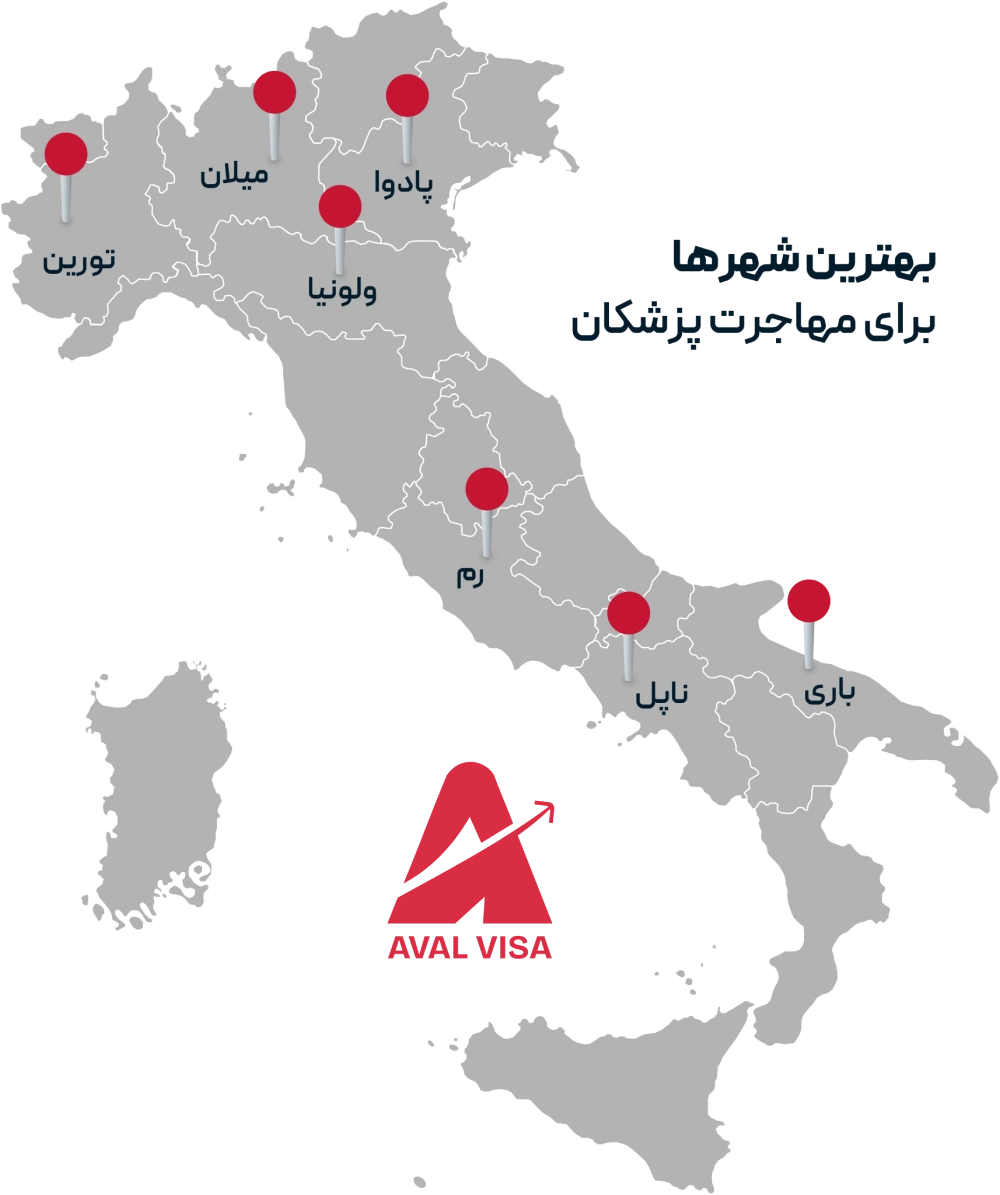
With the requirements and process covered, the next question is where to live. The right choice depends on whether family are coming, schooling for children, income against costs, climate, and above all the range of roles available locally.
Aval Visa would point doctors towards these cities:
- Milan: the country’s medical and economic hub
- Rome: a centre for teaching hospitals
- Bologna and Padua: strong medical universities
- Turin: reasonable living costs alongside a good range of roles
- Bari and Naples: lower living costs and persistent staffing demand
What it costs for doctors to move to Italy
| Cost item | Cost in EUR |
|---|---|
| Obtaining a Dichiarazione di Valore | EUR 50 to 100 |
| Recognition exam (Esame di Stato) | Set by the university holding the examination |
| Registration with the Italian medical board (Ordine dei Medici) | EUR 80 to 150 |
| Medical liability insurance | EUR 100 to 200 |
| Legal residence (Permesso di soggiorno) | EUR 100 to 160 |
Moving to Italy with Aval Visa
Moving to Italy, or to other European countries, as a doctor is achievable, but it requires working through a defined set of stages and producing complete academic records, so that the authorities can be satisfied about clinical competence.
Language learning and degree recognition are the two real hurdles, and once past them Italy is a strong destination for physicians from abroad. If you want to practise in Europe with good pay and stable employment, Italy is worth planning for seriously.
Complete the free assessment form to start, and our team will take your file through the process and help you prepare for life in Italy.
Frequently asked questions
- Which medical specialties need recognition? All of them. Any medical qualification requires recognition before you can register and work in Italy.
- Is the Esame di Stato difficult? It is a moderate-level examination testing both theoretical and practical knowledge. With proper preparation it is a realistic hurdle, and many internationally trained doctors pass it.
- Which Italian language certificate is accepted? CILS or CELI at C1 is the level normally expected for clinical work, though the medical board sets the requirement, so confirm the current level with the Ordine dei Medici in your province.
- Can I move without a specialty? Yes. A general practitioner can have their university qualifications recognised, sit the required examinations and work in Italy.
This article is general information, not legal advice, and it describes published official rules rather than any individual case.