If you are looking at Europe and you have a business idea that can scale, the Italy Startup Visa is worth understanding properly. It is the route Italy uses to bring in founders from outside the EU who want to build an innovative company in one of Europe’s larger economies, and it carries a residence permit with it.
Italy offers solid infrastructure, access to the single market, a network of certified incubators and a set of tax measures aimed at innovative companies. This guide sets out how the route works, what the authorities look for, what it costs and how long it takes.
What is the Italy Startup Visa?
The Italy Startup Visa is a national visa route for non-EU founders who want to set up an innovative company in Italy.
The legal framework for innovative startups was created in 2012, and the Italia Startup Visa programme itself opened in 2014. It is run through the Ministry of Enterprises and Made in Italy, the department formerly known as MiSE, with the aim of attracting founders who add to innovation and employment in the country. Applicants need an idea that is genuinely innovative, scalable and technology-related, set out in a written business plan.
The route gives founders legal residence in an EU member state and a base from which to reach European markets and Italian sources of funding. Approval is not automatic: an evaluation committee reviews every plan on its merits, and the decision rests with the Italian authorities.
Two ways into the Italy Startup Visa
There are two routes into the programme:
- Applying directly to the Italia Startup Visa Committee
You prepare the business plan in English or Italian and submit it through the official portal. If the committee accepts that the idea is innovative and capable of generating revenue and jobs, it issues a certificate of no impediment, the nulla osta. That certificate is what allows you to apply for a national type D visa at an Italian consulate.
- Applying with the backing of a certified Italian incubator
Certified incubators are public or private organisations that support early-stage companies. Where one of them formally endorses your project, the file carries more weight and tends to move faster. Incubators also provide workspace, legal and financial guidance, seed funding and access to a professional network.
Italy Startup Visa requirements
The core requirement is an idea that is innovative, workable and capable of making money. The detail goes into a business plan, written for the committee or the incubator, which has to show:
- where the company starts from
- what resources it needs
- how it reaches profitability and creates jobs
- how much capital it requires
- when it expects to generate revenue
The second requirement is capital of at least EUR 50,000 available for the business. That money can come from your own funds or from recognised sources such as private investors, investment funds or certified incubators. You have to evidence it, so that the authorities can see the company is capable of being financed.
Beyond that, applicants are expected to hold a relevant qualification or professional record, have no criminal record, and hold health insurance valid in Italy. There is no formal language test, but the application and the business plan have to be in English or Italian, and you will be working with Italian partners in one of those two languages. If you are applying through a certified incubator, its formal letter of acceptance forms part of the file.
Documents for the Italy Startup Visa
| Documents | Details |
|---|---|
| Completed visa application form | Filled in accurately and in full, with all required information |
| Business plan | Details of the idea, target market, revenue model and financial projections |
| Acceptance letter from an incubator or government approval | Official acceptance letter or Nulla Osta from the Italian authorities |
| Proof of funds | Bank documents or investment agreements proving at least EUR 50,000 in capital |
| Police clearance certificate | From the police or the relevant authority in the country of origin |
| Medical fitness certificate | Proof of the applicant's physical and mental health |
| Valid identity documents | Passport + birth certificate + national ID card |
| Work and education CV | Full academic and professional history |
| Proof of accommodation in Italy | Rental contract or hotel booking for the initial stay |
| Health insurance documents | Valid health insurance covering medical costs in Italy |
How the Italy Startup Visa process works
Everything starts with turning the idea into a business plan that fits Italian company rules. Once that is ready, the sequence runs as follows:
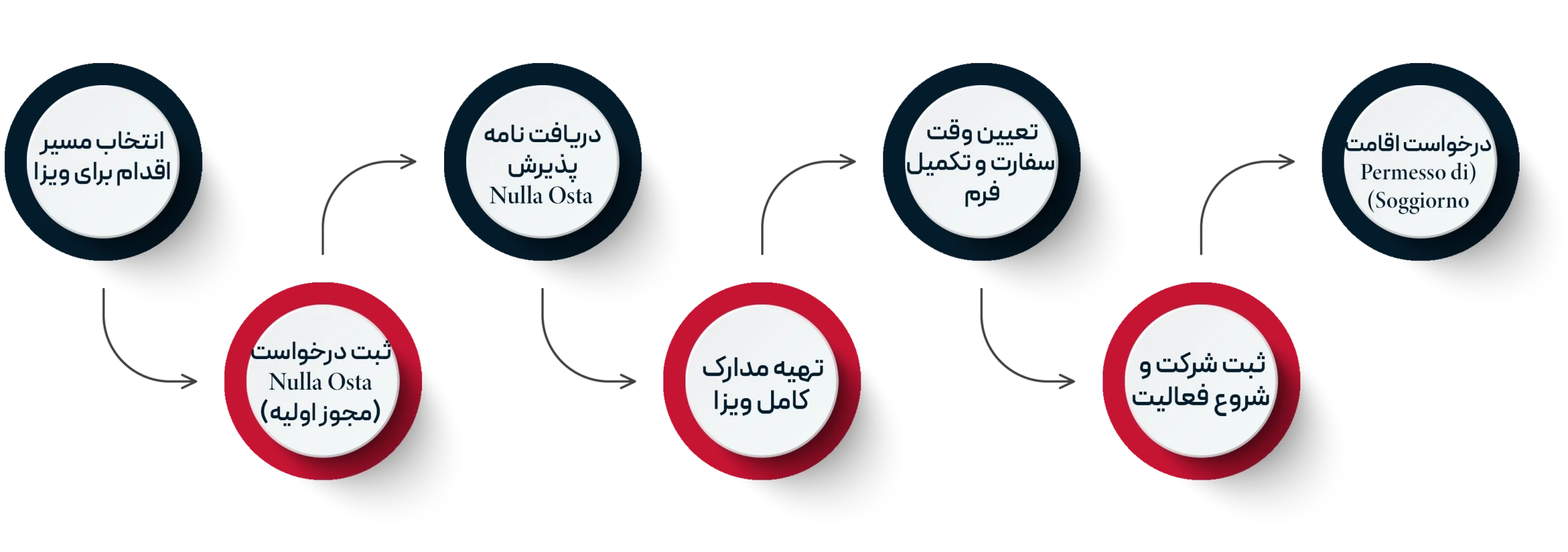
1. Choose which of the two routes to use
- Obtain a letter of acceptance from a certified Italian incubator
- Apply directly and obtain the nulla osta from the Italian ministry responsible for enterprise
2. File the nulla osta application
If you are applying directly, submit the online request through the official Italia Startup Visa portal and upload the supporting documents.
3. Receive the acceptance letter or the nulla osta
Once the file has been reviewed, the incubator issues its letter of acceptance or the committee issues the nulla osta. The certificate has a limited validity, so plan the consular step around it.
4. Assemble the visa documents
With the certificate in hand, prepare the rest of the file and arrange sworn translations where they are required.
5. Book the consular appointment and complete the visa form
Complete the national visa application form and book an appointment at the Italian consulate responsible for where you live. You submit the documents in person and wait for the decision.
6. Register the company and start trading
After arrival in Italy, register the company formally and begin operating along the lines set out in the business plan.
7. Apply for the residence permit (Permesso di Soggiorno)
You have 8 days from arrival in Italy to apply for the residence permit.
Italy Startup Visa costs
| Item | Amount in EUR | Notes |
|---|---|---|
| Initial investment in the startup | Minimum EUR 50,000 | To prove sufficient funds to launch the business |
| Visa processing fee | EUR 100 to 150 | Per person |
| Tax stamp (Marca da Bollo) | EUR 16 | Official stamp for documents |
| Annual health insurance | EUR 200 to 400 | Mandatory for residence in Italy |
| Document translation | Variable | Depends on document type and the translation office's rates |
| Document legalisation (Apostille), per document | EUR 50 to 100 | For documents issued outside Italy |
| Incubator support fee (optional) | EUR 1,000 to 2,500 | If working with a certified incubator |
| Business plan preparation (if needed) | EUR 1,000 to 3,000 | If advisory services are used |
| Initial living costs in Italy (monthly) | EUR 300 to 800 | Varies by city of residence |
Points worth knowing about the programme
The EUR 50,000 minimum can come from personal funds, investors or incubators. On top of that figure, budget for document translation, certifications and professional advice in Italy.
Working with an incubator is optional rather than compulsory, but a credible endorsement strengthens a file. Choose one whose sector expertise matches your idea, and contact it before you submit anything, so you know what its programme actually provides. You can also hand the whole job to Aval Visa. Our team shapes the business plan into the form the committee expects, approaches incubators on your behalf, assembles and translates the documents and prepares the file end to end, so you can spend your time on the business itself.
Leading startup incubators in Italy
The list below covers incubators that come up repeatedly in the Italian ecosystem and that support founders with business plan validation, funding and the steps that follow:

1. Digital Magics, Milan
Works in digital technology, fintech and the internet of things. Known for acceleration programmes of roughly 3 to 6 months, seed funding and access to a wide network of investors and advisers.
2. LUISS EnLabs, Rome
Focused on fintech, artificial intelligence and SaaS. Runs an acceleration programme of about 5 months, invests up to around EUR 160,000, and is tied to LUISS University.
3. H-FARM, near Venice
Known for technology and digital transformation. Runs an incubation programme of around 12 months, invests up to around EUR 100,000 and provides access to a network of investors and advisers.
4. PoliHub, Milan
Linked to Politecnico di Milano and focused on advanced and deep technology. Alongside hands-on advice for founders, it runs incubation and acceleration programmes and opens access to investors and industrial partners.
5. I3P, Turin
Linked to Politecnico di Torino, with a focus on clean technology, biotechnology and digital innovation. It offers workspace, dedicated mentoring and introductions across the Piedmont innovation network.
Advantages of the Italy Startup Visa
If you want to live in Italy and build a company there, these are the practical benefits of the route:
- Legal long-term residence in Italy, inside the Schengen area
- Travel within the Schengen area for up to 90 days in any 180-day period
- Access to the European single market and room to grow the business
- Public support programmes and financial measures aimed at innovative startups
- Tax incentives available to registered innovative startups and their investors
- A route into the Italian innovation ecosystem, with investors and international networks
- Family members (spouse and children) can join, with the right to work and study
- Renewal where the company is genuinely trading, and a path toward long-term residence
- Modern infrastructure and a skilled workforce in technology and business services
The Italy Startup Visa with Aval Visa
The Italy Startup Visa suits founders with a defensible idea who want to enter the European market and hold residence while they build. With public support programmes, certified incubators and access to funding, a founder can bring their family and, after five years of legal residence in Italy, apply for the EU long-term residence permit. Outcomes depend on the company actually trading, and every decision rests with the Italian authorities.
Aval Visa takes founders through that sequence. We review your idea against what the committee treats as innovative, put the business plan into shape, identify the incubators that match your sector, prepare and translate the documents, complete the visa forms and book the consular appointment. Book a consultation and our team will tell you where your case stands before you spend anything on it.
Other startup visas in Europe: the Netherlands startup visa, the Finland startup visa and the Estonia startup visa.
Frequently asked questions
- Which Italian cities are best for launching a startup? Milan, Italy’s business capital, along with Rome, Turin, Bologna and Florence, are where most of the ecosystem sits. The right city still depends on your sector, the resources you need, the accelerators active in that field and where your customers are.
- Which sectors do best in Italy? Based on ministry data and the innovation ecosystem, ICT and software, health technology, renewable energy and sustainability, fashion technology, and online education and digital learning attract the most support and funding.
- How long is the Italy Startup Visa valid? The visa is issued for 1 year. Once the company is registered and genuinely trading in line with the business plan, the residence permit can be renewed, and after five years of legal residence a founder and their family can apply for long-term residence.