

Digital Nomad Visa: Countries, Requirements and Costs

Digital nomad visa

Work online and live legally in some of the best countries in the world

A digital nomad visa is the legal route to temporary residence for freelancers and remote workers. It lets you live in your destination country without a local job offer and without registering a company, keep earning in your existing currency, and use the banking, insurance and public services that come with legal residence. We help you choose the country, test your profile against its conditions and prepare the file.

Family members

Allowed

Language requirement

None

Typical timeline

About 2 to 8 weeks

Approximate cost

EUR 80 to USD 600

Digital nomad routes

آیکون مهاجرت تحصیلی

Spain digital nomad visa

This visa lets remote workers live in Spain and carry on with their professional work, with no obligation to be in an office

آیکون مهاجرت تحصیلی

Portugal digital nomad visa

Portugal’s digital nomad visa opened a clear way to live in the country while working remotely, and it has drawn strong interest from freelancers and independent professionals

The route in detail

Who qualifies for a digital nomad visa?

  • Freelancers and remote workers with a steady income in foreign currency
  • People working remotely for companies or employers based abroad
  • Owners of online businesses (e-commerce store, training platform, digital startup)
  • Content creators (YouTube, blogs, podcasts, social media)
  • Developers, designers, digital marketers, writers and online consultants
  • Applicants who can prove a set monthly income, usually USD 2,000 to USD 4,000
  • Applicants with no criminal record and valid international health insurance

Work that suits a digital nomad visa

  • Programming and software development
  • Graphic design and UI/UX
  • Digital marketing and social media management
  • Content production, writing and translation
  • Online teaching and language tuition
  • Business, financial and coaching consultancy
  • Project management and online support
  • Building and running internet businesses

The document checklist in full

  • Valid passport
  • Biometric photo
  • Completed visa application form
  • Professional CV or a link to your work profile (LinkedIn, Upwork and similar)
  • Employment contract, employer letter or freelance evidence
  • Proof of monthly income or bank statements
  • Valid international health insurance
  • Proof of accommodation (hotel booking or rental agreement)
  • Police clearance certificate (required in some countries)

Does a digital nomad visa lead to permanent residence?

  • A digital nomad visa does not grant permanent residence on its own
  • Several countries allow renewal for up to 2 or 3 years
  • After a period of legal residence, and with a local employer, a switch to a work permit can be possible
  • Starting a business or registering a company can open a long-term residence route
  • Some countries will consider permanent residence or a self-employment permit after several years of continuous legal residence

Costs, stated up front

Government visa fee

1000$

Monthly cost of living

900$

How we work with you

  1. 1Assess your profile and choose the right country

  2. 2Sign the agreement and open your file

  3. 3Prepare and translate the documents, then book the appointment

  4. 4Visa issued, then arrival and settling in

Frequently asked questions

Can I be hired by a local employer on a digital nomad visa?

No. This visa covers independent work for clients and employers outside the country. It is not a work permit, so it does not allow local employment.

It depends on the destination. The threshold is usually between USD 2,000 and USD 4,000 a month, and several countries tie it to their own minimum wage, so it changes each year.

Yes. Many countries allow a spouse and children to apply as dependants, against additional documents and a higher income threshold.

Do you meet these conditions?

Have your digital nomad visa eligibility checked now, free of charge. A careful review before you apply is what keeps a refusal, and a second round of fees, off the table.

Digital nomad visa: the complete guide

Digital nomad visa

As remote roles have multiplied, the digital nomad has become a settled way of working rather than a novelty. Digital nomads earn online, are not tied to one office or one city, and live in the countries that will have them.
The pattern suits work that needs a laptop and a connection: software development, graphic design, digital marketing, writing, online teaching and business consulting. In response, a growing number of countries now issue a dedicated permit, usually called a digital nomad visa.

A digital nomad visa is what makes that income legal and long-term in the country you live in. If you freelance or work remotely, the sections below set out the requirements, the documents, the steps and the costs.

What is a digital nomad visa?

A digital nomad visa is a temporary residence permit issued to people who work remotely for clients or employers outside the country granting it.
Professionals, founders and freelancers who serve companies or clients abroad are the target group. The permit runs for a fixed term, typically 6 to 24 months, and lets the holder live and work in the country for that period.

Estonia, Portugal and the United Arab Emirates were among the first to open this route, and dozens of countries have followed.

Who qualifies for a digital nomad visa

Digital nomads fall into a few broad groups, defined by how they earn:

  • Specialists such as graphic designers, translators and writers who work project by project for different clients.
  • Employees who work remotely for one named company.
  • Owners of online businesses, from e-commerce stores to training platforms and apps.
  • Content creators earning from YouTube, Instagram, blogs or podcasts.
  • People teaching languages, skills, music or academic subjects remotely.
  • Whichever group you fall into, the application turns on proving the work is real and that you have the skills and the income behind it.

Which countries offer a digital nomad visa?

Not every country issues one. The best-known programmes include:

  • Portugal
  • Spain
  • Estonia
  • Croatia
  • Germany (freelance residence permit)
  • Georgia
  • Dubai (United Arab Emirates)
  • Mexico
  • Costa Rica
  • Bermuda
  • Barbados
  • Colombia
  • Indonesia (the Bali nomad route)
  • Thailand (Smart Visa and long-stay nomad routes)
Conditions differ from country to country. What they share is temporary residence for remote work, with no requirement to be hired by a local company.

Spain digital nomad visa

The Spain digital nomad visa suits people who work remotely for companies or clients outside Spain and want to live in the country for a period. It allows qualifying applicants to reside in Spain while carrying on their professional work. Before applying, check the income threshold, your work history, insurance and the document list carefully. The income bar is set as a multiple of the Spanish minimum wage and is revised each year, and there is a cap on how much of your income may come from Spanish clients. It is also worth understanding the drawbacks: living costs in some Spanish cities, the tax and social security obligations that follow residence, and the limits on the kind of work you may do. Alongside those, price the visa itself and the extras around it, from insurance to certified translations and accommodation.

Spain digital nomad visa

Germany for digital nomads

Germany can work well for people who earn online, given the strength of the economy, the connectivity and the size of the market. One point matters before anything else: Germany does not have a digital nomad visa. The route used instead is the residence permit for self-employed and freelance work under the Residence Act, and it is built around clients based in Germany rather than an employer abroad. Requirements vary with your profession and your profile, and applications normally call for financial records, client contracts or letters of intent, health insurance and proof that you can cover your living costs. So before you commit to a work visa or a freelance permit in Germany, weigh the residence conditions together with the visa fees, living costs, insurance and the rest of the moving budget.

Portugal for digital nomads

Portugal has become one of the most popular choices for people who want to live in Europe while earning from work based elsewhere. The climate, the pace of life and cities such as Lisbon and Porto have made it a magnet for remote employees and freelancers. Before applying, check the income requirement, which is pegged to a multiple of the Portuguese minimum wage and updated annually, along with the evidence of work, accommodation and insurance. Comparing the cost of a digital nomad visa in Portugal with Spain and Germany is a sensible step. In the end the choice should rest on your income, the cost of living, your tax position, the residence conditions and what you want in the long run.

What do digital nomads earn?

Earnings vary with skill, experience, the type of work and the destination. Recent market figures look roughly like this.

    1. Established freelancers: USD 1,500 to USD 5,000 a month
    2. Developers and engineers: sometimes USD 10,000 a month or more
    3. Content creators: from USD 500 to tens of thousands a month, depending on audience
    4. Business consultants and coaches: USD 3,000 to USD 8,000
Because living costs are low in countries such as Indonesia, Georgia and Thailand, even a mid-range income buys a high standard of living there.

Digital nomad visa requirements

The core requirement is a steady monthly income, generally USD 2,000 to USD 4,000, and proof that the work is genuinely remote or freelance. That proof comes from an employment contract, evidence of self-employed activity or bank statements. Conditions differ by country, but most programmes ask for:

  • A set monthly income, usually USD 2,000 to USD 4,000
  • An employment contract or other evidence of stable income
  • A valid passport, with at least 6 months left to run
  • International health insurance
  • No criminal record
  • Proof of accommodation (hotel booking or rental agreement)
On top of those, applicants are usually asked for accommodation evidence or a lease, and sometimes a cover letter or CV, so that the consulate can see both the money and the purpose behind the move.

How to apply for a digital nomad visa

Applications go through the official immigration or interior ministry site of the destination country. Estonia, for example, publishes the full conditions and forms on its Digital Nomad Visa page. The sequence is broadly the same everywhere:

  • Choose the destination country and check its conditions
  • Gather the documents: proof of income, insurance, CV
  • Complete the application form on the official government or embassy site
  • Pay the visa fee
  • Attend an interview, in person or online, where the country requires one
  • Wait for the file to be assessed and the visa issued, usually 2 to 8 weeks
  • Enter the country and register your residence, which is compulsory in some states

Digital nomad visa documents

Like any visa, this one turns on documents. Applications are refused for a small number of recurring reasons: income that is not high enough or not stable enough, incomplete or unverifiable paperwork, no valid international health insurance, and a criminal record. Refusals are common enough that the file deserves real care. The documents below normally have to be submitted in certified translation alongside the originals:
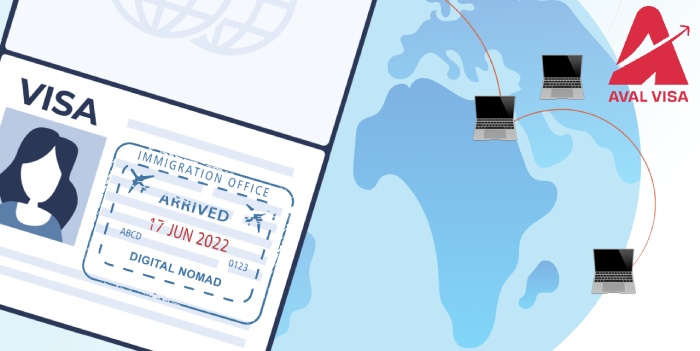
  • Valid passport
  • Recent biometric photo
  • Professional CV or a link to your work profile, such as LinkedIn or Upwork
  • Proof of monthly income or a tax return
  • Employment or freelance contract
  • Valid international health insurance
  • Completed visa application form
  • Police clearance certificate, required in some countries
  • Proof of accommodation, such as a rental agreement or hotel booking
Consulates are alert to an unclear source of income or figures that do not match across documents, and they refuse where there is doubt. Accurate documents, honest information and attention to detail make a real difference to how an application is assessed.
Digital nomad

Digital nomad visa costs

Fees depend entirely on the country. Recent government charges look like this:

  • Estonia: the short-stay and long-stay versions of the digital nomad visa carry different fees, so check the current amounts before you apply
  • Portugal: EUR 75 to EUR 90 at the consulate, with the residence permit charged separately after arrival
  • Barbados: USD 2,000 for an individual and USD 3,000 for a family
  • Dubai: around USD 600
  • Croatia: around EUR 100, plus the cost of the temporary stay permit
  • Thailand: the long-stay routes carry their own government fees, set in baht and revised from time to time, so check the current amount on the Thai e-visa site before you budget
Government fees are only part of it. Budget as well for certified translations, international insurance and your first weeks of accommodation.

Digital nomad life: the upside and the friction

Working from anywhere brings real advantages: freedom of location, exposure to different cultures and flexibility over how you structure your day. It also brings friction, from tax residence and healthcare to isolation and the paperwork of renewals. The table below sets both sides out.

BenefitsChallenges
Geographic freedom, work from anywhereNo settled place to live
Exposure to new cultures and new peopleLoneliness or distance from family
Lower cost of living in some countriesLimited access to healthcare or banking services
Flexible working hours and locationTime-zone gap with employer or clients
Room to grow personally and gain fresh experience Heavy time-management demands
Lower daily commuting and office costsInternet problems or no fixed workspace

Apply for a digital nomad visa with Aval Visa

Working online lets you combine a professional career with the freedom to choose where you live. With skills that transfer online, a stable income and the right documents, a digital nomad visa turns that into legal residence.
This guide has covered the requirements, the documents, the steps and the costs. If you still have questions about the conditions, the process or which country fits your profile, leave them in the comments or complete the free assessment form and our team will get back to you.

Free assessment
Hadi Imani — Regulated Canadian Immigration Consultant — RCIC #R522575  ·  Verify this licence on the CICC Public Register ↗
Weekly immigration newsletter
One email a week. Unsubscribe anytime.