
An LMIA in Canada, short for Labour Market Impact Assessment, is a document a Canadian employer obtains from the federal government before hiring a foreign worker. It is issued to the employer, not to the worker. A positive LMIA records that Employment and Social Development Canada is satisfied the hire will not harm the Canadian labour market. In practice the employer has to show it made real efforts to recruit Canadians and permanent residents for the position and still could not fill it.
The assessment looks closely at the effect of the hire on local wages and working conditions, and it is used most often for occupations where employers cannot find workers locally. Below is what the LMIA involves, who needs one, what it costs and how the process runs, as part of immigration to Canada.
What an LMIA in Canada actually is
The Labour Market Impact Assessment is the document a Canadian employer must hold before hiring a foreign worker under the Temporary Foreign Worker Program. It is how the government checks that the hire will not displace Canadian workers or push down local wages. The employer has to demonstrate that no Canadian citizen or permanent resident was available to do the job. The process is run by Employment and Social Development Canada (ESDC). Requirements differ across the streams: high-wage, low-wage, agriculture and the Global Talent Stream each have their own rules.
The Temporary Foreign Worker Program’s wage thresholds, permit durations and regional refusal-to-process rules are revised frequently by ESDC. Check the current programme requirements before you plan a hire.
LMIA streams for a Canadian work permit
Under the program, employers have to prove they made a genuine effort to hire locally. The application route depends on the wage level and the type of work, as set out below.
| LMIA Type | Applicable Occupations | Key Features |
|---|---|---|
| High-wage LMIA | Jobs paying above the regional median wage | Employer must show that hiring a foreign worker will not negatively affect the labour market |
| Low-wage LMIA | Jobs paying below the regional median wage | Employer must show its efforts to recruit local workers |
| LMIA under the Global Talent Stream | High-demand technology occupations | Designed for faster hiring of foreign workers in tech occupations |
| LMIA for agricultural workers | Seasonal and year-round agricultural workers | Employer must show it was unable to fill the position with local workers |
| LMIA for home caregivers | Hiring home caregivers or home support workers | Employer must show a need to hire a foreign worker due to a shortage of local workers |
LMIA requirements for employers
The LMIA is how the government limits the effect of foreign hiring on the domestic labour market. To obtain one, an employer has to:
- Show it tried to fill the role with a Canadian citizen or a permanent resident.
- Show a genuine need for a foreign worker in the position.
- Offer wages and working conditions that match the prevailing standard for that occupation and region, so local wages and conditions are not undercut.
- Provide evidence such as job postings on recognised job boards, including the national Job Bank, and the results of its recruitment.
- Meet the stricter recruitment requirements that apply to low-wage positions, showing that despite those efforts no Canadian worker was found.
How to get an LMIA in Canada, step by step
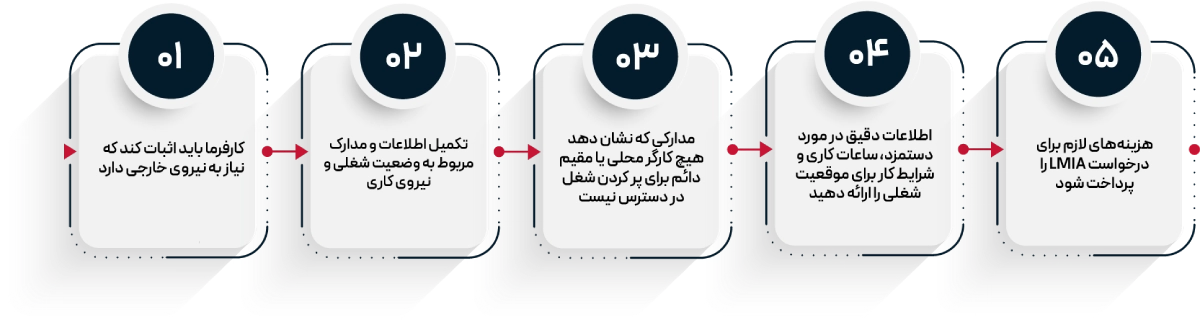
The application runs like this:
- The employer establishes that it needs a foreign worker and can document that need.
- The employer advertises the position on recognised Canadian job boards, normally for at least four weeks and through more than one recruitment method, to confirm no local worker is available.
- The employer assembles supporting material: the job description, proof of advertising and the reasons a foreign worker is needed.
- The employer files the application with Employment and Social Development Canada (ESDC) with the supporting documents.
- The employer pays the processing fee, which depends on the stream.
- ESDC reviews the file and decides whether to issue a positive assessment.
If the assessment is positive, the employer receives it and the worker can then apply to IRCC for a work permit, attaching the LMIA and the job offer. Not every work permit needs an LMIA: many are issued under exemptions, and the LMIA route is only one of them. The work permit is a separate application with its own requirements, and IRCC decides it independently of the LMIA.
Documents needed for an LMIA application
An LMIA application generally includes:
- Evidence that the employer tried to fill the position locally.
- Details of the business and of the position being filled.
- Evidence that no Canadian citizen or permanent resident was available for the role.
- Full details of the wage, hours and working conditions attached to the position.
- An explanation of why the position cannot be filled from the domestic labour force.
- Payment of the processing fee.
LMIA cost in Canada
The cost depends on the stream and the circumstances. The figures below are current at the time of writing and are reviewed by the government, so confirm them before you file:
- The LMIA processing fee is CAD 1,000 per position requested, for both high-wage and low-wage streams. It is paid by the employer and is not refundable if the application is refused. Low-wage applications can carry additional compliance costs, including transport and housing obligations.
- The worker’s work permit application is charged separately: CAD 155 for the permit, plus CAD 100 for the open work permit holder fee where it applies, plus CAD 85 for biometrics.
- Employers may also face further costs, such as credential assessments or legal and recruitment expenses.
The LMIA fee is part of the lawful process for hiring a foreign worker. What it comes to overall depends on the stream, on labour market conditions and on any additional documents required. Paying the fee buys the assessment; it does not buy an approval, and ESDC can and does issue negative assessments.
Read more: A guide to a Canadian work permit without a language test
Why the LMIA matters
An LMIA gives structure to foreign hiring and makes the recruitment record auditable. Employers can bring in specific skills that are not available locally, and workers who hold a job offer backed by a positive LMIA can apply for a work permit and work in Canada lawfully. For employers in sectors with genuine shortages, it is the route to filling roles without exposure to the penalties that follow from employing someone without authorisation.
Some streams move faster than others: the Global Talent Stream has a published service standard of ten business days for the LMIA, which suits technology employers hiring specialised staff. Note what an LMIA does not do. A job offer supported by an LMIA is a temporary work authorisation, not permanent residence. Some provincial nominee streams give weight to an employer-supported job offer, but selection for permanent residence rests with IRCC and the provinces. Anyone comparing routes should read the current rules for a Canadian work permit before making plans.

LMIA-exempt work permits
Not every work permit needs an LMIA. The following categories are commonly exempt under the International Mobility Program:
- Intra-company transferees moved to a Canadian branch, subsidiary or affiliate of the same employer.
- Researchers and university faculty coming for academic and research work, in the categories set out in the regulations.
- Professionals and traders admitted under a free trade agreement, such as CUSMA, which replaced NAFTA in 2020, or CETA.
- Spouses of certain work permit and study permit holders, who may qualify for an open work permit under the current rules.
- International graduates applying for a Post-Graduation Work Permit after finishing an eligible program at a designated learning institution.
- Refugee claimants and protected persons, who can be issued a work permit without an LMIA.
- Family members of accredited diplomats and foreign representatives posted to Canada.
Caregivers are a common misunderstanding: most caregiver hiring still requires an LMIA, and the dedicated home care worker pathways are routes to permanent residence rather than LMIA exemptions. Technology roles are another: the Global Talent Stream is not an exemption, it is an expedited LMIA stream. Exemption codes change, so confirm the category before relying on it.
Getting professional advice on Canadian immigration
The Labour Market Impact Assessment is a formal process an employer completes before hiring a foreign worker. A positive LMIA records that no domestic worker was available for the role and that the hire will not harm the local labour market. It is an employer application first, and a worker’s work permit application second. If you want to understand which route fits your situation, put your questions to the Regulated Canadian Immigration Consultants at Aval Visa. We will tell you what the rules require and what your realistic options are; no one can promise you a decision.
Read more: A complete guide to job interviews in Canada
Frequently asked questions
- Does every job in Canada need an LMIA? No. Many work permits are LMIA-exempt under the International Mobility Program, including intra-company transfers, free trade agreement categories such as CUSMA, post-graduation work permits and certain academic positions. The Global Talent Stream is not an exemption; it is a faster LMIA stream.
- How long does an LMIA take? It depends on the stream. The Global Talent Stream has a ten-business-day service standard. Other streams generally take longer, and the times ESDC publishes change month to month with volume and with the completeness of the application.
- How much does an LMIA cost? The processing fee is CAD 1,000 for each position requested. The employer pays it, and it is not refunded if the assessment is negative.
This article is general information, not legal advice, and it describes published official rules rather than any individual case.