
Studying in Canada gives international students a route into academic, personal and professional growth. One of the more useful features of the Canadian education system is co-operative education, usually shortened to co-op, which lets students build practical experience in their field alongside classroom study.
This guide walks through how a co-op work permit application works in Canada, the documents you need and the points worth checking before you apply. If you plan to combine study with paid work placements in Canada, start here.
What is a co-op program in Canada?
Co-operative education in Canada combines classroom teaching with paid work terms in a real workplace. In a true co-op program the work placement is a mandatory part of the curriculum: the student cannot graduate without completing it.
The point of co-op is to connect academic study with the labour market. Students apply what they have learned in real settings and enter the job market with experience already on their record.
Read more: the highest-paying jobs in Canada
How a co-op program in Canada is structured
Students on a Canadian co-op program usually alternate between academic terms and work terms. One term is spent in class, the next in a workplace. Learning is not confined to lectures and reading, and the student practises the skills the job actually calls for.
The work terms are tied to the field of study. If you are studying civil engineering, your work term will be with an engineering firm or on a construction project, not in an unrelated job.
Co-op work permit eligibility in Canada
If you are applying for a Canada study permit and want work experience in your field while you study, a co-op program is one of the better options. Many college and university programs in Canada build a work placement into the curriculum. Since 1 April 2026, however, eligible post-secondary international students no longer need a separate work permit for a work placement that is required by their programme: a valid study permit carrying work conditions is enough, provided the placement makes up 50% or less of the programme. Secondary-school students still need a co-op work permit, and existing co-op work permits stay valid for their full term.
You are eligible for this type of work permit if all of the following apply:
- You hold a valid study permit.
- The work placement is a required part of your program of study.
- You have a letter from your school confirming that all students in the program must complete the placement or internship.
- The placement makes up 50% or less of the total program of study.
Who cannot get a co-op work permit in Canada?
Some students are not eligible for this permit. For example:
- You are studying English or French as a second language (ESL or FSL)
- You are taking general interest or preparatory courses
- You are taking courses that prepare you for entry into another program
In those cases you cannot apply for a co-op work permit.
From Aval Visa: read about the best fields of study for immigration to Canada.
Types of co-operative in Canada and where students are placed
Two different things share the name “co-op” in Canada, and it is worth separating them. Co-operative education is the study model described above. A co-operative is a business structure owned and controlled by its members. Co-op students are placed with all kinds of employers, and co-operative enterprises are among them, so the main types are set out below.

1. Consumer co-operatives
The members are the people who buy the goods or services the organisation supplies. A student placed here works for an organisation that delivers directly to its own member-customers.
Typical sectors: retail supply, manufacturing, advanced industry, service companies and direct sales.
2. Producer co-operatives
Here independent producers pool resources to process, market or sell what they make. A placement suits students who want experience of supply chains and member-owned production.
Typical sectors: agriculture and food processing, consulting practices, freelancers and small businesses.
3. Worker co-operatives
The employees own the business and make the decisions. A placement gives a student a close view of team decision-making and shared responsibility.
Typical sectors: retail, forestry, tourism and recreation, local services.
4. Multi-stakeholder co-operatives
Membership mixes consumers, workers and sometimes producers, all working towards a shared purpose. Students see how competing interests are balanced inside one organisation.
Typical sectors: home care services, community development, social projects, tourism and recreation.
5. Worker-shareholder co-operatives
Employees hold shares in the operating company alongside other investors, so the workforce has an ownership stake as well as a job.
Typical sectors: wood and mineral processing, business services, emerging technologies.
6. New generation co-operatives
This model spreads the capital cost and the risk of value-added processing across members. Membership is usually capped and the shares are transferable.
Typical sectors: agriculture.
7. Social co-operatives
These focus on services to community members and on general welfare. They usually operate on a non-profit basis and may hold charitable status.
Typical sectors: health, social, educational and other community services.
Read more: the complete guide to the Canada work permit
Benefits of a Canada co-op work permit (Co-op)
A co-op program in Canada combines university teaching with real work experience. Students learn how a Canadian workplace operates and build the practical skills employers look for. For international students in particular, the advantages are substantial.
- Real work experience in your field
Co-op students work in settings connected to their program of study. That lets them apply theory in practice and form a clearer view of the profession they are entering. - Paid work terms
In most co-op programs the work terms are paid. Students gain experience and cover part of their living and study costs at the same time. - Exposure to the labour market and workplace culture
Working in Canada gives international students first-hand knowledge of Canadian workplace culture, which makes it easier to adapt to professional structures and expectations later on. - Stronger communication and professional skills
A professional environment builds skills such as clear communication, teamwork, time management, resume writing and interview preparation. These matter in future hiring decisions. - A clearer sense of career direction
A co-op placement lets a student sample different areas of work and judge which career path fits their interests and abilities. - Better prepared for work after graduation
Students who complete co-op terms tend to be readier for the job market when they graduate. Documented work history, practical skills and familiarity with professional settings all improve employment prospects.
Co-op in Canada is best understood as a chance to learn more deeply, sharpen skills and enter the labour market with something to show for it.
Read about in-demand occupations in Canada on the Aval Visa site.
How to apply for a co-op work permit in Canada
The steps below apply only where a co-op work permit is still required, for example for secondary-school students. Eligible post-secondary students no longer make this application, because their study permit already covers a placement required by the programme.
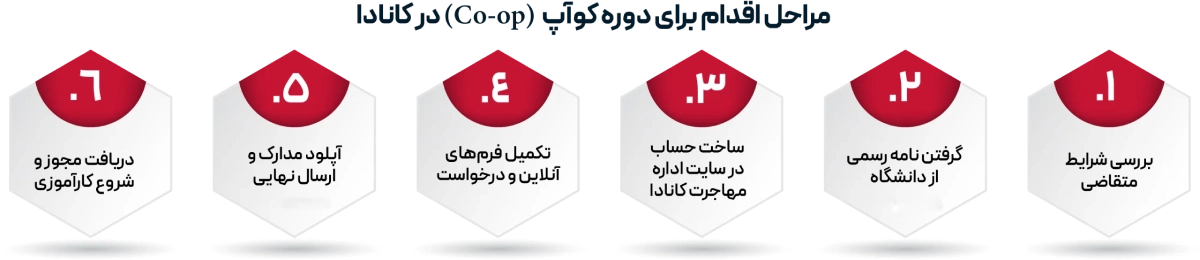
Step one: check that you qualify
Before applying for a co-op work permit, confirm that you meet these conditions:
- You hold a valid Canadian study permit and are enrolled at a designated learning institution (DLI).
- Your program requires the work placement as part of the curriculum, meaning you cannot graduate without completing it.
- The placement is 50% or less of the total length of the program.
Step two: get the letter from your school
Ask your university or college for a letter confirming that the placement or related employment is a mandatory part of your program. This letter is one of the core documents in a Canada co-op work permit application.
Step three: create an account with IRCC
To start, create an online account with Immigration, Refugees and Citizenship Canada, using either GCKey or a Sign-In Partner. The account is where you submit documents, track the application and receive the decision.
Read more: a complete guide to job interviews in Canada
Step four: complete the online forms
Once signed in, select “Apply to Come to Canada”. Answer the questions about the purpose of your application and choose the co-op work permit option. Then complete the relevant form, normally IMM 5710, carefully and in full.
Step five: upload documents and submit
At this stage you upload documents such as your passport, a digital photo, the school letter, the completed form and, in some cases, an immigration medical examination (IME). For most post-secondary students there is now no application and no fee at all, because a separate co-op work permit is no longer required. Where a permit is still needed, for example for secondary-school students, check the current fee list on the IRCC website before you submit.
Final step: receive the permit and start the placement
If you applied from outside Canada, an approval produces a port of entry letter of introduction in your online account. You show that letter to the border services officer on arrival and the work permit is issued there. If you applied from inside Canada, the permit is mailed to you. Once you have it, apply for a Social Insurance Number (SIN) so that you can work legally during the placement.
Comparing Canadian co-operatives with other business structures
| Feature | Co-operative (Co-op) | Share Capital Corporation | Non-Profit Organization |
|---|---|---|---|
| Ownership | Members, by purchasing membership shares | Shareholders, by purchasing shares | Members are not owners |
| Voting rights | One vote per member | Votes based on the class and number of shares | Usually one vote per member |
| Directors | At least 3 directors, usually drawn from the members | 1 or more directors; public companies: at least 3 directors | At least 1 director; if soliciting: at least 3 directors |
| Proxy voting | Not permitted | Permitted | Permitted |
| Distribution of profit or surplus | Profit returned to members or placed in a statutory reserve | Profit distributed to shareholders (dividends) | Surplus cannot be distributed |
| On dissolution | Assets transferred to similar co-operatives | Assets divided among shareholders as required by law | Assets transferred to a similar organization |
What comes after a co-op placement in Canada?
Finishing a co-op work term is not the end of the process. The next step is to look closely at the universities and programs that interest you and at the specific conditions and prerequisites attached to their co-op streams. Many institutions, the University of Waterloo among them, publish detailed co-op guides that are worth reading.
If you are still unsure whether co-op suits you, talk to students who have been through it. Their accounts of how the work terms actually ran will tell you more than a brochure.
For more on co-op programs in Canada, you can call Aval Visa on 02159307 or visit the Co-operative Education and Work-Integrated Learning Canada website and read its education pages.
Frequently asked questions
1. What are the drawbacks of a co-op program in Canada?
Co-op programs can be highly competitive and hard to get into. Even students who are admitted may face a heavy workload and significant responsibility. Some students also struggle to secure a placement that gives them the experience they were hoping for.
2. How long is a co-op program in Canada?
A traditional co-op program usually includes 3 to 4 work terms. The student alternates between four-month academic terms and four-month full-time paid work terms. Once the coursework and three or four work terms are complete, the degree or diploma is awarded with the co-op designation.
3. How many hours can a co-op student in Canada work?
Hours worked on a co-op work permit are set by the placement and the program. Separately, an eligible study permit holder may work off campus up to 24 hours per week during academic terms, with no cap on on-campus work. During scheduled breaks between terms, an eligible student may work full time on or off campus. Off-campus work limits have changed more than once in recent years, so check the current rule on the IRCC website before you rely on it.
This article is general information, not legal advice, and it describes published official rules rather than any individual case.