
If you entered Canada as a visitor and want to move to a Canadian work permit or a study permit, this article sets out what is and is not possible. There is no mechanism that “converts” a visitor visa into another status. What exists is a set of rules on who may apply for a new permit from inside Canada and who must apply from outside. Changing status from inside Canada means meeting those rules, filing a fresh application and waiting for an IRCC decision. Here is how it actually works.
Where the rules stand now
From 2020 a temporary public policy let visitors already in Canada apply for an open or employer-specific work permit without leaving the country. It was introduced to help fill labour shortages and was extended several times.
The policy was reported ended on 28 August 2024, ahead of its scheduled February 2025 expiry. It has not been reinstated. A visitor in Canada today generally has to apply for a work permit from outside the country, unless they fall within one of the categories in the Immigration and Refugee Protection Regulations that allow an in-Canada application.
Documents you will need
Each route has its own document list. A study permit application, for example, cannot proceed without a letter of acceptance from a designated learning institution. When you start an application, IRCC generates a document checklist in your account based on your answers. The items below are common to most applications.
1. Identity documents:
- Your passport, original and copy
- Two recent photographs meeting the IRCC specification
- Civil identity documents such as a birth certificate and national identity card
2. Proof of funds to cover living costs and tuition or the period before you start work:
- Bank balances and statements
- Deposit certificates or equivalent financial instruments
- Documentation of shareholdings and investments
- Evidence of stable income, such as rental income from property
3. Family status documents:
- A marriage or divorce certificate, if applicable
- Birth certificates for any children
- Custody or guardianship documents, where relevant
4. Immigration history:
- Proof of your immigration status in any third country you have lived in
- Records of previous immigration applications to any country, whether approved or refused
The routes that are actually open
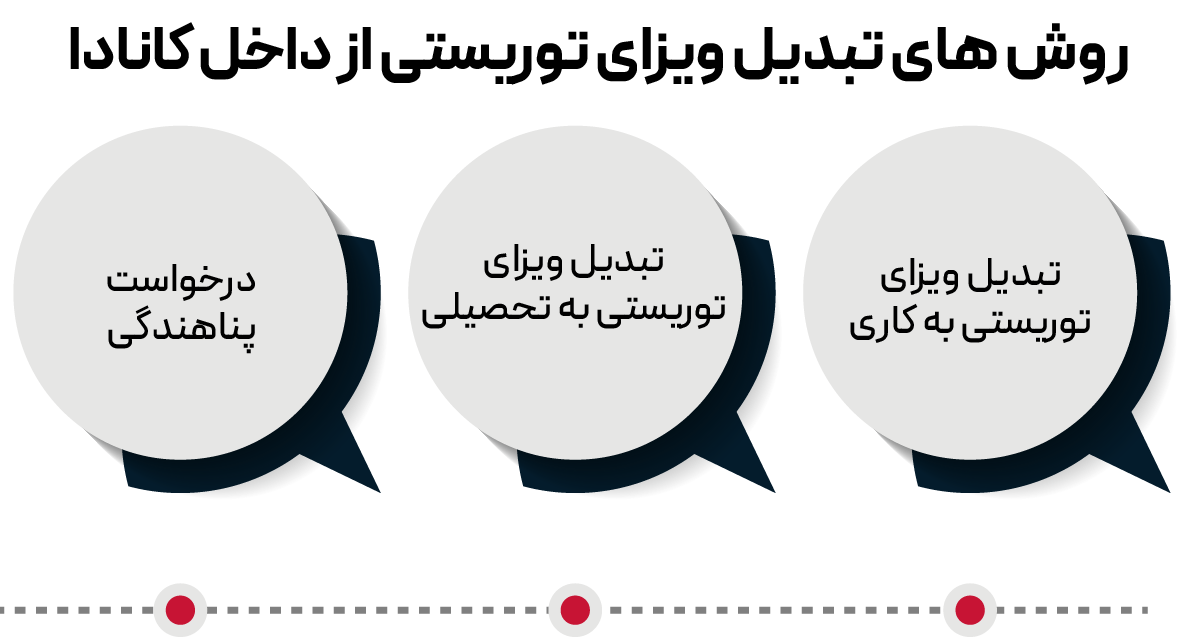
Three routes come up most often for someone already in Canada on a visitor visa: applying for a study permit, applying for a work permit, or making a refugee claim. Each has different eligibility rules, and none of them turns on simply being in the country.
Visitor visa to work permit in Canada
For roughly four years, visitors in Canada could apply for a work permit without leaving. That temporary policy answered a post-pandemic labour shortage, and it has now ended. The ordinary rules apply again.
Since August 2024, a visitor who wants to work in Canada normally needs a job offer from a Canadian employer and then applies for a work permit, in most cases from outside Canada. If you are applying on an employer-specific permit backed by a labour market impact assessment, the offer should set out:
- The job title
- The wage
- The hours of work
- The work location
- The duties
- The employer’s signature
- The positive LMIA, where one is required
Visitor visa to study permit in Canada
If you travelled to Canada as a visitor and secured admission to a designated learning institution (DLI), the next question is where you may apply for the study permit. This is where a lot of misinformation circulates. Most visitors cannot apply for a study permit from inside Canada. Section 215 of the Immigration and Refugee Protection Regulations limits in-Canada study permit applications to specific groups, including people who already hold a valid study or work permit, the spouse, partner or child of someone who does, minor children in primary or secondary school, exchange or visiting students, and people who have completed a course required for admission to their programme. The temporary policy that widened this for visitors has ended.
Where you are eligible, the study route has some advantages over other options:
- A clearer evidentiary basis than a speculative work permit application, since admission and funds are documented
- Access to post-graduation work permit eligibility for qualifying programmes
- The possibility of applying for a work permit after graduation, subject to eligibility at the time
None of that makes approval likely or certain. IRCC assesses each study permit application on its own merits, and refusals are common.
Read more: Study permit to work permit in Canada: the full guide
Making a refugee claim from inside Canada
A person who can show that returning to their own country would put them at real risk, for reasons such as political conditions, armed conflict, religious belief or a direct threat to their safety, may make a refugee claim in Canada. This is a legal process with a high evidentiary bar, not an alternative immigration route.
Protection in Canada is available to people who can demonstrate with evidence that returning home would expose them to persecution, a threat to life, torture or cruel and unusual treatment. The grounds include:
- Political opinion
- Religion
- Sexual orientation
- Membership of a particular social group
- Severe domestic violence
- Threats of death or torture from the state or from non-state actors
and comparable grounds.
A claim can be made in one of two ways: at a port of entry, to a Canada Border Services Agency (CBSA) officer, or from inside Canada through the IRCC online portal. Either way you must complete the Basis of Claim (BOC) form and attend an eligibility interview. Note that under the Safe Third Country Agreement, most claims made by people arriving from the United States are ineligible, subject to a limited set of exceptions.
If the claim is found eligible, it is referred to the Immigration and Refugee Board (IRB), which holds a hearing and issues a decision. Given what is at stake and how the hearing works, claimants should be represented by a lawyer or by a Regulated Canadian Immigration Consultant authorised to appear before the IRB. Proper legal representation matters more here than anywhere else in the system.
What refugee claimants should know
Canadian refugee law recognises persecution on political, religious, gender and social grounds, and claims are decided individually on the evidence presented.
| Advantages | Disadvantages |
|---|---|
| Possible permanent residence if the claim is accepted | Long and legally complex process |
| Access to health services during the process | The claim may be refused and a removal order issued |
| Work permit after a set period | Psychological strain from an uncertain, stressful process |
| Social and legal support in some provinces | Various documents needed to substantiate the claim |
Staying in Canada lawfully, with Aval Visa
Frequently asked questions
- Can I apply for a study permit while I am in Canada as a visitor? Usually not. In-Canada study permit applications are limited to defined categories, such as holders of a valid study or work permit and their family members, minor children in school, exchange students, and applicants who have completed a prerequisite course. If you do not fall into one of them, you apply from outside Canada after receiving your letter of acceptance.
- My visitor status is about to expire. Can I extend it? Yes. You apply through your IRCC account for a visitor record, which extends your stay; the visa in your passport is a travel document and is a separate thing. IRCC advises applying at least 30 days before your status expires. If you apply before it expires, you keep maintained status while a decision is pending.
- How long does a refugee claim take? It varies with the type of claim and the IRB’s caseload, and has run anywhere from several months to more than two years. No timeline can be promised.
-
What changed about applying for a work permit from inside Canada? The temporary public policy that let some visitors apply for a work permit from within Canada ended on 28 August 2024. Entering Canada as a visitor and finding a job no longer creates a route to a work permit from inside the country. An applicant has to qualify under one of the standard work permit categories and, in most cases, apply from outside Canada.
-
Can a visitor to Canada get a work permit? In some circumstances a person in Canada as a visitor may be eligible to apply for a work permit from inside Canada, for example as the spouse of a work or study permit holder. Holding a visitor visa does not create that right on its own, and the temporary policy that specifically allowed visitors to apply from within Canada ended on 28 August 2024.
This article is general information, not legal advice, and it describes published official rules rather than any individual case. Hadi Imani is a Regulated Canadian Immigration Consultant, licence R522575, practising in Toronto; that licence covers Canadian immigration only.