International students studying at a Canadian university, college or other institution on a Canadian study permit can look for work after they graduate and extend their stay in the country. To do that they need a work permit. This article is a complete guide to moving from a study permit to a work permit in Canada.
If you want to handle it yourself, follow the sequence set out below. If you would rather have it handled, Aval Visa can prepare the application so that you can file the moment your final results are confirmed.
Why move from a study permit to a work permit in Canada
Start with the reason a graduate would want to stay and work. Beyond the fact that Canadian work experience can support a later application for Canadian permanent residence, the advantages of switching from a study permit to a work permit include:
- Starting a professional career at Canadian salary levels
- Working legally, with the labour rights and workplace protections that apply to every worker in Canada
- Access to jobs at large Canadian and international employers
- Freedom to compete in the open labour market rather than for one specific role
- The ability to apply for Canadian permanent residence once you meet a program’s requirements
- A later route to citizenship, which requires permanent residence first and then 1,095 days of physical presence in Canada within the previous five years
- An open work permit through the PGWP, with no employer sponsorship needed
- The possibility of bringing family: your spouse or partner may qualify for an open work permit under the current, narrower rules, and dependent children can study. Sponsoring parents or grandparents is a separate matter and is only open to Canadian citizens and permanent residents who meet an income test
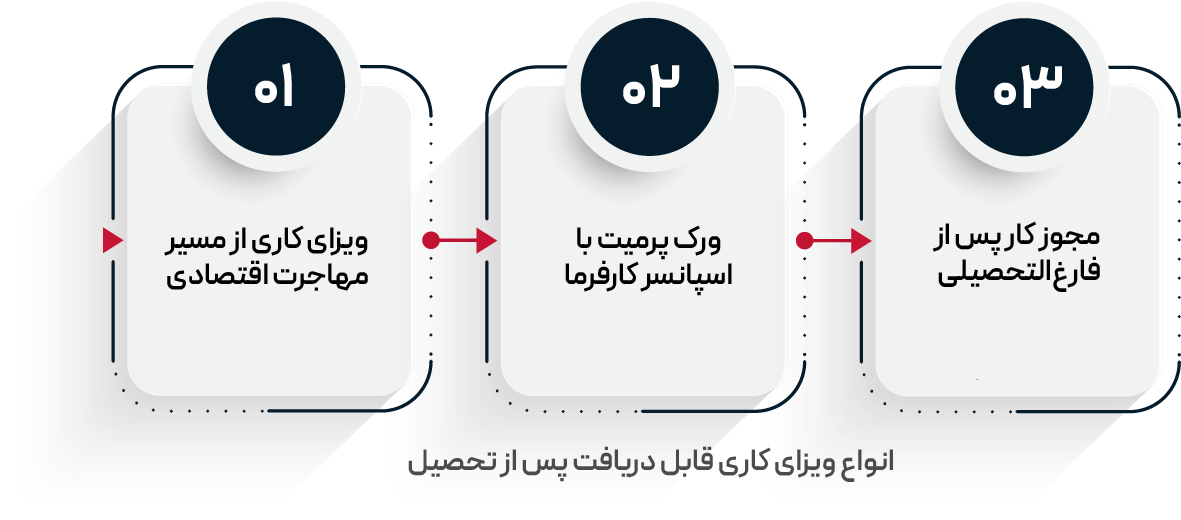
Work permits available after graduation
Graduates of recognised institutions holding a DLI number, that is a designated learning institution, can apply for a Canadian work permit through several lawful routes. Those routes are explained below.
Post-Graduation Work Permit (PGWP)
The most common route from a study permit to a work permit in Canada is the Post-Graduation Work Permit (PGWP). It allows a graduate to work legally in Canada once the program is finished.
The permit is issued for a period based on the length of your program, up to a maximum of three years. Programs shorter than two years generally get a permit matching the program length. The PGWP can normally be held only once in a lifetime, so timing matters.
Eligibility has been tightened. Depending on the type of credential, applicants must meet a language requirement, currently CLB 7 for university graduates and CLB 5 for college graduates, and graduates of many non-degree college programs must have studied in an eligible field. Confirm the current field-of-study list before you enrol, not after.
The advantages of this route:
- No job offer is required
- You can work in any occupation or sector
- The permit length follows your program length, to a maximum of three years
- It is an open permit: full-time work, with no restriction on the employer
From a study permit to a work permit in Canada without a job offer
One of the main advantages of the PGWP is that, unlike most other work permits, it does not depend on a job offer from a Canadian employer. An eligible graduate can enter the labour market with the permit already in hand and look for the right role. That flexibility lets you target positions that match your field, your skills and where you want your career to go.
So if your aim in moving from a study permit to a work permit in Canada is not just a short extension of your stay, but a later permanent residence application, relevant Canadian work experience becomes a central part of the plan. For most graduates the PGWP is the link between studying, entering the labour market and whatever immigration route comes next.
Employer-specific work permits
Some graduates hold a valid job offer from a Canadian employer and can apply for an employer-specific work permit supported by an LMIA. If you can put a strong profile in front of employers, on LinkedIn for example, interview well and receive a formal written offer, the employer can apply for a Labour Market Impact Assessment (LMIA), and you then apply for the permit.
An employer-specific permit names the employer, the job and often the location. You may work only under those conditions. To change employer or role you need a new work permit before you start; working outside the conditions on your permit puts your status and any future application at risk.
Economic immigration routes: CEC and PNP
Once you are working on a PGWP and have built up enough experience, you can look at one of two routes and then apply for permanent residence:
- The Canadian Experience Class (CEC)
- Provincial Nominee Programs (PNP)
The main CEC requirements
The Canadian Experience Class is one of the programs managed through Express Entry, and it is built for people who have gained Canadian work experience, typically on a PGWP. If you have at least 12 months of full-time work, or the part-time equivalent, in TEER 0, 1, 2 or 3 occupations within the past three years, you can be eligible to apply. CEC is a permanent residence program in its own right, so a successful application leads directly to permanent residence rather than to another temporary status. The main requirements:
-
- Valid work authorisation for the experience you are claiming
- Paid, lawful work experience; unpaid work and self-employment do not count
- CLB 7 language ability for TEER 0 and 1 occupations
- CLB 5 language ability for TEER 2 and 3 occupations
- Canadian study, which adds CRS points
- An Express Entry profile, followed by a CEC application after an invitation
Provincial Nominee Programs (PNP)
Graduates who have worked for a few years and want to settle in a specific province, as well as move from a study permit to a work permit in Canada, should look at that province’s nominee program. These programs score candidates on their own criteria, and Canadian work and study experience usually scores well, although a nomination is never guaranteed.
Applying for permanent residence does not by itself authorise you to keep working. To keep working while your application is processed you need a valid work permit, or a bridging open work permit if you qualify for one. Permanent residents and work permit holders are not Canadian citizens, and only citizens can vote or hold a Canadian passport. A child born on Canadian soil is a Canadian citizen by birth, but that does not give the parents any immigration status.
The Provincial Nominee Program (PNP) is designed for people who intend to live and work in one specific province or territory and apply for permanent residence from there.
PGWP versus an employer-specific work permit
When you look at the current rules on changing status in Canada, the distinction between the PGWP and an employer-specific work permit matters. The PGWP is an open permit: an eligible graduate is not tied to one job or one employer. An employer-specific permit, built on a job offer and usually an LMIA, is tied to the employer, the occupation and often the work location named on it.
That is why anyone planning to move from a study permit to a work permit in Canada should compare the two routes before filing. The right choice affects how quickly you can start work, and it also shapes your options for permanent residence later.
Steps to change from a study permit to a work permit in Canada
With the routes covered, here is the sequence to follow.
The first step is graduating from a designated learning institution with a DLI number. Once you have written confirmation that you completed your program, you can apply for a work permit. Have these documents ready when you file:

Applications are filed online through your IRCC account. Once the application is submitted through the official IRCC portal and the fee is paid, the file goes into processing. If it is approved, the work permit is issued and you can work full time. The decision is IRCC’s alone.
Cost of changing from a study permit to a work permit in Canada
Government fees are reviewed periodically, so confirm the current amounts on the IRCC website before you pay. All figures are in Canadian dollars.
| Cost type | Amount in CAD |
|---|---|
| PGWP application fee (a separate application, not a conversion of the study permit) | CAD 255 |
| Biometrics fee (if required) | CAD 85 |
| Legal or consultant fee (optional) | Varies |
| Passport renewal (if expired) | Varies |
Study permit to work permit in Canada with Aval Visa
Moving from a study permit to a work permit is one of the more consequential decisions a graduate makes about staying in Canada and holding lawful status. It opens the Canadian labour market to you, and it builds the work history that later permanent residence applications are assessed on.
Through the Post-Graduation Work Permit, the Canadian Experience Class or a Provincial Nominee Program, a graduate can use a Canadian credential to find work and start a career here on a solid legal footing.
If you are close to graduating and want the work permit application ready to go, the Aval Visa team can take the paperwork off your hands so you can focus on your exams. Aval Visa is led by Hadi Imani, a Regulated Canadian Immigration Consultant (RCIC #R522575) regulated by the College of Immigration and Citizenship Consultants; we advise on Canadian immigration only, and no consultant can promise a result. To begin, fill in the consultation form and we will come back to you.
Frequently asked questions
- Can I apply for permanent residence while holding a PGWP? You can become eligible to apply. One year of full-time Canadian work experience in a TEER 0, 1, 2 or 3 occupation meets the CEC work requirement; you still have to meet the language and other criteria and receive an invitation, and IRCC decides the application.
- Does work I did while studying count? No. Work experience gained while you were a full-time student, including co-op and internship terms, does not count toward the Canadian Experience Class. Experience gained after you graduate, on a valid work permit such as a PGWP, does count.
- What happens if I apply more than 180 days after graduating? After 180 days you are no longer eligible for a PGWP, and the permit cannot be issued twice, so you would need to look at other options such as an employer-specific permit supported by an LMIA, or an application from outside Canada.
This article is general information, not legal advice, and it describes published official rules rather than any individual case. Hadi Imani is a Regulated Canadian Immigration Consultant, licence R522575, practising in Toronto; that licence covers Canadian immigration only.