
Unlike the United States or Canada, which recognise birthright citizenship (jus soli), a birth in Austria does not by itself lead to residence or citizenship. Austrian nationality law is based on descent (jus sanguinis): a child acquires Austrian citizenship only if one parent is an Austrian national at the time of the birth.
So Austrian residence through the birth of a child is not a route in itself, although family residence is possible in some situations. This article looks at exactly those situations, along with the requirements, the costs and the law on having a baby in Austria. If you are thinking about moving to Austria and giving birth there, it is worth reading in full.
When a birth in Austria can lead to status
Austrian residence cannot be obtained through the birth of a child. Austria grants citizenship to children born on its territory only in the narrow cases below:
- If a child is born in Austria to stateless parents, or to parents whose nationality cannot be established, the child receives Austrian citizenship.
- If a child is born in Austria and the identity of the parents is unknown, Austrian citizenship is granted to prevent statelessness.
- If the parents are not married and the father is an Austrian citizen, the child acquires Austrian citizenship where paternity is established within 8 weeks of the birth.
Given these rules, treat residence in Austria linked to the birth of a child as something that applies mainly to families already living in Austria lawfully, who are consolidating or extending their status through family provisions.
Any couple lawfully resident in Austria, whether on an Austrian student visa, an Austrian job seeker visa, a work permit or another route, can apply for a residence permit for their newborn.
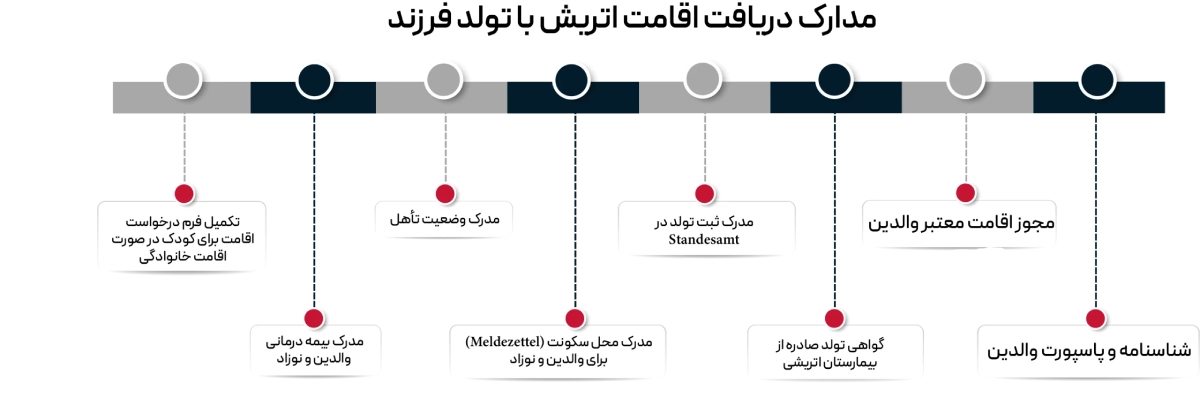
Documents needed for a child’s residence permit in Austria
The documents required for an Austrian residence permit following a birth are:
- The parents’ birth certificates and passports (translated and certified)
- The parents’ valid residence documents (a residence card or a lawful visa)
- The birth certificate issued by the Austrian hospital
- Proof of registration of the birth with the Standesamt (the Austrian civil registry office)
- Proof of address (Meldezettel) for the parents and the child
- Proof of marital status (marriage or divorce papers, or a custody order)
- Proof of health insurance for the parents and the child
- A completed residence application form for the child, where family residence applies
In some cases the authorities ask for additional documents, such as a police certificate or evidence of funds. Supplying everything on the consular checklist makes both the child’s application and the parents’ extension considerably easier.
Maternity and hospital costs for a birth in Austria
The table below sets out the costs associated with a birth in Austria, covering the delivery, medical services, health insurance and the administrative fees connected to residence. Actual costs run higher or lower depending on the hospital, whether you use a midwife, your health insurance cover and similar factors.
| Category | Cost item | Cost (EUR) | Notes |
|---|---|---|---|
| Childbirth costs | Natural birth in a private hospital | EUR 8,127 | Booking and stay in a twin room; costs may vary by type of birth and additional services |
| Birth with a private midwife | EUR 1,700 | Pre- and post-natal care, not reimbursed by insurance | |
| Home birth with a private midwife | EUR 1,900 to 3,100 | Pre- and post-natal visits; up to EUR 1,500 reimbursed by insurance. | |
| Private health insurance | Cover for the mother | EUR 45 to 100 per month | Varies with age; recommended for access to private and more comfortable services |
| Cover for the newborn | EUR 30 per month | Medical cover for the newborn; cost varies by insurer and chosen level of cover | |
| Residence costs | Residence card fee for parents | EUR 137 | Per person |
| Residence card fee for a child (0-6 years) | EUR 86 | Per child | |
| Biometrics fee for residence | EUR 23 | Biometric services and file handling | |
| Living costs | Minimum income required for parents (couple) | Up to EUR 2,000 per month | To prove financial means for residence; must remain available after fixed costs such as rent |
The law on permanent residence in Austria after a birth
The following are the key legal points on having a child in Austria, so that anyone already living there lawfully can extend their own status on time and obtain status for their child. All of it follows the published rules of the Austrian Federal Office for Immigration and Asylum.
- A birth in Austria to non-Austrian parents does not create automatic citizenship or residence. You cannot travel on an Austrian tourist visa, give birth in the country and apply for residence on that basis.
- Every birth has to be registered with the local civil registry office (Standesamt), whatever the parents’ nationality, and only parents who themselves hold lawful status (work, study or asylum) can apply for residence for the child. Where the parents are lawfully resident, the child can be granted a family residence permit (Familiennachzug).
- A child can apply for Austrian citizenship after 6 years of continuous residence in defined circumstances, and after 10 years under the general rule.
- If a child is born in Austria and no country recognises it as a national, the Austrian state may grant citizenship on exceptional grounds (Staatsbürgerschaft aus besonderem Grund).
- Where at least one parent is an Austrian citizen at the time of birth, the child acquires Austrian citizenship automatically and an Austrian passport can be issued.
- Where both parents of a child born in Austria are foreign nationals, the birth does not lead to residence, and the parents have to approach their own country’s embassy to obtain a passport for the newborn.
For the practical immigration steps you will be dealing with the Austrian embassy or consulate responsible for your country of residence, so check its address, opening hours and closing days before you plan anything around an appointment.
Moving to Austria with Aval Visa
Austrian citizenship and residence law is written so that the birth of a child on Austrian soil does not on its own produce residence for the child or the parents. Parents hoping for Austrian residence through a birth need to establish lawful residence by another route first.
If your situation resembles any of the cases above, or you want to look at moving to Austria more generally, the advisers at Aval Visa handle the full file, the legal advice, the embassy appointment and the administrative work. Contact us for more detail, or fill in the free assessment form and we will set out the Austrian route that best fits your current circumstances.
Frequently asked questions
- If my child is born in Austria, do I get residence? No. The birth of a child in Austria creates no residence right for the parents. Parents have to apply through a route such as a work visa, a study visa or an investment route.
- Does my child get Austrian citizenship by being born there? No. Austrian citizenship follows descent, and a newborn acquires Austrian citizenship and an Austrian passport at birth only if a parent is Austrian.
- Which European countries grant citizenship for a birth on their territory? Only a few, and always with conditions attached. Ireland and Portugal grant citizenship on the basis of birth in the territory (jus soli) where the parents meet residence requirements, and Germany and France grant it to children born there when their parents’ residence conditions are met. Most EU states, including Austria, Italy and Spain, apply jus sanguinis and do not grant citizenship simply because a child was born on their soil.
This article is general information, not legal advice, and it describes published official rules rather than any individual case.