Italy has long been on the shortlist for students worldwide, thanks to well-regarded universities and a strong academic tradition. Within that, artificial intelligence in Italy has become one of the most sought-after and forward-looking subjects, drawing large numbers of international students in recent years.
Artificial intelligence is offered on a wide range of terms, including attractive scholarships that cut the cost of a degree and make student life considerably easier.
If you are working towards an Italian student visa and want to know more about studying artificial intelligence there, which universities lead the field and what funding exists, this article covers it.
Why Italy is a strong choice for studying artificial intelligence
Italian universities are among the better destinations for an artificial intelligence degree. Here is why.
1. Sustained public investment in AI
Italy invests actively in artificial intelligence and runs national programmes to develop the field. Bodies such as CNR and IIT are recognised research centres in this area.
2. Strong research infrastructure
Institutions such as IIT and AI4I, together with the Leonardo supercomputer, give researchers the computing power and facilities to work at the front of the field.
3. Well-regarded universities
Politecnico di Milano and Sapienza University of Rome run substantial programmes in this area, and many of them are taught in English.
4. Good employment prospects
As artificial intelligence grows, so does hiring in the sector, and Italian universities maintain close ties with industry.
5. Reasonable cost of study and living
Tuition at Italian public universities is lower than in most of Western Europe, and living costs are below those of comparable developed countries.
6. A rewarding place to be a student
Italy’s culture, its cities and its cost of living combine into a good environment for study.
Taken together, the quality of the teaching, the job market and the cost make Italy a strong destination for an artificial intelligence degree.
Read more: Regional scholarships in Italy: what they really cover
The best universities in Italy for artificial intelligence
If Italy is your destination, the universities below are worth putting at the top of your list, alongside the engineering universities in Italy:
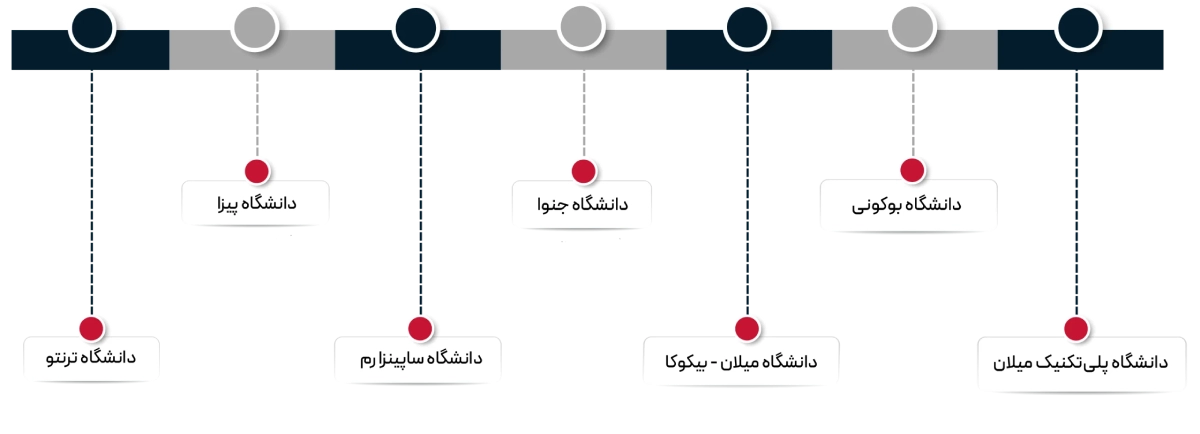
1. Politecnico di Milano
Politecnico di Milano is one of the leading technical universities in Italy and internationally. It runs master’s programmes in computer science and engineering and in data science with an artificial intelligence focus. It is known for the standard of its teaching, the breadth of its research and its close links with industry.
2. Bocconi University
Bocconi in Milan runs a two-year master’s degree in artificial intelligence with a particular emphasis on machine learning, natural language processing and computer vision. The programme is applied and international in outlook, and it prepares students directly for the labour market.
3. University of Milano-Bicocca
Milano-Bicocca, together with the University of Pavia, runs a specialised English-taught programme on artificial intelligence applications in science and technology. It suits students who want depth in scientific and technical domains.
4. University of Genoa
The University of Genoa offers a master’s in computer science with an artificial intelligence track, focused on machine learning, data mining and collaboration with industry. It provides a wide range of research opportunities.
5. Sapienza University of Rome
Sapienza is one of the largest universities in Italy and runs a master’s in computer engineering with an artificial intelligence specialisation. The programme covers current AI techniques and methods and their wider applications.
6. University of Pisa
The University of Pisa runs a master’s in artificial intelligence and data engineering, focused on advanced AI algorithms, machine learning and big data technologies. It prepares students for research and for industry.
7. University of Trento
Trento offers an interdisciplinary programme in cognitive science with artificial intelligence and data mining components. It gives students a fresh perspective on how AI is applied across different fields.
Read more: The University of Verona
Admission requirements for artificial intelligence in Italy
Admission to Italy’s leading universities depends on meeting the requirements below:
| Level | University | Prerequisites |
|---|---|---|
| Bachelor's | Pavia / Milano-Bicocca | 12-year school diploma, TOLC-I or SAT, English B2, mathematics |
| Sapienza | As above, with a good entrance-test score | |
| H-FARM | Diploma, language, mathematics fundamentals, practical focus | |
| Master's | University of Milan (H-CAI) | Related bachelor's degree, 30 relevant credits, language B2, interview |
| Siena | Engineering bachelor's degree, technical ability and language | |
| Pisa | Bachelor's in CS/Engineering, language and mathematics knowledge | |
| Bologna | Related bachelor's degree, language, test + interview, higher tuition |
Documents needed to apply for AI programmes in Italy
Before you begin, gather the documents required to apply for an artificial intelligence programme in Italy.
University application documents
To apply for an artificial intelligence programme in Italy, you need your academic records, including your bachelor’s degree and transcripts. In addition, the following are required:
- A CV
- A motivation letter
- A recognised language certificate such as IELTS or TOEFL
- Reference letters from academic staff
Some programmes also ask for a portfolio. A number of universities require a Statement of Comparability so that your qualifications can be assessed against the Italian system.
Visa documents (for non-EU students)
Students from outside the European Union applying for an Italian student visa need a valid passport, the visa application form, the university’s letter of admission, proof of financial means, health insurance, proof of accommodation, passport photographs and the visa fee receipt. These go to the Italian embassy or consulate handling your application.
Residence permit documents (after arrival in Italy)
Once in Italy, students must apply for a residence permit (Permesso di Soggiorno). This requires the application form, your passport and a copy of it, a valid student visa, health insurance, proof of accommodation, passport photographs and the fee receipt. The application has to be lodged within eight working days of arrival in Italy.
Proof of financial means
Proof of financial means is one of the key requirements for both the visa and the residence permit. You must show you can cover your living costs in Italy, normally through bank statements, scholarship documents or a sponsor’s letter of support. The minimum is fixed each year by the Italian authorities and published by the consulate handling your application, so confirm the figure that applies to your intake.
Health insurance
Valid health insurance covering medical costs is compulsory for the whole of your stay. The policy must provide at least EUR 30,000 of cover and include medical treatment, hospital admission and accidents. It can be an international policy or one from a recognised Italian insurer.
How much does an artificial intelligence degree in Italy cost?
Costs move from year to year, but the most recent figures are as follows:
| University | Programme | Duration | Tuition | Additional costs |
|---|---|---|---|---|
| University of Bologna | Professional Master in Artificial Intelligence and Innovation Management | 1 year | EUR 14,800 (in 3 instalments) | Scholarships cover learning resources and access to university facilities |
| Bocconi University | MSc in Artificial Intelligence | 2 years | EUR 18,000 per year | Scholarships available; living costs counted separately |
| Universita Cattolica del Sacro Cuore | Data Analytics for Management | 1 year | EUR 9,000 | Scholarships available, covering learning resources and access to university facilities |
| University of Pisa | MSc in Artificial Intelligence and Data Engineering | 2 years | EUR 2,400 per year (for EU students) and EUR 2,530 (non-EU) | Annual registration fee EUR 356; living costs separate |
| Sapienza University of Rome | MSc in Artificial Intelligence and Robotics | 2 years | EUR 2,924 per year | Living costs separate |
| University of Calabria | MSc in Artificial Intelligence and Computer Science | 2 years | EUR 1,000 to 1,500 for the whole programme | Living costs separate |
| University of Verona | MSc in Artificial Intelligence | 2 years | Annual fee, banded by ISEE; see the university fee regulation | Living costs separate |
| University of Trieste | MSc in Data Science and Artificial Intelligence | 2 years | Annual fee, banded by ISEE; see the university fee regulation | Living costs separate |
Scholarships for artificial intelligence in Italy
Many established Italian universities offer scholarships to international students. The main options are set out below:
| University / institution | Scholarship | Coverage | Fields |
|---|---|---|---|
| University of Padua | International Excellence | Full tuition waiver + EUR 8,000 annual grant | Computer science, cybersecurity, data mining, artificial intelligence |
| University of Milan | Excellence Scholarship | Full tuition waiver + EUR 8,000 grant + housing + meal card | Artificial intelligence, data science, data-driven economics |
| Politecnico di Milano | Merit-Based Scholarship | Tuition waiver + grant up to EUR 10,000 per year | Computer engineering, cybersecurity, data mining |
| University of Milan | UNICORE 6.0 | EUR 6,000 grant + housing + meal card | All English-taught master's programmes |
| ISI Foundation | Research Scholarship | Research grant of EUR 2,800 per year | Data mining, digital epidemiology, complex systems |
| University of Naples Federico II | PhD in Explainable AI | Monthly stipend set by the programme call (bando), research-based | Federated learning, graph neural networks, AI ethics |
What the job market looks like after graduation
Demand for artificial intelligence graduates in Italy is concentrated in the northern cities, with Milan the largest market; no reliable public breakdown of vacancy numbers is available.
Many of these roles are open to recent graduates. The titles most in demand include:
- AI and machine learning engineer
- AI architect
- Data analyst and NLP specialist
- IT project manager
- Designer of intelligent systems and devices
With this range of practical openings, students have good reason to consider an artificial intelligence degree in Italy.
Frequently asked questions
- Are there artificial intelligence programmes taught in English in Italy?
Yes. Many Italian universities teach artificial intelligence programmes in English. - Do I need Italian for an artificial intelligence programme?
Not for English-taught programmes. Learning Italian is still worthwhile for daily life and for internships. - Can international students work while studying in Italy?
Yes. Non-EU students holding a valid student residence permit may work part-time alongside their studies, within an annual hours cap set by law. Check the current limit on your residence permit conditions before you take a job.
This article is general information, not legal advice, and it describes published official rules rather than any individual case.