
If you are married to someone who lives in Austria and you want to build a life together there, family reunification is the route that applies. It is usually called the Austria marriage visa or spouse visa, and it is one of the more common ways of moving to the country.
This route is a long-standing part of immigration to Austria and can be the start of a new life in central Europe. Marriage on its own is not enough, though. Austria sets conditions on age, income, housing, insurance and German, and each document has to be presented in a specific form. This guide sets out how the route works and what the authorities look at.
How the Austria marriage visa works, step by step
The route runs in a fixed order. Each step below explains what is checked and what you need to have ready.
1. Check the conditions for an Austria marriage visa
Residence through marriage is a popular route into Europe, and Austria is no exception. It is also a route where applications fail on detail rather than on substance: incomplete files and misunderstood requirements account for a large share of refusals and long delays. Start by working through the conditions:
- You must be legally married to an Austrian citizen, or to a third-country national who holds a valid Austrian residence title.
- Both spouses must be at least 21 years old at the time of application.
- You must show adequate means of subsistence, so that you do not need to draw on Austrian social assistance. The threshold is tied to the ASVG reference rates, which are adjusted every January. Check the current amounts on migration.gv.at before you apply.
- You must show evidence of accommodation in Austria that is adequate for the size of your family by local standards.
- You need health insurance that is valid in Austria and covers all risks. Family members of Austrian citizens are often co-insured through the sponsor.
- In most cases you must prove German at A1 level before entry. Exemptions exist, for example for applicants under 14, on documented medical grounds, and for family members of certain permit holders.
- Any document that is not in German or English needs a certified translation. Many documents also need an apostille or legalisation.
2. Gather the documents the Austrian embassy asks for
The marriage visa is a type D national visa for family reunification. Both you and your spouse in Austria have documents to produce.
Documents from the applicant (the non-EU spouse):
- Visa application form: completed and signed
- Passport photo: one recent photo, 35×45 mm
- Valid passport: at least two blank pages, valid for three months beyond the end of the visa
- Birth certificate: certified translation, legalised
- Police clearance certificate: certified translation, legalised
- Marriage certificate: certified translation, legalised
- Health insurance valid in Austria: cover of at least EUR 30,000 is the usual benchmark at the visa stage
- Flight reservation
- Financial documents: bank statements for the last three months
- Accommodation documents: tenancy agreement or hotel booking
- German A1 certificate, where it is required
Documents from the spouse in Austria:
- Copy of passport or identity card: valid
- Proof of Austrian citizenship or of a valid residence title
- Income documents: payslips or tax assessment
- Housing documents: tenancy agreement or proof of ownership
- Registration certificate (Meldezettel): proof of registered address
Every document must be translated into German or English by a certified translator. Some documents also need legalisation or an apostille. Requirements differ slightly from one Austrian mission to another, so check the checklist published by the embassy that will handle your file.
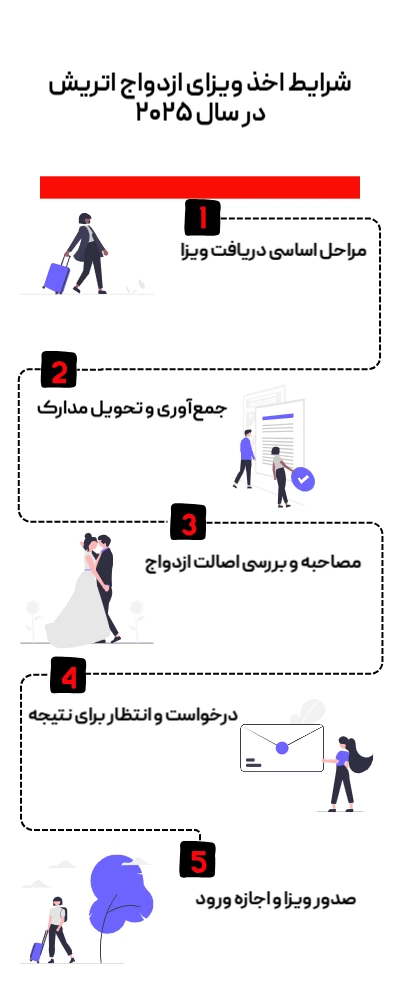
3. File the application at the Austrian embassy
Submit the application and the documents to the Austrian embassy or consulate in your country of residence. The mission checks the file and forwards it to the competent settlement authority in Austria.
4. Interview and checks on the marriage
Processing commonly takes three to five months. During that period you may be asked to attend an interview or to supply further documents. If the application is approved, a type D visa is issued so that you can travel to Austria. After you move in, you must register your address within three days.
5. Application to the settlement authority
Once you are in Austria you apply to the settlement authority for the residence title. For the spouse of an Austrian citizen this is the “Family Member” (Familienangehoeriger) title. It is normally granted for twelve months and can be renewed.
6. Renewal and the longer path
After two years of lawful residence and completion of Module 1 of the Integration Agreement, the title can be extended for three years. After five years of continuous lawful residence you may qualify for “Long-term resident – EU” status. None of these steps is automatic: each is decided by the Austrian authorities on the file in front of them.
What does an Austria marriage visa cost?
The cost of a type D family reunification visa depends on the applicant’s age and on the particulars of the case. The table below sets out the main items:
| Fee type | Adults | Minors |
|---|---|---|
| Application fee | EUR 120 | EUR 75 |
| Visa issuance fee | EUR 20 | Set by the Austrian authorities - check the current schedule |
| Personalisation fee | EUR 20 | EUR 20 |
These figures are indicative and can change with individual circumstances and with fee revisions. For current amounts, check with the Austrian embassy or consulate that covers your country.
Which residence permit does an Austria marriage visa lead to?
The permit you receive depends on your spouse’s legal status in Austria.
1. Residence titles for family members of Austrian citizens
If your spouse is an Austrian citizen, the “Family Member” residence title is normally issued. It allows you to live in Austria and gives unrestricted access to the labour market. Once the qualifying periods are met, you can apply for long-term status.
2. Residence titles for family members of third-country nationals
If your spouse is a non-EU citizen settled in Austria, you may qualify for one of the following:
- Red-White-Red Card plus: for family members of Red-White-Red Card holders, EU Blue Card holders, and people with long-term resident status in Austria. It allows unrestricted work in the Austrian labour market.
- Settlement permit – dependant: for other relatives who meet additional conditions, including a declaration of liability from the sponsor.
3. Validity and conditions
- Initial validity: residence titles are usually granted for 12 months.
- Renewal: after two years of lawful residence and completion of Module 1 of the Integration Agreement, the title may be extended for 3 years.
- Long-term residence: after five years of continuous lawful residence you may apply for “Long-term resident – EU” status.
Before you apply
The Austria marriage visa is decided by the Austrian embassy and the Austrian settlement authority. No adviser, in Austria or anywhere else, can guarantee the outcome. What you can control is the file: complete documents, certified translations, income evidence that clearly meets the reference rate, and a housing contract that matches the size of your family.
Aval Visa publishes these country guides as general information. Our regulated practice is Canadian immigration, so if Canada is also on your list you can start with a free assessment. For an Austrian file, apply directly to the Austrian embassy or consulate, or take advice from a lawyer authorised to practise in Austria.
Frequently asked questions
- Can I work in Austria on this visa?
Yes. Both the “Family Member” title and the Red-White-Red Card plus give full access to the Austrian labour market, so no separate work permit is needed.
2. What happens if the relationship ends?
After a divorce or separation the residence title can be withdrawn, unless:
- you qualify for a different type of residence permit, or
- specific criteria are met, such as the length of your residence in Austria or your degree of integration.
3. Is there a visa for fiances who are not married yet?
Austria has no fiance visa. Couples normally marry first and then apply for family reunification. Family members of Austrian citizens may in some cases lodge the application inside Austria during a lawful stay, but a short-stay Schengen visa is issued for a visit, and an application that contradicts the stated purpose of that visit can be refused. Confirm the position with the Austrian embassy before you travel.