Every year a large number of people look for a way to start working and living in Germany, but choosing the right route is rarely simple. Some applicants do not hold a university degree, some want to keep costs down, and some simply want to reach the labour market sooner. All of them are looking for an alternative to the usual academic path.
The German Ausbildung is the route that now gets the most attention from international applicants. It lets you learn a trade, build real work experience and earn a wage while you train. Choosing the right occupation matters, because entry requirements, pay and job prospects differ a great deal from one field to another. Below we look at the best Ausbildung programmes in Germany for 2026, the occupations in demand, the pay, the requirements and the career outlook for each.
What is a German Ausbildung?
If you are thinking about moving to Germany but do not want to spend several years at university first, you have probably come across the German Ausbildung. It has become popular in recent years because it lets you pick up a specialist skill, gain genuine work experience in Germany and make your entry into the labour market a great deal easier.
An Ausbildung is a vocational training programme that combines classroom theory with practical work. You are not only taught in a classroom; you spend part of your time in a company, a clinic or a workplace, learning the skills of a job in a real setting. This system, known as dual training (Duale Ausbildung), is one of the main ways Germany trains its skilled workforce, and a large share of the country’s skilled staff enter their occupations through it.
Read more: The best cities in Germany for work and life
Who can apply for an Ausbildung in Germany?
International applicants need to meet a few core conditions before they can join a German Ausbildung. The exact requirements vary by occupation and by employer, but the following usually carry the most weight:
- School qualification: for many occupations a secondary school leaving certificate is enough, although some specialist fields ask for a higher level of education.
- German language: because both the training and the workplace run in German, language skills matter a great deal. B1 is the level required for many programmes, but in fields such as healthcare a B2 certificate improves your chances considerably.
- Ausbildung contract: to apply for a visa you normally need a signed Ausbildung contract from a company or training provider in Germany.
- A clear motivation and career goal: having a defined career path, and being able to explain why you chose that occupation, counts in both the admission and the visa process.
How is an Ausbildung different from a university degree?
One of the most common questions is whether to apply for an Ausbildung or to study at a German university. The answer depends on your goal. If you want to continue an academic path and earn a degree, a German student visa may be the better fit. If you want to learn a specialist trade and start working sooner, an Ausbildung is likely to suit you better.
A university course concentrates on academic and theoretical training. An Ausbildung concentrates on job skills and on preparing you for the labour market. That is why fields such as nursing, IT, mechatronics, electrical engineering, medical assistance and a range of technical and service occupations are so popular with Ausbildung applicants.
The table below sets out the main differences between the best Ausbildung programmes in Germany for 2026 and a university degree:
| Aspect | Ausbildung in Germany | University study |
|---|---|---|
| Purpose | Learning a trade and entering the labour market | Earning a university degree |
| Type of training | Practical and theoretical | Mainly theoretical |
| Duration | About 2 to 3.5 years | 3 years and up |
| Cost | Lower, and paid a salary in some fields | Varies by university and programme |
| Language | German B1 or higher | Depends on the programme and university |
| Suited to | People who want a faster route into work | People with academic goals |
Which Ausbildung suits which applicant?
The best Ausbildung for moving to Germany depends on personal circumstances: your school qualification, your language level, your work history, your interests and your career goal. An occupation that suits someone with a technical background may be a poor choice for someone drawn to healthcare or technology. So rather than choosing on pay alone, look at the entry requirements and the career outlook for each field.
Best Ausbildung for applicants with a secondary school certificate
Applicants who hold a secondary school leaving certificate can apply for a wide range of Ausbildung programmes. Nursing, hospitality, logistics, cooking, building services, electrical work and several other technical occupations are all realistic options.
For this group, a German language certificate and clear evidence that you are motivated and ready to learn a practical skill matter most. Choose the occupation on the basis of your interests and ability, not on the likely pay alone.
Best Ausbildung for applicants with a technical or vocational qualification
Applicants who already have technical training usually do well in hands-on occupations, because they have learned part of the required skill set already.
Fields such as:
- Mechatronics
- Electrical and electronic engineering
- Industrial mechanics
- Building services and installation
- Automotive technology
are good choices for this group. Relevant hands-on experience strengthens a CV and attracts the attention of German employers.
Best Ausbildung for applicants with work experience
Relevant work experience is a real advantage when you apply for an Ausbildung. If you have already worked in a particular field, it is usually best to choose an occupation close to that experience. That consistency makes it easier to find an employer willing to offer you an Ausbildung contract.
Best Ausbildung for applicants over 30
Many Ausbildung candidates are young, but applicants over 30 can also look at this route if they meet the requirements. At that age it matters more that the occupation lines up with your work history, your skills and your longer-term goals. For this group, fields connected to previous experience are usually the more logical choice, because you can carry existing skills into the new path.
Best Ausbildung for women
Germany places no formal restriction on Ausbildung choice by gender, and women can train in any occupation. The choice should rest on interest, ability, working conditions and personal goals.
Many women train in fields such as:
- Nursing and healthcare
- Information technology
- Hospitality
- Administration and finance
- Technical trades
and success in any of them depends mainly on skill, interest and preparation.
Best Ausbildung for men
Men face no restriction either and can apply in any field that matches their interests and abilities. Technical occupations such as:
- Mechatronics
- Electrical engineering
- Industrial mechanics
- Building services and installation
- Logistics
are among the popular choices, but IT, banking, nursing and service occupations are equally suitable.
Best occupations for applicants at B1 level
B1 is a common starting level for the Ausbildung route, although the language level actually required depends on the occupation and the employer. Applicants at B1 can usually look at options such as:
- Technical trades
- Building services and installation
- Mechanics
- Logistics
- Some service occupations
For occupations with more direct customer or patient contact, such as nursing or banking, a higher language level normally improves your chances of being accepted.
Read more: The best universities in Germany for international students
Best Ausbildung programmes for applicants at B2 level
A B2 certificate opens up a wider range of options, because many employers want staff who can hold a professional conversation in German. Applicants at B2 have a reasonable chance in fields such as nursing, IT, banking, administration and specialist technical occupations.
In the end, the best Ausbildung for any individual is the one that balances personal ability, language level, previous experience, demand in the German labour market and long-term goals. For the official requirements and the current document list, check with the German mission in your country, and read our guide to the German student visa if you are weighing up the academic route as well.
Which are the best Ausbildung programmes in Germany for 2026?
Choosing the right occupation is one of the most important decisions on the Ausbildung route. Do not look at pay alone; weigh up demand in the labour market, how realistic it is to secure an Ausbildung contract, and the career outlook in that field. According to Germany’s official immigration portal, nursing, IT, technical trades and several service occupations are among the fields with the strongest Ausbildung demand. Some of the best Ausbildung programmes in Germany for 2026 are set out below.
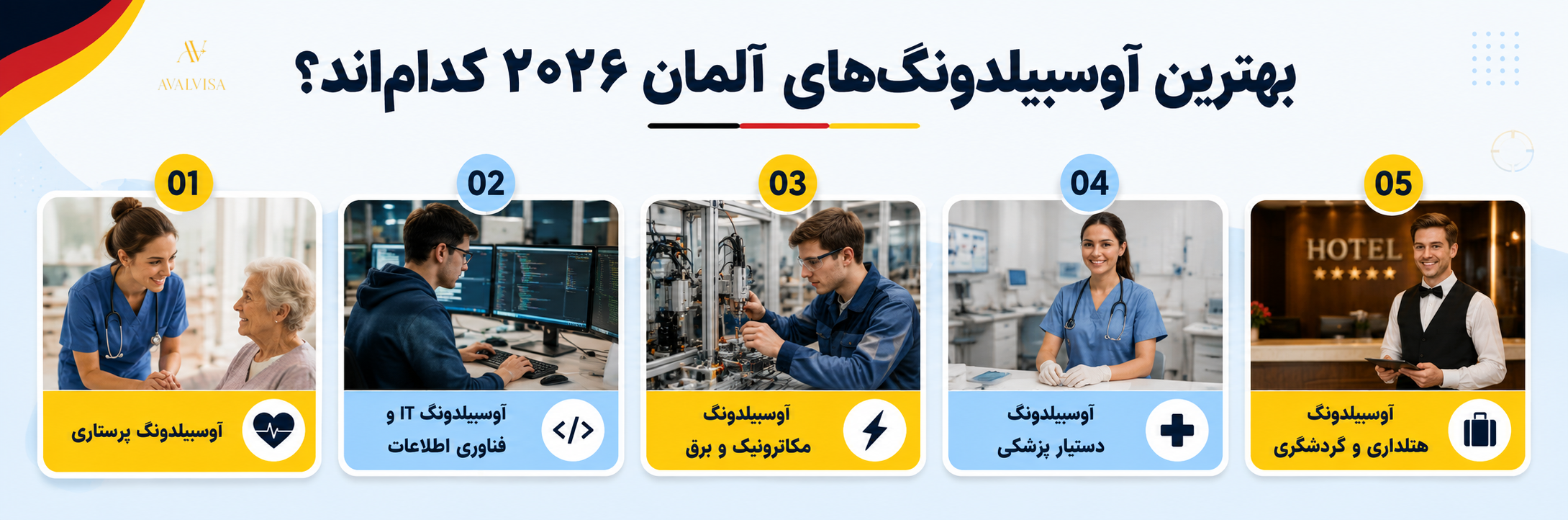
Nursing (Pflegefachkraft)
Nursing is one of the most sought-after Ausbildung fields in Germany. As demand for healthcare staff grows, hospitals and care homes are actively recruiting trained people. During the programme you learn patient care, basic clinical procedures, teamwork with medical staff and how to handle the range of situations that arise in a care setting. It suits people who are drawn to healthcare and who enjoy working with and helping others. Because the work involves direct patient contact, a solid level of German matters a great deal.
| Item | Details |
|---|---|
| Programme length | 3 years |
| Salary during training | approx. EUR 1,400 to 1,600 gross per month |
| Earnings after completion | approx. EUR 2,800 to 3,800 gross per month |
| Required language level | German B1 to B2 |
| Labour market | Very favourable, given the shortage of healthcare staff in Germany |
| Suitable for | People interested in healthcare and patient care |
IT and information technology (Fachinformatiker)
As technology advances and businesses move online, IT occupations have taken their place among the best Ausbildung programmes in Germany for 2026.
Popular specialisations in this field include:
- Programming and software development
- Networks and computer systems
- IT security
This route suits people who enjoy technology, problem solving and working with computer systems.
| Item | Details |
|---|---|
| Programme length | 3 years |
| Training allowance | About EUR 1,100 to 1,600 gross per month |
| Income after completing the programme | About EUR 3,000 to 5,000 gross per month |
| Language level required | German B1 to B2 |
| Job market | Very good, though competition for places is higher |
| Suited to | Those interested in programming, networks and technology |
Mechatronics and electrical engineering (Mechatroniker / Elektroniker)
Germany is one of the world’s industrial centres, which is why technical occupations such as mechatronics and electrical engineering carry so much weight. On these programmes you cover a mix of mechanics, electronics and industrial technology, and learn to work with machinery, automation systems and modern equipment. Electrical and industrial metalworking occupations also appear on Germany’s shortage occupation lists.
| Item | Details |
|---|---|
| Programme length | 3.5 years |
| Pay during the Ausbildung | Set by the applicable collective agreement, at least the statutory minimum training allowance (section 17 BBiG), which is raised every 1 January |
| Income after completion | About EUR 3,000 to 4,500 gross per month |
| Language level required | German B1 to B2 |
| Labour market | Demand in the automotive, manufacturing and automation sectors |
| Suited to | People interested in mechanics and industrial technology |
Medical assistant (Medizinische Fachangestellte)
For people drawn to healthcare who do not want to train as nurses, the medical assistant Ausbildung is a sensible alternative. Medical assistants work in doctors’ practices, clinics and treatment centres, handling patient coordination, records, equipment preparation and support for the doctor. The role calls for good communication skills and a solid command of German, because daily contact with patients is a large part of the job.
| Item | Details |
|---|---|
| Programme length | 3 years |
| Training allowance | About EUR 900 to 1,200 gross per month |
| Income after completing the programme | About EUR 2,300 to 3,200 gross per month |
| Language level required | German B1 to B2 |
| Job market | Good, given the demand from clinics and practices for medical assistants |
| Suited to | Those interested in healthcare, working with patients and medical settings |
| Important note | Physically less demanding than nursing, but requires strong communication skills and good German |
Read more: A complete guide for doctors moving to Germany
Hospitality and tourism (Hotelfachmann / Hotelfachfrau)
Hospitality and tourism is another sector that offers Ausbildung places in Germany. It suits people who enjoy customer contact, teamwork and international environments. The programme covers front-desk management, customer service, coordination between hotel departments and the fundamentals of tourism. According to German official sources, hospitality and catering (Hotellerie/Gastronomie) is a sector with a wide range of training and employment openings.
To make the fields easier to compare, the table below summarises the key facts for each of the best Ausbildung programmes in Germany for 2026.
| Ausbildung field | Area of work | Suited to | Career outlook |
|---|---|---|---|
| Nursing | Treatment and patient care | Those drawn to healthcare | Very good |
| IT and information technology | Programming, networks and systems | Those drawn to technology | Very good |
| Mechatronics and electrical | Industry, machinery and equipment | Technically minded people who like hands-on work | Good |
| Medical assistant | Doctors' practices and clinics | Those drawn to a medical setting | Good |
| Hotel management and tourism | Services, hotels and tourism | Sociable people who enjoy customer contact | Suitable |
The right Ausbildung for any individual depends on German language level, educational background, personal interest and labour market conditions, so it is worth reviewing the requirements of each occupation separately before you decide. For a free consultation on the German Ausbildung route, get in touch with the Aval Visa team.
The best-paid Ausbildung fields in Germany
When people talk about the best-paid and best Ausbildung programmes in Germany for 2026, pay is naturally one of the main criteria. But do not look only at what you earn during the training. Some fields pay more from the first year; others open up better job prospects and stronger earnings growth once the programme ends.
IT, electrical engineering and mechatronics, industrial mechanics, financial services and several healthcare occupations tend to be attractive on both career outlook and earnings growth. Pay in any field varies with the city, the type of company, the collective agreement and your experience.
| Ausbildung field | Approximate monthly training pay (set by collective agreement, varies) |
|---|---|
| Insurance and financial services | Set by collective agreement; check the current rate |
| IT and information technology | About EUR 1,200–1,300 |
| Mechatronics | About EUR 1,200–1,300 |
| Industrial mechanics | About EUR 1,200–1,300 |
| Nursing | About EUR 1,200–1,400 |
| Banking | About EUR 1,200–1,300 |
| Electrical engineering and electronics | About EUR 1,100–1,300 |
| Medical assistant | About EUR 900–1,100 |
| Hospitality | About EUR 900–1,100 |
The table gives a general picture only; actual pay varies from post to post. So when you choose an occupation, weigh interest, entry requirements and job prospects alongside the money.
If you want to review your own position and pick a route that fits, complete the free Aval Visa assessment form and speak to an adviser.
How much do the best Ausbildung programmes in Germany pay in 2026?
One of the real advantages of a German Ausbildung is that on most programmes you earn a wage while you learn the skill and build experience. The amount normally rises in later years, as your responsibilities and skills grow.
The statutory minimum training pay for Ausbildung programmes starting in 2026 is set out below in approximate terms:
| Ausbildung field | Year 1 | Year 2 | Year 3 |
|---|---|---|---|
| Nursing | Set by the applicable collective agreement; at least the statutory minimum training allowance (BBiG s.17) | Rises with each training year | Rises with each training year |
| IT and information technology | approx. EUR 1,100 to 1,300 | approx. EUR 1,200 to 1,400 | approx. EUR 1,300 to 1,500 |
| Mechatronics | approx. EUR 1,000 to 1,200 | approx. EUR 1,100 to 1,300 | approx. EUR 1,200 to 1,400 |
| Industrial electrical engineering | approx. EUR 1,000 to 1,200 | approx. EUR 1,100 to 1,300 | approx. EUR 1,200 to 1,400 |
| Medical assistant | approx. EUR 1,050 | approx. EUR 1,150 | approx. EUR 1,250 |
| Banking | approx. EUR 1,200 to 1,300 | approx. EUR 1,300 to 1,400 | approx. EUR 1,400 to 1,500 |
| Hospitality | approx. EUR 900 to 1,000 | approx. EUR 1,000 to 1,100 | approx. EUR 1,100 to 1,200 |
These are statutory minimums, and many trainees, particularly in technical and industrial fields and at larger companies, are paid more. Earnings usually rise again once the programme ends, depending on the occupation, your experience, the city and the employer. So when you are weighing up the best-paid Ausbildung in Germany, look past the training wage and consider the career outlook and the room for earnings growth.
Read more: The cost of living in Germany for new arrivals
Steps to a German Ausbildung visa
Getting an Ausbildung visa involves more than picking a field. It is best to start with the occupation and your German, then move on to finding a place and preparing documents.
1. Choose the occupation and check the requirements
Start by choosing a field that fits your educational background, language level, interests and circumstances. Looking at labour market demand and the entry requirements for each occupation will sharpen the choice.
2. Learn German
Most Ausbildung programmes call for a German certificate at B1, although some occupations and employers ask for more. According to Germany’s official immigration portal, German matters for the training, the workplace and the examinations.
3. Find a place and sign an Ausbildung contract
Once you have chosen a field, apply for suitable places and, if you are accepted, obtain the contract or confirmation from the training provider. Holding a confirmed Ausbildung place is one of the core conditions for the visa application.
4. Prepare documents and lodge the visa application
You will need documents such as your passport, the Ausbildung contract, your language certificate, your educational certificates, a CV and evidence that your living costs are covered. The exact list depends on the type of programme, the circumstances of your case and the requirements of the mission, but the following are usually needed:
- A valid passport
- The completed visa application form
- An Ausbildung contract or confirmation of a place from a company or training provider in Germany
- A German language certificate; most programmes ask for B1, unless the training provider or employer has confirmed your language ability
- Educational certificates with certified translations
- A CV and a letter of motivation
- Evidence that your living costs are covered; on a company-based Ausbildung the training wage can cover part of this. If the wage is not enough, you may need to supply additional financial evidence
- Proof of valid health insurance
- A biometric photograph that meets the visa standard
Documents alone are not enough: they have to be consistent with the programme and with the rest of your file. Check the current document list with the official source and the German mission before you lodge the application.
5. Assessment and visa decision
Once the application is lodged, the authorities assess the documents, and for some company-based programmes the Federal Employment Agency also has to give its approval. If the visa is issued, you can travel to Germany to begin the Ausbildung.
Every Ausbildung case is different, and the occupation you choose, your language level and your documents all affect how the application is assessed.
The route to permanent residence in Germany after an Ausbildung
Finishing an Ausbildung can be the start of a long-term career in Germany. Many people who complete the programme move into the labour market, change their residence status and then look at the route to long-term and eventually permanent residence.
After the programme, if you find a job that matches your training and skills, you can apply for a work-based residence permit as a skilled worker. If you do not find a job immediately, you may be able to apply for a job-seeking residence permit, which gives you more time to enter the German labour market.
Once you are working, your employment record, your social insurance contributions and your ability to cover your living costs all count towards permanent residence. People who have completed vocational training in Germany may, if they meet the conditions, qualify under the specific permanent residence routes for skilled workers.
The Ausbildung: a route with a different set of opportunities
Choosing a migration route is never a simple decision, especially when you are planning several years of your life around building a new future. For many international applicants the German Ausbildung in 2026 is a solid option, because alongside learning a practical skill it gives you real work experience and a first-hand understanding of the German workplace.
Frequently asked questions
- Can you apply for a German Ausbildung without a university degree?
Yes. One of the advantages of the Ausbildung is that it focuses on learning a skill and entering the labour market, and many occupations are open to applicants with a secondary school certificate. - Is there an age limit for a German Ausbildung?
There is generally no fixed upper age limit for starting an Ausbildung, although age can affect which route makes sense and how a case is assessed. Some related visas, such as the visa for seeking an Ausbildung place, do carry specific age conditions. - What language level do you need for a German Ausbildung?
Most programmes ask for a German certificate at B1, but some occupations and employers require a higher level such as B2. - Can international students apply for a German Ausbildung?
Yes, international applicants can apply. You need an educational qualification, German language skills (often at B1) and, if you are from outside the EU, the appropriate visa. - How much does a German Ausbildung pay?
Pay depends on the occupation, the region and the employer, and normally rises each year. Some healthcare fields, nursing among them, pay more during training than most other occupations. - What is a dependant visa for an Ausbildung? A dependant visa lets the spouse, and in some circumstances other family members, of someone moving to Germany for an Ausbildung live there with them. It usually applies to the spouse and children of the main applicant, and the assessment looks at proof of the family relationship, coverage of living costs, suitable accommodation and compliance with German residence rules. If the visa is granted, family members can stay in Germany for as long as the main applicant’s residence permit is valid, and depending on their status and the rules in force they may also be able to work or study.
- Does a German Ausbildung require proof of funds? Yes, an Ausbildung application requires proof that your living costs are covered, but on a company-based (dual) Ausbildung the training wage can serve as that proof. The amount you must show is set by the German authorities and revised each year, so check the current figure with the German mission handling your application; if the training wage does not cover it, the shortfall can be made up with a blocked account or a formal declaration of financial support. On a school-based Ausbildung there is no training wage, so the funds have to be shown from your own resources.
This article is general information, not legal advice, and it describes published official rules rather than any individual case.