Among European destinations, immigration to France is one of the more sought-after options, and the French passport is one of the strongest travel documents in the world. Holding one gives you unusual freedom to travel, live and work, and it changes what is available to you for the rest of your working life.
Getting that passport means meeting a defined set of legal conditions, and knowing them in advance makes the route considerably shorter. If you want to know how the French passport is acquired and what it carries with it, read on.
The passport in France
The French passport is one of the world’s strongest travel documents, giving holders visa-free or visa-on-arrival access to more than 190 countries and territories and placing it consistently among the top three in global passport rankings.
A French passport lets the holder travel abroad and exercise the full rights of French citizenship internationally. If you live in France, you apply for the passport at your local town hall (Mairie).
If you live outside France, you apply through the French embassy or consulate in your country of residence.
Requirements for a French passport
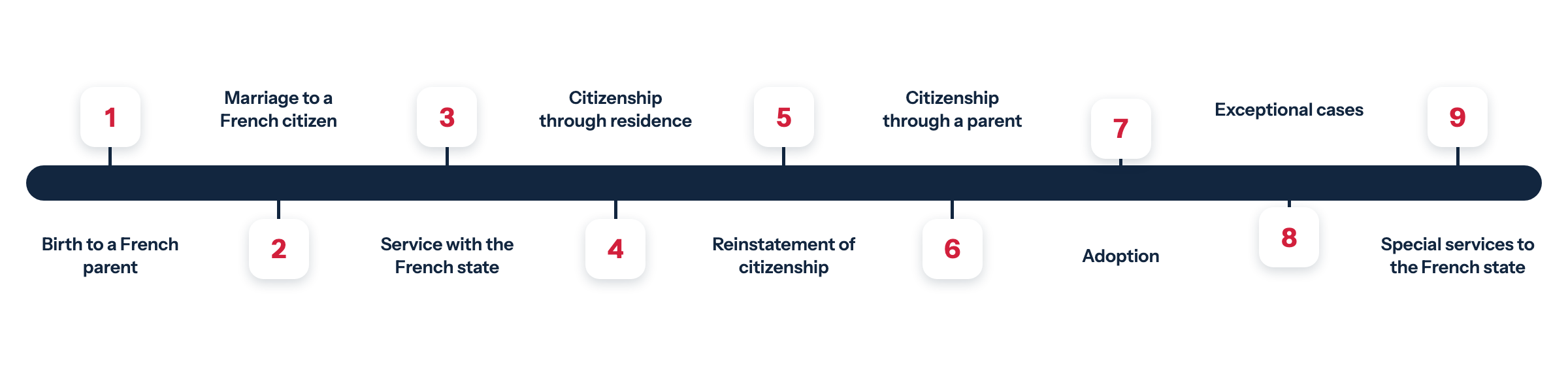
France issues passports to people who qualify for French citizenship, and it recognises dual citizenship. Citizenship, and with it the passport, can be acquired on any one of the following grounds:
- Birth to a French parent
A child born to a French mother or father is automatically a French citizen, including where the birth takes place outside France. - Marriage to a French citizen
A person married to a French national can apply for citizenship after four years of married life together and evidence of a genuine relationship. Where the couple has lived outside France, that period can rise to five years. - Service with the French state
People who have served the French state for a defined period, in the armed forces or the public service for example, may qualify for citizenship. There is a full account of the French work visa on the Aval Visa site. - Citizenship through residence
Someone who has lived lawfully and continuously in France for at least five years can apply for French citizenship. That period can fall to two years for graduates of a French university or for people who have rendered particular services. You can also read about the best courses to study in France on the Aval Visa site. - Reinstatement of citizenship
People who previously lost French citizenship, by renunciation or under particular legal provisions, can apply to have it restored.
- Citizenship through a parent
Where a parent acquires French citizenship before the child reaches the age of majority, the child can also acquire French citizenship through the family effect. - Adoption
A child fully and lawfully adopted by French parents qualifies for citizenship and, in turn, a French passport. - Exceptional cases
In particular cases, such as outstanding achievement in science, culture or sport, or in emergency circumstances, French citizenship may be granted exceptionally by government decision. - Special services to the French state
People who have provided particular or strategic services to French national interests, through significant investment or security cooperation for example, may be granted citizenship in recognition of that.
Read more: A full guide to the cost of moving to France
How to obtain a French passport
A French passport requires French citizenship. Anyone who is formally a citizen of the French Republic can apply for the passport by producing the necessary documents. In outline, the process runs as follows.
1. Acquire French citizenship
The first step towards a French passport is citizenship itself, which can be acquired in several ways:
- At least five years of lawful, continuous residence in France
- Marriage to a French national, with at least four to five years of married life
- Birth to French parents, or acquisition through a parent
- Particular services to the French state, or significant investment
Applicants for citizenship must produce identity documents, proof of residence, a French language certificate at the level fixed by decree (that level was raised under the 2024 immigration law, so confirm the level currently in force with your prefecture before you sit an exam), a criminal record check, financial documents and other supporting evidence. Assessment and a final decision on citizenship normally take 12 to 18 months.
2. Apply for the French passport
Once citizenship is granted, you apply for the passport at a town hall inside France, or at a French embassy or consulate abroad. The documents required are:
- A passport photograph to the international standard
- Proof of address
- French identity papers or the citizenship decree
- Proof of payment of the passport fee
The passport fee in France is EUR 86 for adults, and between EUR 17 and EUR 42 for applicants under 18. The amount charged at embassies can be slightly higher.
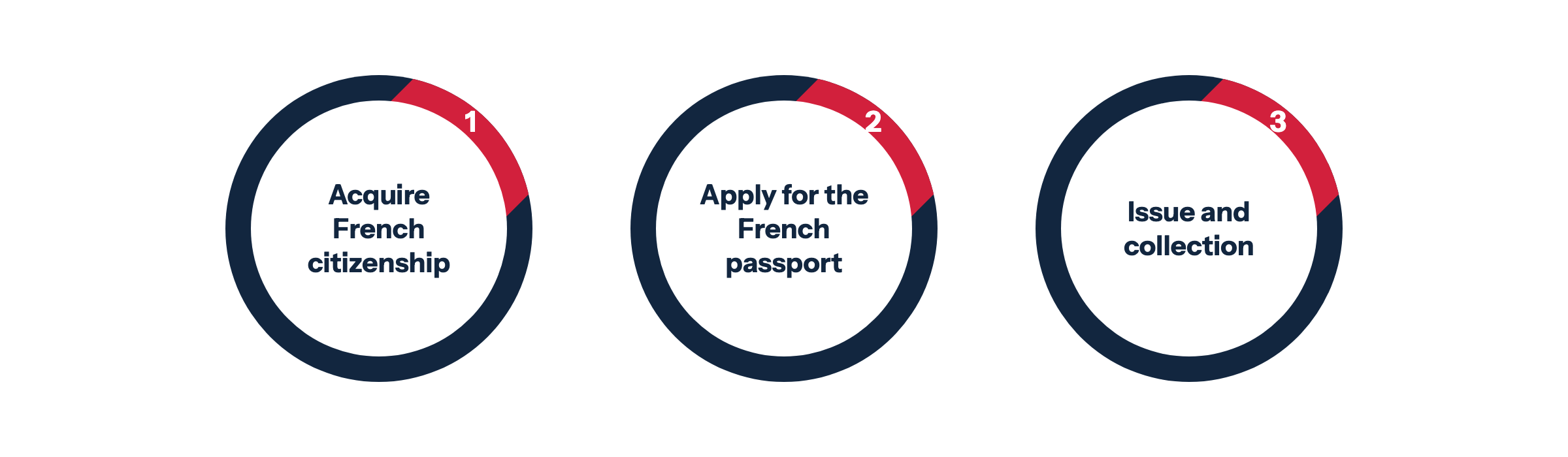
3. Issue and collection
Once the application and documents are lodged, production of the passport begins. Inside France this normally takes four to eight weeks, and at embassies three to seven weeks. The passport must then be collected and signed for in person.
Types of passport issued in France
The passports issued in France differ in validity and in what they are used for:
| Passport type | Validity | Pages | Biometric | Intended for |
|---|---|---|---|---|
| Ordinary biometric | 10 / 5 years | 32 pages | Yes | General public |
| Frequent traveller | 10 years | 48 pages | Yes | Frequent travellers, professionals |
| Diplomatic | Up to 10 years | Not specified | Yes | Diplomats and official state representatives |
| Service | 5 years | Not specified | Yes | Non-diplomatic government staff |
| Mission | 5 years | Not specified | Yes | Government or military missions |
| Temporary emergency | 1 year or less | Fewer than ordinary | No | Urgent situations or a lost passport |
Benefits of a French passport
Holding a French passport carries a number of practical advantages:
- Exceptional freedom of international travel
The French passport ranks among the three strongest in the world. Holders can travel to more than 190 countries and territories without a visa or with a visa on arrival.
That list includes the United States, the United Kingdom, Canada, Japan, Australia, the EU member states and many others.
Visa-free is not the same as nothing to arrange. The United States requires an ESTA, Canada an eTA, and since 2 April 2025 the United Kingdom requires an Electronic Travel Authorisation before boarding. None of the three is a visa, and each must be held before you fly. - Full EU citizenship rights
A French passport lets you live, work, study or retire in any of the 27 EU member states with no visa and no residence permit.
It also brings equal access to healthcare, education and pensions, and makes it easier for family members to join you. - Education and healthcare
French citizens pay the lower, EU-national rate of tuition at European universities.
They also have access to high-quality, affordable healthcare in France and across the EU through the European Health Insurance Card (EHIC). - Political rights and civic participation
French citizens can vote in national, local and European elections, and can stand for office, including citizens who were not born in France. - An end to immigration paperwork
With citizenship there are no more residence permits to renew and no more immigration bureaucracy. At border control you use the EU citizens’ lanes, which cuts the time spent entering and leaving. - Social and economic security
French citizens have full access to social security, including family allowances, unemployment insurance and state pensions.
Anywhere in the EU you can work or set up a business without a further permit, and opening a bank account, investing and buying property are all more straightforward. - Dual citizenship
France recognises dual citizenship, so you can hold a French passport without giving up your existing nationality.
A French passport is not only about easier travel. It is an entry point to the social and economic opportunities, and the standard of living, of one of the most developed regions in the world.
Read more: The highest-paying jobs in France
The French passport as a key to open borders
Taken as a whole, the French passport is one of the most valuable travel documents in the world. It brings wide visa-free access, international career options, and high-quality healthcare and education.
If you intend to apply for it, work through the lawful routes and the conditions attached to each of them carefully, and take professional advice to avoid mistakes that cost time.
Aval Visa can help with that. For guidance and professional support on French immigration and citizenship, contact the Aval Visa advisory team.
Frequently asked questions
- Does France recognise a second citizenship?
Yes. You do not have to give up your existing citizenship, or your existing passport, when you acquire French citizenship. - How long is a French passport valid?
French passports are valid for 10 years for applicants aged 18 and over, and for 5 years for applicants under 18. - Can you hold several citizenships in France?
Yes. France allows multiple citizenships, two or even three, and that is no obstacle to French citizenship.
This article is general information, not legal advice, and it describes published official rules rather than any individual case.