Marrying a German citizen is one of the shortest legal routes to immigration to Germany. There is no capital requirement and no long selection process, and you join a spouse who already lives in the country. It is still a formal legal procedure: you have to show that the marriage is genuine, complete the national visa forms, book an appointment at a German mission and work through the administrative steps that follow. This guide sets out the route from marriage to a German residence permit. If you need more detail, leave a comment and our team will answer your questions.
Marriage in Germany
Whatever you may have read, family life matters in German culture, and marriage is treated as both a personal and a formal commitment. Couples often spend years together before they marry and go into it knowing each other well. Independence, respect for personal space, shared responsibility inside and outside the home, joint parenting and open discussion are all typical features of German family life.
For many people, marrying a German citizen is both a new cultural experience and a route to long-term residence. With that in mind, here is how a German residence permit through marriage actually works.
Requirements for a Germany marriage visa
Both spouses must be at least 18 years old, and one spouse must be a German citizen or a legal resident of Germany who can sponsor the other under the family reunification rules. The remaining requirements are as follows:
- Evidence that the marriage is genuine
- Evidence that the relationship is settled and long standing
- Adequate accommodation for the couple in Germany
- Sufficient income where the sponsor is a foreign national resident in Germany; spouses of German citizens are normally exempt from the secure-livelihood requirement
- No reliance on social assistance where the income requirement applies
- Basic German at CEFR level A1 for the visa application

Documents required for a Germany marriage visa
| Document | Details |
|---|---|
| Completed visa application form | Fill it in carefully and leave no field blank |
| Passport and biometric photo | Valid passport and photo with a white background |
| Marriage certificate | Or confirmation of the marriage being registered in Germany |
| German language certificate | At A1 level |
| Identity documents of the spouse residing in Germany | Passport and other identity documents |
| Proof of accommodation in Germany | Such as a property deed or tenancy agreement |
| Financial documents of the spouse residing in Germany | Payslips, tax return and bank statements |
| Valid health insurance | For the period of residence in Germany |
Germany marriage visa fees
| Service | Cost |
|---|---|
| Visa application | EUR 75 |
| Residence permit after arrival | Up to EUR 100 |
| Certified translation of documents, attestations and legal advice | Varies |
How to apply for a Germany marriage visa
If you meet the requirements and can evidence a genuine marriage, the route to a residence permit runs as follows.
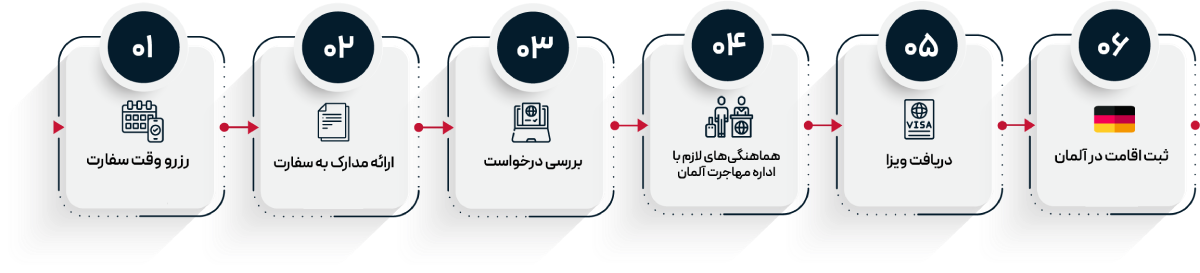
Start by having your documents translated by a sworn translator and certified. While that is under way, book a national visa appointment through the consular services portal of the German Federal Foreign Office for the German mission responsible for your place of residence, and arrive at least 30 minutes early on the day. After biometrics and, in some cases, an interview, the mission issues a decision within roughly 8 to 12 weeks, in coordination with the local immigration office (Ausländerbehörde) in Germany. Once the national D visa is in your passport you can book your flight and travel to Germany, where the visa is converted into a residence permit.
Benefits of moving to Germany through marriage
Compared with the Germany student visa, the Chancenkarte or Opportunity Card and other routes, the marriage visa is usually the fastest way to move to Germany. Marriage to a German citizen also brings the following advantages:
- Visa-free travel throughout the Schengen area
- The right to work and study in Germany without a separate work permit
- Tuition-free state schooling and public university places for children
- German citizenship for children with a German parent
- The right to vote in German elections, once you naturalise
- Access to public-sector posts, most of which are reserved for citizens
- The option to apply for a settlement permit and later for citizenship and a German passport
- Eligibility to represent Germany in national sports teams after naturalisation
- Access to BAföG student support
- Access to the statutory health and long-term care system
- Access to bank lending and state support schemes on the same terms as other residents
Key legal points
A German residence permit through marriage depends on getting the legal detail right, so consider working with a lawyer or an experienced adviser. The first residence permit is normally issued for 3 years. It is tied to the marriage during that period: if the couple separates, the permit can be withdrawn.
After three years of lawful residence, with the marriage having lasted at least two years, the non-German spouse can apply for German citizenship. German at CEFR level B1 is required alongside the other conditions, so treat language learning as part of the plan from day one.
Applying for a German visa with Aval Visa
A German residence permit through marriage is one of the clearest legal routes to building a life together in Germany. Meeting the conditions, assembling the documents, understanding each stage of the application and taking advice on the German marriage visa all make the process easier to manage.
If you would rather move to Germany another way, the student and work routes are open too. For an initial consultation, contact the Aval Visa team. Our advisers assess your circumstances and budget, recommend the route that fits, and handle the file from start to finish.
Frequently asked questions
- We married outside Germany. How do we register the marriage? A marriage concluded abroad usually has to be recognised by the German civil registry office (Standesamt), which may require certified translations and consular legalisation.
- How long until I can apply for a German passport through marriage? Naturalisation is generally possible after three years of lawful residence, provided the marriage has lasted at least two years and the other conditions are met.
- What happens to the non-German spouse’s status after a divorce? Where the marriage ends because of domestic violence or another recognised hardship, the non-German spouse can keep an independent right of residence and later switch to a work visa, a student permit or an Ausbildung place. A parent of a German child also has a residence right in their own name.
- Can I apply without a German language certificate? Not usually. Exemptions are limited, and cover cases such as refugee status and spouses of EU Blue Card holders.
- Can I apply for a marriage visa while in Germany on a Schengen visa? No. A short-stay Schengen visa cannot be converted into a residence permit for family reasons. A non-EU spouse must enter on a national D visa issued for marriage or family reunification, and apply through the German mission responsible for their place of residence.
This article is general information, not legal advice, and it describes published official rules rather than any individual case.