For anyone weighing up a move to Europe, the Netherlands comes up again and again. Modern cities, long-established universities, low crime, and a labour market with genuine demand and good salaries are the reasons people keep choosing it.
If the Netherlands is at the top of your list, this guide covers how Netherlands permanent residence actually works: the legal routes into the country, the requirements, the documents, the costs and the rules you need to keep in mind. It starts with immigration to the Netherlands on a temporary permit.
Why choose the Netherlands?
The Netherlands is often recommended for family migration because of its stable economy and low crime rate, but that is only part of the picture. It also offers a broad range of routes and benefits, which is why the immigration process is selective: the system is built to admit people who intend to settle lawfully and contribute.
The main advantages include:
- An advanced, resilient economy
- A high-quality higher education system
- A safe country with a low crime rate
- Health coverage for all lawful residents
- Several routes in, including study, work and the Dutch startup visa
- The right to live and work in the Netherlands without restriction once settled
- The option of permanent residence after several years of temporary residence
- Visa-free travel across the Schengen area and the EU
Routes to Netherlands permanent residence
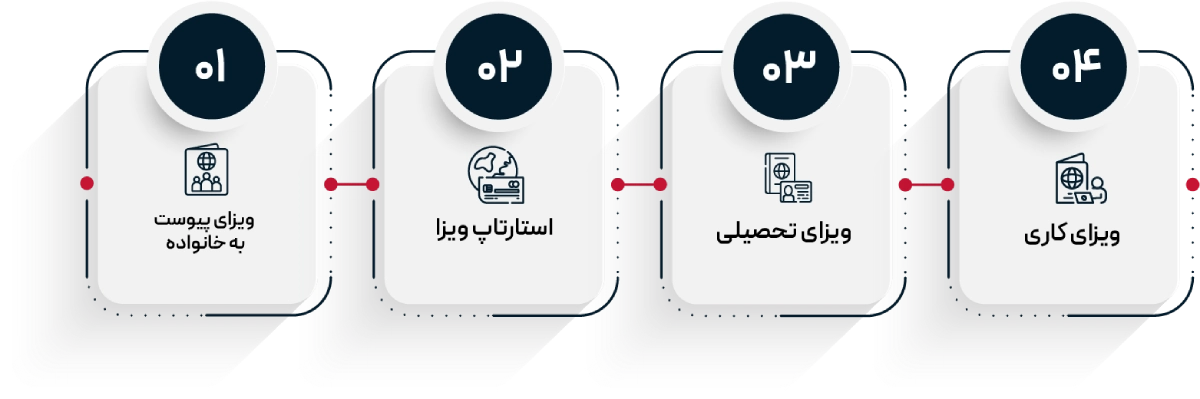
The first thing to understand is that you cannot apply for Netherlands permanent residence directly from abroad. You start with a temporary residence permit on a specific basis: study, work, the Dutch startup visa, investment and so on. A spouse and children can normally be included in the same application and live lawfully in the Netherlands with you.
After several years, provided you have complied with the rules and have no criminal record, the temporary permit can be converted into a permanent one. The routes below are the ones that most often lead there.
Permanent residence through work
Applicants who are specialists in their field, with work experience that matches their academic background, can apply for a Netherlands work visa. The essential condition is finding a recognised Dutch employer who is willing to sponsor a non-EU hire and to pay at or above the applicable salary threshold. With three things in place:
- a job offer
- relevant work experience
- a university qualification
you can apply for a Dutch work permit and, once you arrive, apply for an EU Blue Card. A work permit holder can bring a spouse and children, and after 5 years can apply for permanent residence. The route is expensive and slow, and relatively few employers will sponsor a non-EU specialist, so it is not the one we usually recommend as a first option.
Documents for a Netherlands work visa
| Documents | Notes |
|---|---|
| Passport | Valid for at least 6 months from the date of application |
| Completed and signed visa application form | Official form from the IND website |
| Employment contract with a recognised sponsor | An employer on the IND list of recognised sponsors |
| Proof of monthly income | Must meet the minimum set by the IND |
| Educational certificates | Relevant to the job field |
| CV | Including relevant work history and specialist skills |
| Health insurance | Proof of health insurance cover for the stay |
| Proof of funds | To cover living costs for the first few months |
| Biometric photo | Recent, with a white background |
| Application processing fee | EUR 423 (IND fee; revised each 1 January) |
Requirements for permanent residence in the Netherlands
Netherlands residence through a student visa
The next route is for students. If you have completed your previous studies and hold a recognised language certificate such as academic IELTS or TOEFL, you can obtain admission to a Dutch university and then apply for a Netherlands student visa. After graduating, you can use the orientation year to look for work, and if you find a qualifying job you can build towards Netherlands permanent residence.
The orientation year, formally the “zoekjaar hoogopgeleiden”, gives international graduates 12 months in the Netherlands to look for work matching their degree and specialisation.
For this route you need a valid passport, lawful student residence and enough money to support yourself; budget in the region of EUR 1,500 a month. The advantages are:
- Full-time work rights without a separate work permit
- No job offer needed, unlike a standard work permit
- The option to convert from study to work residence
- Time to build work experience and a professional network
Documents for a Netherlands student visa
To study in the Netherlands you first need admission from a university, and then the following for the residence application:
- Passport and a recent biometric photograph
- Completed and signed application form
- Academic CV
- Original transcripts and certified translations
- Original previous qualifications and certified translations
- Original identity documents and certified translations
- IELTS or TOEFL certificate
- The IND application fee for a study residence permit, currently EUR 254 (the MVV is normally applied for together with the residence permit in a single TEV procedure, so only one fee is payable; IND fees change every 1 January)
Residence through marriage or family reunification
Another route to Netherlands permanent residence through marriage is to marry a Dutch citizen or lawful resident and apply for a family residence permit. The applicant has to evidence that the relationship is genuine, and can then live in the Netherlands with their partner while working or studying.
There is also family reunification: if a close relative, such as a parent, is lawfully resident in the Netherlands, an applicant may be able to apply on that basis.
Documents for a family reunification permit
Alongside a valid passport and a recent biometric photograph, a family reunification applicant must provide certified translations of the following:
| Documents | Details |
|---|---|
| Completed and signed application form | Official family reunification (MVV) form from the IND website |
| Identity documents of the sponsor in the Netherlands | Copy of the passport or residence card of the spouse / parent or partner living in the Netherlands |
| Proof of the family relationship | Marriage certificate Child's birth certificate Registered partnership document |
| Proof of the sponsor's legal residence in the Netherlands | Document showing the type of residence permit (e.g. work, study, asylum) |
| Sufficient income | The sponsor in the Netherlands must have a stable income in line with the statutory minimum wage |
| Rental contract or proof of suitable housing | To prove the place of residence |
| IND antecedents certificate | Signed by applicants aged 12 and over, declaring any criminal history; check the IND document checklist for your permit type |
| Civic integration exam certificate (inburgeringsexamen) | Spouses must pass the A1 Dutch language exam at the embassy before travelling |
| Health insurance | To cover medical costs |
| Application processing fee | Set by the IND and revised every 1 January; check the current fee on ind.nl |
Residence through the Dutch startup visa
The fourth route to Netherlands permanent residence is the startup visa, which suits entrepreneurs and investors. If you have an original, commercially viable idea that can be built into a Dutch business, this route is worth testing. It grants one year of residence for a foreign founder, and its central condition is that you work with a recognised Dutch startup visa facilitator who supports the company through its first stage. If the business is trading successfully, the temporary permit can be converted to permanent residence, and after several more years you may apply for Dutch citizenship.
Documents for the startup visa
Alongside a valid passport and the completed startup visa application form, the applicant must provide the documents in the table below:
| Documents | Details |
|---|---|
| Cooperation letter from a facilitator (business mentor) | Contract or formal agreement with a facilitator recognised by the Dutch authorities |
| Business plan | Including market analysis, revenue model, competitive advantage and financial plan |
| Proof of financial means | Means to support yourself in the Netherlands; the IND re-sets the required amount twice a year - check the current figure |
| Entrepreneur's CV | Professional and academic background and experience relevant to starting a business |
| Police clearance certificate | From the country of origin |
| Dutch health insurance | To cover medical costs |
| Facilitator identification documents | Company registration certificate and legal details of the recognised facilitator in the Netherlands |
| Application processing fee | EUR 423 (the IND revises its fees periodically) |
Legal points to know about Netherlands permanent residence
To obtain Netherlands permanent residence, you have to hold one of the lawful statuses above (study, work, startup and so on) and understand the legal conditions attached to it. It is also worth spending time before you move learning about Dutch culture, daily life and social structures.
Understanding Dutch society helps you settle faster, and it improves your chances in the civic integration exam and the permanent residence process. Learning Dutch is a genuine requirement rather than an optional extra: under the current Civic Integration Act the standard language level for the integration route is B1. Start early rather than leaving it until the application is close.
Note that the permanent residence document is renewed every 5 years, although the status itself has no time limit. Spending more than 6 months outside the Netherlands can cause the permit to lapse, so plan long trips carefully.
Permanent residence gives you the right to work in the Netherlands without an additional permit. In exchange, you are obliged to report changes in your circumstances, such as a change of employer, a marriage or a change of address, to the immigration authorities. A criminal record or tax irregularities can disrupt the grant or renewal of a permit, so keep your affairs in order and pay tax on time.
Netherlands residence with Aval Visa
Netherlands permanent residence is one of the more dependable routes to a long-term future in Europe. If you already meet the conditions, or you plan to move through work, study or a startup, now is the point to plan properly. The Aval Visa team has extensive experience with Dutch files and can assess your position and guide the process.
From choosing the right route, completing the forms and preparing documents, to booking appointments and preparing for life in a new country, our advisers work through it with you. Complete the free assessment form or contact us to get started.
Frequently asked questions
- Do I get permanent residence after 5 years in the Netherlands? You can apply after five years of continuous lawful residence, for example on a study or work permit, provided you have Dutch at B1, stable income or sufficient means, and have passed the civic integration exam.
- Does Netherlands permanent residence require a language exam? Yes. You need Dutch at B1 under the current rules and you must pass the civic integration exam (inburgering).
- Can a Dutch residence application be refused? Yes. The residence card is renewed every 5 years, and a file can be refused for reasons including incomplete documents, falsified documents, a criminal record, security concerns or insufficient means.
This article is general information, not legal advice, and it describes published official rules rather than any individual case.