Studying in the Netherlands is one of the better routes into working and living in Europe. Well-regarded universities, strong teaching facilities, a wide range of research and networking opportunities, funding schemes, and programmes taught in English or Dutch: the list of reasons to look at Dutch universities is a long one.
If you want to start down that road, you will need a Netherlands student visa, and the sections below set out the requirements and the steps involved.
Why the Netherlands is a strong study destination
Studying in the Netherlands offers a great deal, and the teaching facilities and English-taught programmes are only the start of it. The other advantages include:
- The option to move from a student permit to a work permit
- Permanent residence after five years of continuous lawful residence
- The chance to study at some of Europe’s oldest universities
- A genuinely multicultural student body
- A varied labour market and good graduate prospects
- The right to bring a spouse and children with you
- The ability to send a formal invitation so family can apply for a visitor visa
The Dutch higher education system
Dutch higher education is delivered in two forms:
- Research-led programmes, suited to master’s and doctoral study (research universities)
- Applied, labour-market-oriented programmes, common at bachelor’s level (universities of applied sciences)

Requirements for studying in the Netherlands
International students need a recognised English or Dutch language certificate and an offer from the university they are applying to. Check the application requirements on the university’s own website in advance and send exactly what the checklist asks for. Some subjects, particularly in the medical sciences, may also involve an interview or an entrance test. Look through the best universities in the Netherlands and pick the one that fits.
An application for admission usually calls for the following:
- Certificates from your previous level of study
- Officially stamped and signed transcripts
- Reference letters, usually for master’s and doctoral applicants
- An English or Dutch language certificate at B2 level
- A motivation letter explaining why you want to study in the Netherlands
- A full CV covering your academic record and research interests
- A funding request letter, if you are applying for a scholarship
The cost of studying in the Netherlands
The cost of study in the Netherlands covers tuition, accommodation, transport, food and other day-to-day expenses. The table below summarises living costs in the Netherlands for students in different cities:
| Expense Item | Average Cost (EUR) | Notes |
|---|---|---|
| Average university tuition | Varies by university and programme | Check the fee page of the university you apply to |
| Rent | EUR 400 to 900 | Varies by city and type of apartment |
| Transport | EUR 100 to 300 | Use a monthly public transport pass |
| Food | EUR 150 to 300 | Shop at the cheaper supermarket chains |
| Leisure | EUR 300 and above | Depends on lifestyle |
Key points on living and study costs
Bear in mind that rent and general costs are higher in large cities such as Amsterdam, Rotterdam and Delft, and that leisure, gym membership and utility bills cost more there too. Cities such as Groningen, Enschede and Eindhoven are considerably cheaper.
For transport, you can use student discounts. Cycling is also popular in the Netherlands: it is cheap, and it is part of how the country works. Buying a basic bicycle keeps your transport costs close to nothing and fits the way most people get around.
Basic health insurance is normally compulsory for students from outside the EU, and it brings down what you pay for medical treatment.
Scholarships for studying in the Netherlands
For bachelor’s and master’s study you usually need to show solid financial means, while at doctoral level you can apply for funding. Scholarships are awarded on the terms set by the university and the supervisor, and those terms change over time. The table below sets out scholarships for study in the Netherlands based on the most recent published data; the details may change in later years, so always confirm directly with the university.
| Scholarship | General requirements | Approximate deadline | University |
|---|---|---|---|
| NL Scholarship | Full admission to a bachelor's or master's programme; for non-EU students | January and February | Government scholarship from Nuffic and participating universities |
| Justus & Louise van Effen Excellence Scholarship | Outstanding academic record and CV; non-EU students | December | TU Delft |
| Utrecht University Excellence Scholarship | Top-performing non-EU students | February to May for the autumn intake | Utrecht University |
| Leiden University Excellence Scholarship | Top-performing non-EU students | February for the autumn intake, October for the winter intake | Leiden University |
| Eric Bleumink Fund Scholarship | Students from developing countries | December | University of Groningen |
| Amsterdam Excellence Scholarship | Top master's students | January and February, depending on the field | University of Amsterdam |
Key points on scholarships
Scholarships for study in the Netherlands are limited in number and the selection process is highly competitive. Work for a strong grade average and a good language score, and start corresponding with academic staff early.
Note too that some awards cover a single year while others can be renewed subject to satisfactory academic progress. Check which type you are applying for before you commit.
If you do not have a scholarship, present credible proof of financial means for your tuition and living costs so that your application is not put at risk. As a student you can also work part-time for up to 16 hours a week, provided your employer holds the required work permit.
Documents for a Netherlands student visa
In the Netherlands the university acts as your recognised sponsor and files the entry visa (MVV) and residence permit application with the Immigration and Naturalisation Service (IND) on your behalf. Once it is approved, you collect the MVV at a Dutch embassy or consulate. The document checklist normally includes:
- A valid passport
- Original and translated certificates from your previous studies, plus transcripts
- A recognised language certificate (IELTS, TOEFL) at B2 level
- A full academic CV
- A motivation letter explaining why you chose the Netherlands
- Reference letters from previous supervisors, at least two for doctoral applicants
- A portfolio, for creative subjects such as architecture, fine art and conservation
- Bank-stamped proof of financial means, for students without funding
How to apply to study in the Netherlands
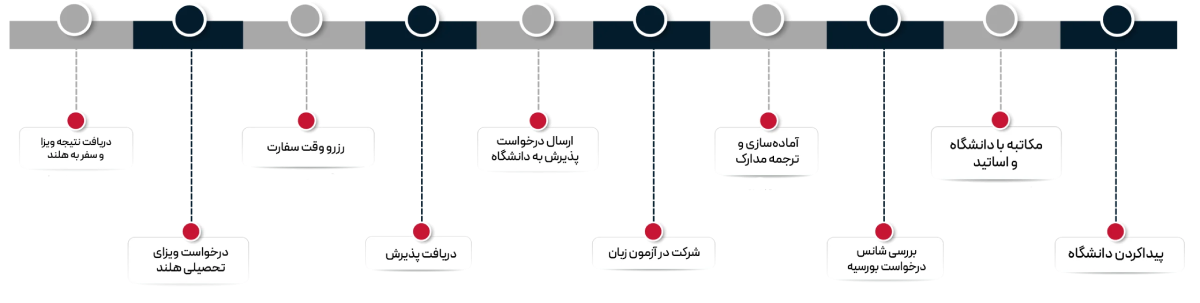
If this has convinced you and you meet the requirements, start by choosing a university on the basis of your subject and your grades, and apply before the intake deadline. The steps are as follows:
- Find a university that matches your subject and your grades
- Contact the university and academic staff, and check your chances of funding
- Prepare and translate the documents you need to apply
- Sit the language test and obtain a certificate at the required score
- Submit your application and upload your documents
- Receive a formal offer of admission
- Have the university file your MVV and residence permit application with the IND
- Collect your entry visa
- Travel to the Netherlands and collect your residence permit
Start your application to study in the Netherlands
Studying in the Netherlands combines high-quality teaching, life in Europe, a diverse student body and access to an international labour market. If it appeals to you, contact the advisers at Aval Visa to review your position, plan your route and choose a university for the coming intake.
With years of experience in European student visas and Dutch residence, we handle the paperwork with you, from completing forms and arranging appointments to obtaining letters and filing the formal applications, and we stay with you throughout the move to the Netherlands.
Frequently asked questions
- Can I study in the Netherlands without IELTS? In most cases, no. A language certificate is required to study in the Netherlands, although some universities accept alternatives.
- Can I stay in the Netherlands after I graduate? Yes. The orientation year permit lets you look for work and move on to a work permit. After five years of continuous lawful residence you can apply for permanent residence.
- Can I bring my family with me? Yes. A student can apply for dependant permits for a spouse and children under 18.
This article is general information, not legal advice, and it describes published official rules rather than any individual case.