If you are ready to move but want a destination that is inexpensive to live in and straightforward to organise, Russia deserves a look. It is one of the largest countries in the world, with a deep cultural history, vast natural resources and a cost of living well below western Europe, and it has become a realistic option for people who want to study, work or invest abroad without spending a fortune to do it.
Students go for the universities and the scholarships. Skilled workers, investors, entrepreneurs and company managers each have their own route in. This guide walks through every one of them, with the documents and the costs attached, so you can see which route your profile actually supports.
Why move to Russia?
The winters are hard and the language is harder, but people still choose Russia for reasons like these:
- A cost of living that stretches a modest budget
- Broad, cheap public transport
- Well-regarded universities in cities such as Moscow and St Petersburg
- Extensive teaching and research facilities with up-to-date equipment
- An active labour market in engineering, information technology and education
- A wide range of scholarships for international students
- Workable employment rules and varied opportunities for international students
- Permanent residence after several years of lawful residence and tax payment
With that in mind, here is what each route actually requires.
What documents do you need to move to Russia?
The conditions and the paperwork depend on the programme you choose, and the full checklist is issued once your consular appointment is booked. The table below covers the documents common to every route:
| Document | Details |
|---|---|
| Valid passport | Valid for at least 6 months after entering Russia |
| Proof of funds | Evidence of being able to cover living costs for the stay |
| No criminal record | For permanent residence and work visas |
| Physical and mental health certificate | Health or vaccination certificate |
| Health insurance | International medical insurance approved by the Russian government |
| Russian language certificate | Level B1 for some routes |
| Accommodation or tenancy documents | For the duration of the stay in Russia |
| Visa and residence fees | Depending on the type of visa applied for |
Routes to Russia
Now to the detail: how each route works, what it costs and what you need in hand before you apply.
Studying in Russia
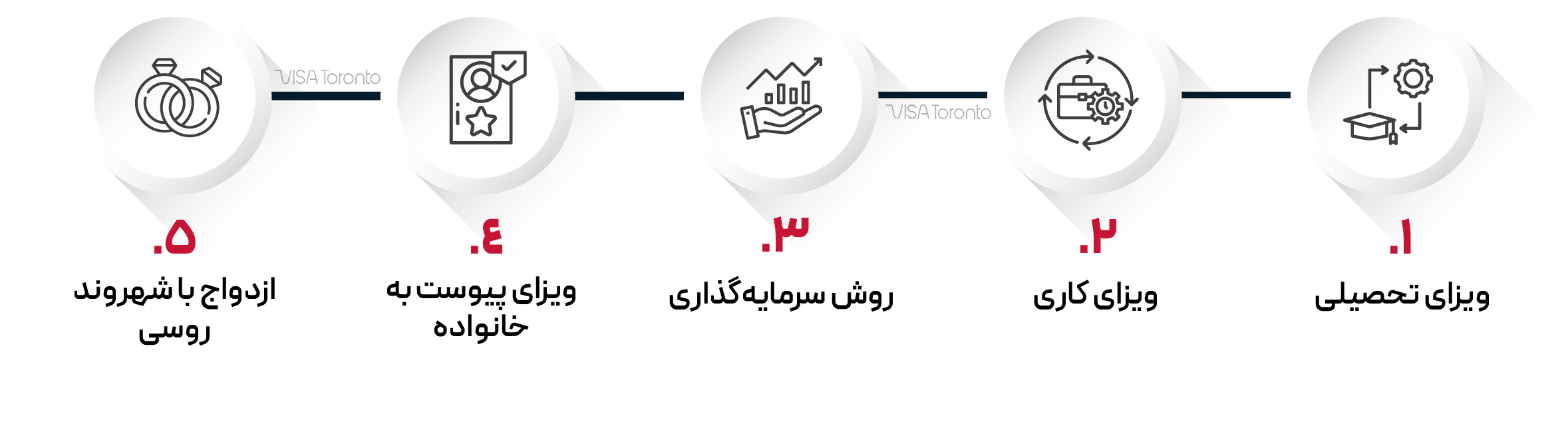
One of the fastest and most straightforward routes into the country is to win a place at a Russian university and apply for a student visa. Scholarships, admission to well-regarded institutions, modern teaching and research facilities and the right to work part-time while you study are the main reasons this route is so heavily used.
Most teaching is in Russian, but some programmes are delivered in English. For a Russian-taught programme you generally need Russian at B1 level; for an English-taught programme, expect a minimum of IELTS Academic 6.5 or TOEFL 92.
If you do not speak Russian and want to study in it, you take a preparatory language year first. Tuition runs at roughly USD 1,500 to USD 5,000 a year depending on the university and the level of the degree.
Living costs run at about USD 300 to USD 600 a month depending on the city and how you live. Moscow and St Petersburg are the expensive ones; studying in a smaller city such as Kazan brings the figure down.
You apply for admission first, on documents alone or through an entrance exam depending on the subject. With a valid offer in hand you book your consular appointment and submit the rest of the file for the student visa.
A Russian student visa is issued within about three working weeks and is initially valid for 90 days. After that it is extended to cover the length of your course. You can work part-time while you study and apply for full-time work once you graduate. From there, salaried work and tax payments open the way to a permanent residence application.
Students can work inside the university without a separate permit, but work outside it requires a work permit from the migration authority.
Practical points for international students
Before you arrive, get your Russian or English to a level you can live in, and read up on Russian law and everyday customs, because it makes the first months far easier. If you are self-funding rather than on a scholarship, do the financial planning properly and budget for tuition and living costs across the whole degree. The official study in Russia platform carries more detail.
Working in Russia
On the employment side you can apply through the standard work visa, the highly qualified specialist visa, an intra-company transfer or a temporary work permit.
The standard work visa needs one thing above all: a job offer. With an offer in hand you apply for a one-year work visa, and when the contract is renewed the visa can be renewed with it.
Legally the route is not complicated, but it is not easy either. The work is in persuading an employer to hire from abroad, and that takes time. Here is the standard work visa route in summary:
| Step | Details |
|---|---|
| Job offer | The applicant must receive a formal offer letter from a Russian employer through the GUVM. The employer must also hold a quota for hiring foreign workers |
| Work permit | The employer applies for the work permit at the Russian migration authority (MVD/FMS). The HQS route is defined by a minimum salary set in Russian law; confirm the level in force before relying on it |
| Work visa | An official invitation is sent to the applicant so they can apply at the embassy for a work visa (type D or HQS, depending on the category). Processing usually takes 4 to 8 weeks |
| Entry and registration | After arrival, the employer must register the applicant with the local migration office (GUVM) within 7 days and biometrics are taken. The work permit is then activated |
The highly qualified specialist route (HQS) is for well-paid roles: the salary has to be at least RUB 250,000 a month, roughly USD 3,000, and in exchange the visa is issued faster than the standard one. It runs for three years and covers your spouse and children.
The third option is the intra-company transfer, issued only to employees of multinational companies. Where the company has a Russian branch, a specialist can be moved into it on a transfer and hold a lawful work visa on that basis.
The last option covers temporary and seasonal work, typically short-term jobs in agriculture, hotels and similar sectors. These permits run for nine months, cover the period of the work and are not usually renewed, because the season ends with them.
Investment and entrepreneur routes
If you intend to start a business or invest in Russia, you can move with your family on that basis. Like the work routes, this side has several variants, summarised below.
The Golden Visa programme runs on three qualifying investments. The first is at least RUB 15 million into designated investment projects. The second is buying into or setting up a Russian company, registering it and trading continuously for two years.
On that second option you also have to be tax-compliant and to have paid at least RUB 4 million a year in social insurance contributions. The third option is an investment of RUB 30 million into a company that has been trading for at least three years and pays at least RUB 6 million a year in tax. All three cover the investor, a spouse and children.
Alongside the Golden Visa, property investment is a route in its own right, provided the property has been held for a year and the amount clears one of these floors:
- At least RUB 50 million invested in Moscow
- RUB 20 million in the Far East
- RUB 25 million in other regions
The property investment visa is issued for one year and can then be converted to permanent residence (PRP) without a long wait. Your spouse and children are included, and the residence requirement is six months a year on Russian soil.
The next option is the investor visa, which requires at least RUB 1 million invested in a Russian company. To use it you need a defined business plan and you register the company on the basis of that plan.
With the full document set in hand, meaning contracts, bank statements and proof of capital, you apply for a TRP, the temporary residence permit. It is issued for three years, can be renewed and can be converted to permanent residence, provided you can show the investment was made and the business plan was carried out.
This route moves comparatively quickly, with the visa usually issued within three months, and it follows a clear, documented legal path towards Russian citizenship. The decision itself always rests with the Russian authorities.
The entrepreneur visa is another way in. It starts with registering as an individual entrepreneur (IP) and needs no job offer, but you must show the capital, health insurance and tax receipts behind the business. It offers:
- Lawful residence while you build the business
- A path from temporary to permanent residence through trading activity and tax payments
The newest option is the Shared Values Visa, open since 2024 to people relocating on cultural grounds, which carries no language test. The table below summarises the investment routes side by side:
| Route | Initial investment | TRP/PRP term | Annual presence | Path to citizenship |
|---|---|---|---|---|
| No officially branded golden visa in Russia | Investment-linked residence exists under Russian migration law; thresholds to be confirmed against current rules | - | - | - |
| Investor Visa | From RUB 1m | TRP up to 3 years | Per TRP | After permanent residence |
| Entrepreneur Visa | Depends on the type of business | TRP, renewable | Per TRP | Same as the investor route |
| Shared Values Visa | No investment | TRP 3 years | Per TRP | After PRP |
Family routes
Family reunification and marriage are the fastest and simplest ways into Russia. A family member already living there lawfully can sponsor an invitation for the rest of the family. If your spouse is a Russian citizen, you can apply for a marriage visa through them and then for residence as a family member.
The steps, in order
Start by matching the route to what you actually have: your funds, your qualifications and what you want the move to achieve. Then work through the plan below. For current rules and consular news, the guide to Russian visa policy is worth checking as you go.

Comparing life in Russia’s main cities
| City | Monthly cost of living | Advantages | Drawbacks |
|---|---|---|---|
| Moscow | USD 700 to 1,200 | Strong job opportunities, excellent transport system | Most expensive city in Russia |
| Saint Petersburg | USD 500 to 900 | Cultural, touristic, well-regarded universities | Humid weather and hard winters |
| Novosibirsk | USD 350 to 600 | Quiet, well suited to studying | Limited job opportunities |
| Kazan | USD 400 to 700 | Student city, cheaper than Moscow | Smaller job market |
| Sochi | USD 450 to 800 | Mild climate, popular for investment | Not industrial |
Make the move a decision, not a gamble
Choosing a route means being honest about your funds, your profession and what you want the next ten years to look like. Get that part right and the paperwork follows. If you are also weighing up other European destinations, the team at Aval Visa has years of experience with student and startup files and will tell you plainly which route your profile supports. We assess your case, open the file properly, prepare and check every document and take you through to the consular appointment. Talk to us and start the process today.
Frequently asked questions
- What does it cost to live in Russia? New arrivals typically spend between USD 350 and USD 800 a month depending on the city, and more than that if you live on a larger scale.
- Can you move without speaking Russian? Some universities and international companies operate in English, so you can start without it. For daily life outside that bubble, learning Russian is not optional.
- Which Russian city suits newcomers best? Moscow and St Petersburg are the usual choices, for their international communities, respected universities and the range of work available.