When people talk about the best and most respected universities in the world, the University of Oxford is always among the top five. It admits only the strongest applicants, with high grades and high language scores.
For students who meet that bar and want to start a serious academic and professional career, Oxford is a sound choice. What follows covers the UK student visa, the university’s history, entry requirements, tuition, subjects, scholarships and the steps to an offer.
About the University of Oxford
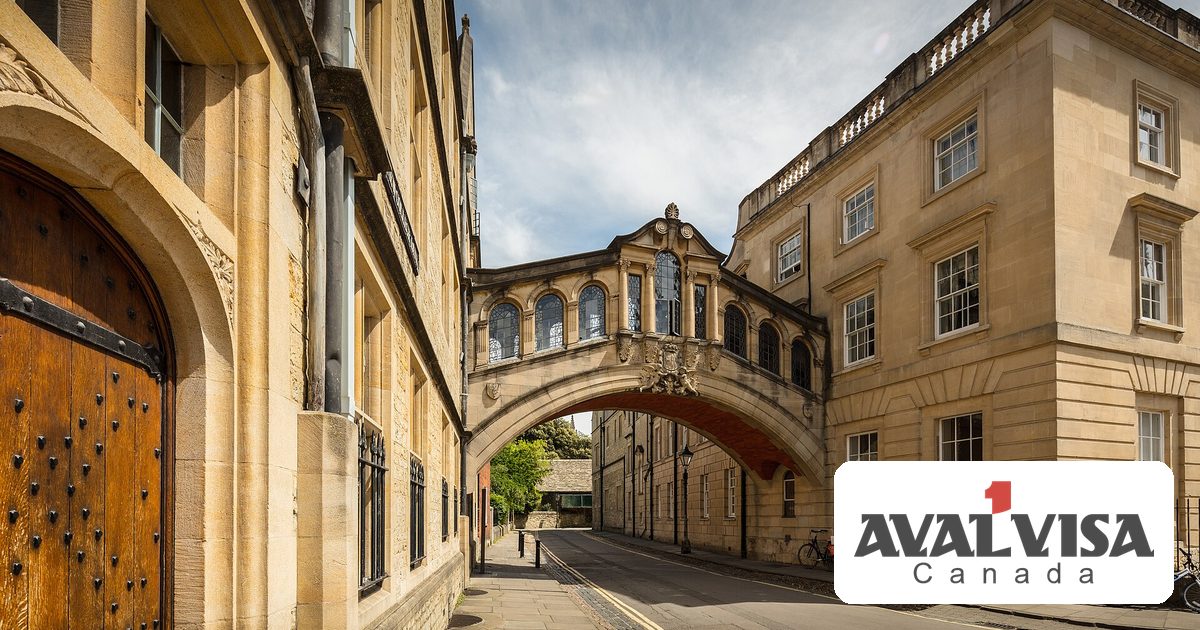
The University of Oxford is consistently ranked among the top five universities in the world. Teaching there dates back to 1096, and the university takes its name from the city it occupies. It is made up of a central university with its academic divisions and faculties, together with a number of self-governing colleges and permanent private halls, covering the full range of subjects; the university’s own website lists the current colleges. Around 45 percent of its students come from outside the United Kingdom.
Oxford is the oldest university in the English-speaking world. In the medieval period it was one of Europe’s leading centres of learning, and its influence was such that in 1209 a group of scholars left after a dispute with local townspeople and founded another of the world’s great universities: Cambridge.
Oxford has held a central place in the scientific, philosophical and political life of Britain and beyond, and its graduates have consistently ended up among the most prominent figures in public life. Its alumni include:
- 30 British prime ministers
- More than 70 Nobel laureates
- A long list of internationally known figures in literature and politics
That record is part of what this old centre of research and teaching is known for.
Documents required for an Oxford offer
An Oxford offer, and then moving to the United Kingdom, is not within everyone’s reach. Anyone hoping to study here needs high grades and a strong language score: A-level grades at the top of the range, and an IELTS Academic score at the level the course you apply for requires. The table below sets out the documents you need for an offer:
| Document | Level | Notes |
|---|---|---|
| Application form (UCAS) | Bachelor's and master's | UCAS form for undergraduate study; master's through Oxford's own application system |
| English language certificate (IELTS/TOEFL) | Bachelor's and master's | Academic IELTS minimum 7 TOEFL minimum 100 |
| Previous academic qualifications | Bachelor's and master's | Certified translation of transcripts + high school diploma for undergraduate, bachelor's degree for master's |
| CV | Master's and some bachelor's courses | A CV must be submitted |
| Personal statement | Bachelor's and master's | Explains motivation, interests, academic and career goals |
| Recommendation letters | Usually 2 letters | |
| Portfolio | Depends on the course | For arts subjects such as fine art, design, architecture |
| Subject admissions test | Bachelor's | Some courses such as medicine, law, philosophy and economics require admissions tests: UCAT for medicine (the BMAT has been discontinued), LNAT for law, TSA for philosophy and economics |
| Research proposal | Master's and PhD | For research-based and PhD programmes |
| Identity document | All levels | An identity document must be submitted |
| Application fee | Master's | GBP 75 |
How to apply to Oxford
For undergraduate admission, start by choosing your course, and note that some courses require an admissions test, such as the UCAT for Medicine, the LNAT for Law, and the TSA for courses including economics, philosophy and politics. You have to reach the required standard in these.
Undergraduate applications go through UCAS only, and the deadline for international applicants is normally 15 October for entry the following autumn.
Once your documents are in and you have sat the required tests, you wait for the university’s decision on whether to invite you to interview. Interviews are usually held in December, and offers are issued by January. That leaves enough time to book an appointment and start the student visa process.
Postgraduate admission works differently. For a master’s or a doctorate you need to check the entry requirements, the documents, the course details, the fees and any funding options on the university’s own pages, and to have a CV or a portfolio depending on the subject.
Once your documents are ready and you begin your application in Oxford’s online system, you pay the GBP 75 application fee in the Graduate Application Portal and, where the department requires it, sit an admissions test or attend an interview.
Once you have an offer, prepare your documents against the student visa checklist, book an appointment and complete your biometrics and visa application.

The cost of studying at Oxford
| Level | Student status | Annual tuition (GBP) |
|---|---|---|
| Undergraduate | International students | GBP 35,000 to 59,000 |
| Master's | GBP 25,000 to 45,000 depending on the subject | |
| MBA programmes | GBP 94,120 (2027-28 intake, fee for the whole one-year programme) | |
| Medical sciences | GBP 43,000 to 57,000 | |
| Doctorate | GBP 24,000 to 45,000 |
Scholarships for international students
International students who meet the university’s criteria can apply for the following:
- Clarendon Scholarship, a full award for master’s and doctoral study
- Rhodes Scholarship, open to applicants from a defined set of countries and regions
- Reach Oxford Scholarship, for undergraduate students from low-income countries
- Jardine, Weidenfeld, Ertegun and other awards from foundations and individual colleges
For the full list, see the University of Oxford scholarships page.
Applying for a UK student visa
To study at Oxford or any other UK university you need to apply for the UK Student visa, the route that replaced Tier 4. It covers undergraduate, master’s and doctoral study and is open to applicants aged 16 and over. Once you have booked your appointment, prepare and submit the following:
- Proof of financial means, if you are not funded
- A formal offer of a place
- An English language certificate
- Original and translated academic certificates
- Original and translated transcripts
- Your CAS reference from the university
- The completed online Student visa application
Students can invite their parents to visit and apply for a UK visitor visa for the trip.
Student living costs in Oxford
| Expense | Monthly cost (GBP) | Annual cost (GBP) |
|---|---|---|
| Food | GBP 300 to 500 | GBP 3,000 to 6,000 |
| Housing | GBP 700 to 900 | GBP 9,000 to 11,500 |
| Personal purchases | GBP 200 to 350 | GBP 2,000 to 4,000 |
| Social activities | GBP 40 to 100 | GBP 500 to 1,500 |
| Extras and leisure | Varies with lifestyle | Varies with lifestyle |
Subjects at the University of Oxford
Oxford has faculties and colleges covering every field of study, including:
- Law and legal studies
- Social sciences
- Humanities
- Natural sciences
- Theology
- Medical sciences
- Computer science
- Engineering
- Philosophy, politics and economics
- English language and literature
- Interdisciplinary programmes in international studies and related fields

Applying for a UK visa with Aval Visa
If you plan to study in the United Kingdom, hold strong grades and meet the English language requirement your course sets, the University of Oxford is one of the best options for your academic development and your career.
Competition for a place at Oxford is intense, but with careful planning, professional advice and thorough preparation you can put forward a serious application. The team at Aval Visa works alongside you on the offer itself, the appointment booking, your CV and the administrative work that goes with it.
Frequently asked questions
- Can I get an Oxford offer without an admissions test? For most subjects, no. The majority of undergraduate courses require a subject-specific admissions test, and competition for places is very high.
- What IELTS score does Oxford require? Oxford sets its English language requirement at one of two levels depending on the course, so check the requirement listed for the course you want before you apply.
- Are scholarships available to international students? Yes. Most awards are aimed at master’s and doctoral applicants, and some undergraduate schemes exist for students from specific countries.
This article is general information, not legal advice, and it describes published official rules rather than any individual case.