Studying medicine in Canada is a goal for many international students who are also thinking about immigrating to Canada. The teaching is strong, the universities are well regarded internationally, and physicians are in demand across most provinces.
There is a hard fact to state at the outset. Canadian medical schools are among the most restricted programs in the country for international applicants. Several faculties, including the University of British Columbia and McMaster, admit only Canadian citizens and permanent residents to the MD program. The Quebec French-language faculties give priority to Quebec residents and hold only a small number of international seats under intergovernmental agreements. A few schools, including the University of Toronto and McGill, do admit a small number of international students each year. This article sets out the full path, the entrance tests, the documents and the licensing steps, so you can judge realistically whether it is a route worth pursuing.
This page is about studying medicine in Canada. If you have already qualified as a physician and hold a licence to practise, the route you want is the Nova Scotia Defined licence route for doctors who already qualified — it does not require the MCCQE, the NAC OSCE or a CaRMS match.
Requirements for studying medicine in Canada
It is worth saying plainly that studying medicine in Canada is difficult and the competition is severe. International applicants need a recognised English or French language test result, and in practice they also need a very strong academic record before a faculty will consider the file.
The path to practising medicine in Canada has three main stages:
- An undergraduate degree, usually in the sciences
- The MD program (Doctor of Medicine)
- Residency training in a chosen specialty
The undergraduate degree takes three to four years and the MD program takes four years at most schools. Residency then takes between two and seven years depending on the specialty, with family medicine at the short end and surgical specialties at the long end. Most applicants complete a bachelor’s degree in a science subject such as:
- Biology
- Chemistry
- Physics
and then sit the MCAT. The MCAT is the standard entrance test for most English-language Canadian medical schools, and without a competitive score your file will not be considered at those schools.
Once admitted, you begin the four-year MD program, which combines classroom teaching with clinical placements. After the MD you enter residency, which lasts from two to seven years.
That is the outline of the route. Note that in Canada, unlike many countries, you cannot enter medical school directly from secondary school. You complete an undergraduate degree first, then apply to the MD program with your grades, your MCAT score and the rest of your file.
Competition for medical school places in Canada is intense, and international seats are the scarcest of all. Careful planning and accurate immigration advice from someone who knows the Canadian system will not change an admissions decision, but it will keep your study permit application clean and your timeline realistic.
Related reading: the steps involved in obtaining a Canadian study permit.
Documents required to study medicine in Canada
With the route set out, here is what an applicant is normally asked to provide for a medical program in Canada:
| Document | Details |
|---|---|
| Transcripts and diplomas from previous studies | Originals and certified translations |
| English or French language results | IELTS Academic 7 or higher TOEFL 100 or higher DELF or DALF for French-language universities |
| MCAT score | Assesses the applicant's academic and analytical ability |
| Letters of recommendation | Two or three letters from university faculty or recognized physicians |
| Resume | Full history and details |
| Statement of purpose | Explains the applicant's motivation and academic goals |
| CASPer test result | Online assessment of social, ethical and decision-making skills, required by some universities |
| Identity documents | Originals and certified translations |
| Completed visa application forms | All fields must be completed |
| Visa fee payment | Study permit processing CAD 150 + biometrics CAD 85 |
| Receipt for application fee and tuition payment | Varies by university |
Entrance examinations for medicine in Canada
Admission to medicine in Canada is not decided on documents alone. There are entrance assessments at several points in the process, and each one screens out a large share of applicants.
The first is the Medical College Admission Test, better known as the MCAT. It measures knowledge in biology, chemistry and physics, along with critical analysis and reasoning. A competitive MCAT score is a prerequisite for most English-language MD programs.
The second is CASPer, an online situational judgement test that assesses communication, ethical reasoning and decision-making (Computer-Based Assessment for Sampling Personal Characteristics). Many Canadian faculties treat the CASPer result as part of the selection decision.
The third stage, for applicants who clear the first two, is the interview, which the faculty invites you to. Most Canadian schools use the multiple mini interview (MMI) format, a series of short stations designed to assess communication and clinical judgement rather than factual recall.
Read more: A step-by-step guide to immigrating to Canada as a nurse

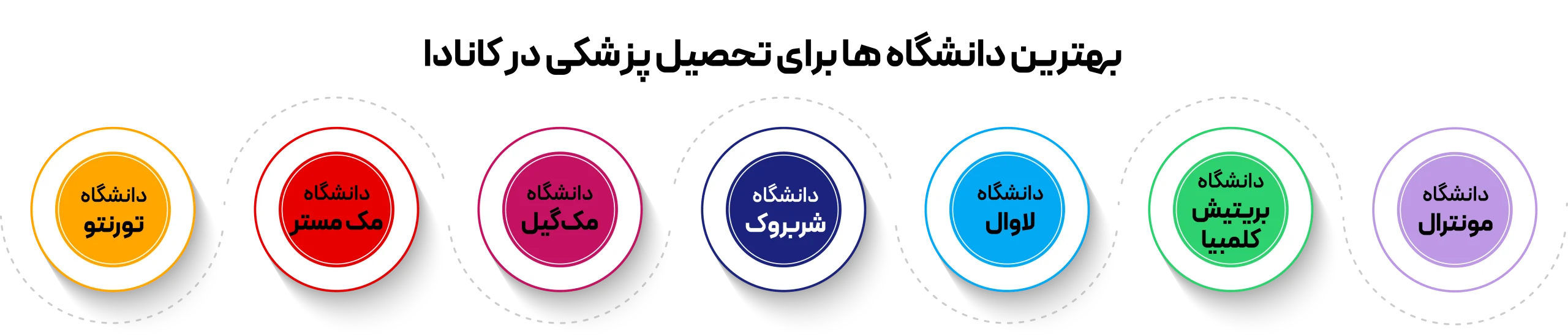
The best universities for studying medicine in Canada
With the entry requirements clear, here is a look at the leading medical schools in Canada and what each one expects. Check each faculty’s admissions page for its current policy on international applicants before you invest time in an application, because those policies change and several schools are closed to international students entirely.
Canadian medical faculties are internationally recognised and hold high teaching standards, which is exactly why competition for their limited seats is so severe.
If you study in French, the three Quebec faculties below are the ones to look at, though all three prioritise Quebec residents. After those, the English-language schools follow, led by the University of Toronto.
Universite de Montreal
Universite de Montreal is one of the most respected French-language universities in Canada and ranks around 100th in the major global league tables. Its medical programs are well funded and research-intensive, and admission is very restricted, with priority given to Quebec residents.
University website: https://www.umontreal.ca/en/
Universite Laval
Universite Laval is one of the oldest medical faculties in Quebec City. Teaching is in French and applicants need a high-level French result, typically DELF B2 or DALF C1. Laval does not require the MCAT, but its seats are allocated mainly to Quebec residents, so the absence of an MCAT requirement does not make it an easier route for international applicants.
University website: https://www.ulaval.ca/en
Universite de Sherbrooke
The third French-language option for studying medicine in Canada is Universite de Sherbrooke. It is known for its teaching quality, its research facilities and its close links with the regional health network.
Students at Sherbrooke enter clinical settings early and build practical skills alongside their classroom work. The MD program runs for four years: two years of pre-clinical teaching covering basic medical sciences, physiology, biochemistry and introductory clinical subjects, followed by two years of clinical clerkship in the hospitals and clinics affiliated with the university.
University website: https://www.usherbrooke.ca/
University of Toronto
The University of Toronto ranks in the global top 20 and its medical faculty is one of the best known in the world. The MD program runs for four years and places particular weight on evidence-based learning and research. Students enter clinical environments from the first year.
An MCAT score is required, and successful applicants generally score well above the mean in each section. Language requirements are typically IELTS 7.5 or TOEFL 100. Toronto is one of the few Canadian faculties that admits international students to the MD program, and the number of seats is small. International tuition for medicine has been in the region of CAD 60,000 a year and rises over time, so confirm the current figure with the faculty.
University website: https://www.utoronto.ca/
McGill University
McGill, in Montreal, ranks in the global top 30 and runs its medical program in English. The MD curriculum introduces clinical teaching alongside classroom work from early in the program. Entry requirements are broadly comparable to those of the other leading faculties, and McGill admits a small number of international students. International tuition for medicine has been in the range of CAD 47,000 to CAD 50,000 a year. Tuition is reviewed annually, so treat that as a starting point rather than a fixed figure.
University website: https://www.mcgill.ca/
University of British Columbia
The University of British Columbia in Vancouver runs one of the largest medical faculties in Canada and ranks in the global top 40. Its program has a strong community and distributed-site focus, with training delivered across several regions of the province. The MD program runs for four years and requires the MCAT. Note that UBC admits only Canadian citizens and permanent residents to the MD program, so it is not an entry route for international applicants. Points worth knowing about UBC medicine:
- Domestic tuition is set by the province; the faculty publishes current fees each year
- Training placements in both rural and urban settings
- Access to strong research facilities
- Close integration with a large hospital network
in short, it is an excellent program that international students cannot apply to directly.
University website: https://www.ubc.ca/
McMaster University
The last of the group is McMaster University in Hamilton, Ontario, known for its innovation in medical education. McMaster pioneered problem-based learning and runs a three-year MD program with no summer breaks, so students reach clinical work sooner. Like UBC, McMaster admits only Canadian citizens and permanent residents to the MD program.
University website: https://www.mcmaster.ca/
After the MD: residency, licensing and immigration status
Graduating from a Canadian MD program is the start of the professional path, not the end of it. After the four-year program you enter residency, which lasts two to seven years depending on the specialty. Residency positions are matched through CaRMS, and the competition is severe. International medical graduates compete in a separate stream with far fewer positions than the stream for Canadian medical graduates.
Certification is handled by the Medical Council of Canada and the specialty colleges. The MCCQE Part I is the qualifying examination all candidates take; the former MCCQE Part II was discontinued and is no longer administered. The NAC OSCE applies to international medical graduates seeking a Canadian residency position, not to graduates of Canadian MD programs. Final licensure is granted by the medical regulatory college of the province where you intend to practise, and each province sets its own requirements.
On the immigration side, graduates of an eligible Canadian program may apply for a post-graduation work permit, which is a separate work permit rather than a conversion of the study permit. Its length depends on the length of the program and the eligibility rules in force when you apply. Residency itself is generally carried out under a work permit.
Skilled work experience in Canada can support a later permanent residence application through Express Entry or a provincial program. There is no automatic route: each application is assessed on its own merits and IRCC decides. Physicians who trained in Canada generally have an easier licensing path than those who trained abroad, which in turn makes the work and permanent residence route more straightforward.
Read more: A complete guide to immigrating to Canada as a dentist
Canadian study permits with Aval Visa
Studying medicine in Canada is one of the hardest academic routes into the country, and for the small number who complete it, one of the most rewarding. The faculties hold high standards, physicians are in demand, and Canadian-trained graduates have a clearer licensing path than internationally trained physicians. The constraint is capacity: seats for international students are very few, and several faculties do not admit international students at all.
If you are planning to study in Canada, the Aval Visa team advises on the study permit side: which programs and institutions fit your profile, how to document funds and ties, and how to present a complete application. Admission decisions rest with the university, and the study permit decision rests with IRCC. Contact the office for a consultation.
Frequently asked questions
- Can international students get into medical school in Canada? A small number can. Several faculties, including UBC and McMaster, are closed to international applicants entirely. A few, including the University of Toronto and McGill, hold a handful of international seats each year and competition for them is extreme. The Quebec French-language faculties prioritise Quebec residents.
- Do the French-language faculties require the MCAT? No. Laval, Montreal and Sherbrooke do not use the MCAT. They do require a high level of French, and their seats are allocated primarily to Quebec residents.
- Are there scholarships for international medical students in Canada? Funding for MD programs is limited and highly competitive. Some Quebec faculties and private foundations offer partial awards to outstanding students, but full funding for an international MD student is rare. Budget on the assumption that you will pay international tuition in full.
Official source: Association of Faculties of Medicine of Canada — applying to medical school
This article is general information, not legal advice, and it describes published official rules rather than any individual case. Hadi Imani is a Regulated Canadian Immigration Consultant, licence R522575, practising in Toronto; that licence covers Canadian immigration only.