Biometrics are a routine but unavoidable step in almost every Canadian immigration application, and they are one of the parts applicants most often get wrong. The process itself is short: an officer scans your fingerprints and takes a digital photograph so that IRCC can confirm you are who you say you are. If biometrics are required and you do not give them by the deadline, your application is incomplete and can be refused on that basis alone. This guide explains who has to give biometrics, where to do it, what it costs and what happens afterwards.
What are Canada biometrics, and who has to give them?
Canada biometrics means two things: your ten fingerprints and a photograph of your face. Immigration, Refugees and Citizenship Canada (IRCC) collects them to verify your identity and to screen your file against immigration and security databases. Unless you are exempt, you will need to give fingerprints and a photo when you apply for:
- Temporary residence, including visitor visas, study permits and work permits (United States citizens are exempt)
- Permanent residence
- An extension of your status inside Canada, if you are not exempt
- Refugee protection or asylum
Since 2018 the biometrics programme has covered every applicant for a temporary resident visa, work permit, study permit or temporary resident permit other than United States citizens, and every applicant for Canadian permanent residence.
If you apply for a work permit, study permit or temporary resident document at a port of entry, the border services officer may collect your biometrics there.
The main exemptions from Canada biometrics are:
- Children under 14
- Applicants over 79, except asylum claimants, for whom there is no upper age exemption
- Heads of state and government, cabinet ministers and accredited diplomats travelling on official business
- Visa-required travellers who hold a valid United States visa and are only transiting through a Canadian airport
- Protected persons and refugee claimants who already gave biometrics and are now applying for a work or study permit
- Temporary residence applicants whose previous biometrics are still valid
For temporary residence, biometrics stay valid for 10 years from the day you gave them. Within that window you normally do not have to repeat them for another temporary residence application. Permanent residence applications are treated separately, so plan on giving biometrics again when you apply for PR.
What is fingerprinting for a Canadian police check?
The Royal Canadian Mounted Police (RCMP) holds Canada’s national criminal record database. Some immigration programmes, and some individual requests from an officer, ask you to be fingerprinted at an accredited agency so that your record can be checked properly.
- This kind of fingerprinting is administrative, not criminal. It is used only to search the record.
- The prints are submitted electronically to the CPIC database.
- If nothing is found, a police certificate confirming no record is issued.
- If a record exists, the full result is returned to you.
Now that both terms are defined, here is how they compare.
Biometrics vs fingerprinting for a Canadian visa
An application to immigrate to Canada may require both, but they are not the same thing and they are not done in the same place.
| Feature | Biometrics | Police Fingerprinting |
|---|---|---|
| Purpose | Identity verification in the immigration process | Criminal record check by Canada's federal police |
| What information is collected? | Fingerprints + facial photograph | Fingerprints (a photograph may also be taken) |
| Where is it done? | Visa Application Centre if outside Canada; Application Support Centre in the United States; designated Service Canada office if inside Canada | RCMP-accredited agencies |
| Which body reviews it? | Immigration, Refugees and Citizenship Canada | Royal Canadian Mounted Police |
| Final output | Identity confirmed for issuing a visa or status document | Police certificate or criminal record report |
| How data is recorded | Digital scan of fingerprints and photograph | Digital fingerprint capture sent to the police database |
| When it is required | Required for most visa and residence applications | Only in specific cases, such as a police certificate request or a particular immigration program |
Which one do you actually need?
Most immigration files need both: biometrics for the immigration application itself, and RCMP fingerprinting for the criminal record check. The only reliable way to know what applies to you is to read the instructions IRCC sends you, letter by letter.
- If you are asked to give biometrics and you are inside Canada, you book at a designated Service Canada site.
- If you need an RCMP criminal record check, you go to an accredited fingerprinting agency and are printed there.
Where to give biometrics for a Canadian visa
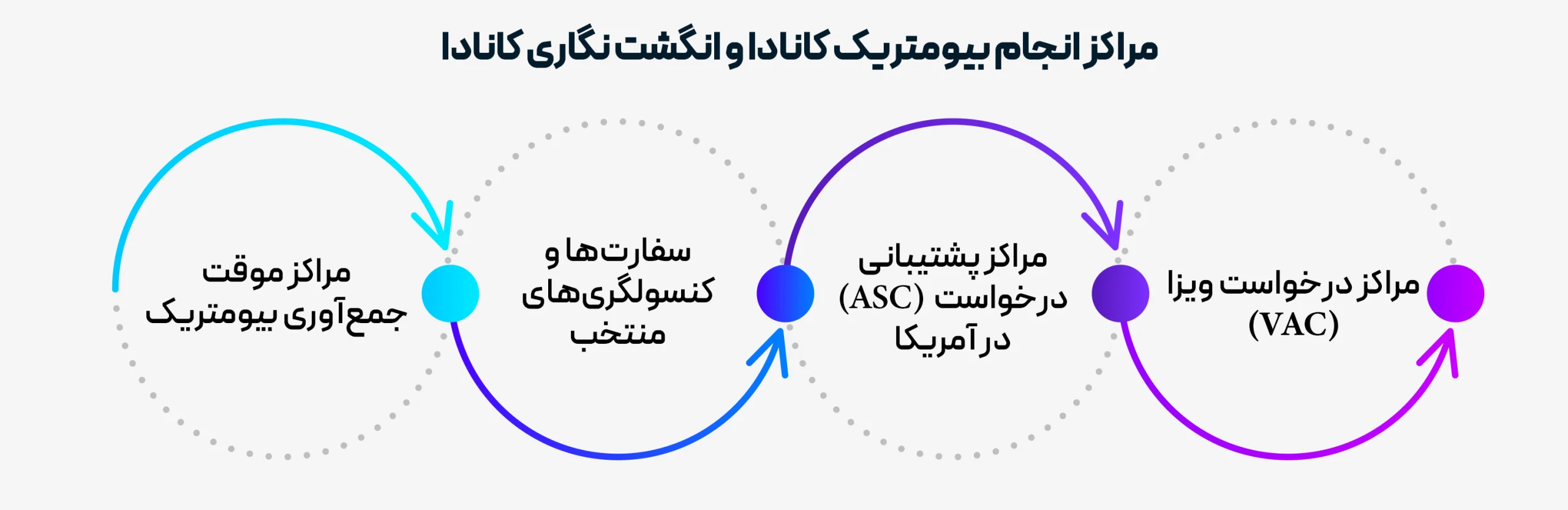
Biometrics can only be collected at an authorised location, so knowing which sites are open to you saves time and travel. The recognised options are these.
Visa Application Centres (VAC)
VACs are the most common place to give biometrics and they operate in most countries. Book through the VAC that serves your country and check that it is listed by IRCC before you travel to it.
Application Support Centers (ASC) in the United States
If you are in the United States, you give biometrics at a USCIS Application Support Center. These are spread across the country and you must book an appointment before you attend.
Selected embassies and consulates
Some Canadian embassies and consulates collect biometrics, usually in countries where no VAC operates. Confirm that the office offers the service before you make travel plans.
Temporary collection sites
In busy periods IRCC sometimes opens temporary biometric collection sites. They are announced on the IRCC website and can be useful where permanent sites are far away or fully booked.
How long the biometrics appointment takes
The appointment itself usually runs 15 to 30 minutes. How long the information takes to reach your file and be processed varies, and depends on:
- The volume of applications being handled
- How many collection sites are operating
- How far ahead appointments are booked
- Technical problems with the fingerprint or camera equipment
After you give biometrics, IRCC needs time to load and process the data. Track your file through your IRCC online account rather than assuming a fixed timeline.
What if there is no VAC in your country?
IRCC allows you to give biometrics at a VAC in another country if there is no VAC where you applied from. Canada does not have a visa office or collection site everywhere, and in some countries the service has been suspended entirely.
If that applies to you, the practical questions are:
- Which nearby countries you can enter, and on what visa
- What the travel will cost
- How far out that VAC is booking appointments
- Whether your biometric instruction letter deadline allows the trip
Distance is rarely the deciding factor. Entry rules for the country you would travel to, and the appointment backlog at that VAC, usually matter more.
Step-by-step: giving Canada biometrics
If you are applying for a visitor visa, a work or study permit, or permanent residence, biometrics are part of the file. Here is the sequence from start to finish.
Step 1: Check whether biometrics are required
Confirm that your application type calls for biometrics. The IRCC website sets this out by application type and by country. Most visitor, study and work permit applicants have to give them, so assume you will unless you fall into one of the exemptions above.
Step 2: Submit the application
Submit your application online or on paper and pay the fees. IRCC then sends a biometric instruction letter (BIL), normally by email. The BIL tells you where you may attend, what the deadline is and what to bring. Nothing can be booked before it arrives.
Step 3: Book the appointment
Once you have the BIL, book an appointment at an authorised collection site. Book early. In busy periods appointments at some VACs are weeks out, and the BIL deadline does not move to accommodate that.
Step 4: Get the documents together
Bring the following to the appointment:
- Your biometric instruction letter (BIL)
- A valid passport
- Proof that the fees were paid, if you have it
- A second government-issued photo identity document, such as a driving licence or national identity card
Step 5: Attend and give your biometrics
Arrive at least 15 minutes early for check-in. Your fingerprints are scanned electronically and a digital photograph is taken. Make sure your hands are clean and free of henna, ink, cuts or bandages, since these can interfere with the scan. For the photograph, keep a neutral expression and remove head coverings unless they are worn for religious reasons.

Step 6: Keep the confirmation receipt
You are given a receipt confirming that biometrics were collected. Keep it until the application is decided, and keep a copy. IRCC then continues processing your file and may ask for further documents or an interview. Updates come by email and through your IRCC account.
How to check whether your biometrics are still valid
If you gave biometrics before, you may not need to give them again. IRCC runs an online biometric validity check that tells you the expiry date. Two points before you use it:
- The information you enter is protected under the Privacy Act.
- The connection between your device and the service is encrypted, so use a current browser that supports it.
To use the service you must accept the terms covering privacy and data security. Select the option confirming you accept them to continue.
How long IRCC keeps your biometrics
Retention depends on the kind of application you made.
Visitor visa, study permit and work permit applicants:
Fingerprints and the photograph are held for 15 years from the date they were given. If the application is refused on serious security grounds, for human or international rights violations, or for serious or organised criminality, the data is held until you turn 100.
Permanent residence applicants:
- If the application is approved, the biometrics are held until you turn 80.
- If you later become a Canadian citizen, the fingerprints and photograph are deleted.
If the application is refused:
- Refusal on serious security grounds, rights violations or serious criminality: held until age 100.
- Refusal for misrepresentation: held for 10 years.
- Refusal on medical, financial or non-compliance grounds: held for 5 years.
- Incomplete or withdrawn application: held for 5 years.
Refugee claimants:
Fingerprints and the photograph are held until age 100.
Canada biometrics fee
The biometrics fee is CAD 85 per person. A family applying at the same time pays a maximum of CAD 170. Groups of three or more performing artists and their staff applying together for work permits pay a maximum of CAD 255. The fee is paid with the application fees, not at the collection site, and IRCC revises published fees from time to time, so confirm the current amount before you pay.
What happens after you give biometrics
Your fingerprints and photograph are sent to IRCC and matched against your file to confirm your identity. The application then continues through assessment, and an officer may ask for more documents. The biometrics are also used for security and criminal record screening, which can add time.
Updates are sent by email and posted in your IRCC account. When a decision is made you are notified, and if the application is approved you are told what the next step is, such as sending your passport for visa issuance. The decision itself rests entirely with IRCC.
Frequently asked questions
1. What happens at the photograph if I wear a head covering for religious or cultural reasons?
The photograph has to show your full face clearly. You may ask to be photographed by an operator of the same gender, and you may ask for a screen or a private area for the photograph.
2. Why does Canada collect biometrics and fingerprints at all?
To confirm that you are the person named in the application, and to check that identity against immigration and criminal record databases. It also lets officers assess the file with more reliable information.
3. Do biometric checks make border waits longer?
Automated fingerprint verification at Canada’s larger airports helps the Canada Border Services Agency handle high passenger volumes and is intended to keep processing times down rather than increase them.
4. How long after biometrics does a Canadian visa decision take?
IRCC publishes processing times by application type and by country, and those figures change regularly. The published time is measured from the date a complete application is received and already includes the time needed for biometrics, so the clock does not restart on the day you are fingerprinted. No processing time is a promise; IRCC decides each application on its own facts.
This article is general information, not legal advice, and it describes published official rules rather than any individual case. Hadi Imani is a Regulated Canadian Immigration Consultant, licence R522575, practising in Toronto; that licence covers Canadian immigration only.