
Driving in France, whether you are a citizen or a resident who has moved to France, means dealing with a defined set of rules and a precise administrative process. Issuing, exchanging or renewing a driving licence depends on your nationality, the type of licence you hold and how long you have been resident.
For many foreign nationals, obtaining or exchanging a French driving licence can look daunting. The process is not only a legal formality; following it correctly is what keeps you a valid driver in the French system.
In this article, Aval Visa sets out the points that matter most about the French driving licence.
Categories of French driving licence
| Category | Vehicle type | Main requirements |
|---|---|---|
| A1 | Scooter or light motorcycle (up to 125 cc and 11 kW) | Minimum age 16; ASSR or ASR certificate |
| A2 | Two-wheel motorcycle (up to 35 kW) | Minimum age 18; ASSR or ASR certificate |
| A | Any 2- or 3-wheel motorcycle above the A2 limit of 35 kW, with no power restriction | Minimum age as set in the code de la route (see service-public.gouv.fr); category A2 held for at least 2 years; 7 hours of mandatory training |
| B1 | Heavy quadricycle | Minimum age 16; ASSR or ASR certificate |
| C | Heavy goods vehicles - category defined in the code de la route; check service-public.gouv.fr | Minimum age 21 (except within vocational training); category B licence |
| C1 | Vehicles between 3.5 and 7.5 t | Minimum age 18 (except within vocational training); category B licence |
| D | Passenger vehicles with more than 9 seats (driver included) | Minimum age as set in the code de la route (see service-public.gouv.fr); category B licence |
| D1 | Passenger vehicles with up to 17 seats and a maximum length of 8 m | Minimum age 21 (except within vocational training); category B licence |
Note: any category carrying the suffix “E” allows you to drive that vehicle with a trailer weighing more than 750 kg.
Conditions for obtaining a French driving licence
Obtaining a driving licence in France means following a defined process and meeting certain legal requirements. Knowing them in advance, particularly if you are a new arrival or an international student, saves both time and money. To obtain a licence in France you must meet the following conditions:
- Minimum age: for a category B licence (cars) you must be at least 18. Other categories, such as motorcycles or heavy vehicles, have different age thresholds.
- Legal residence in France: you must hold legal residence, a residence card or a valid long-stay visa.
- Command of French: you need to understand the language to sit the theory test.
- Medical certificate: a medical certificate is required, particularly for professional vehicles such as lorries and buses.
Steps to obtain a French driving licence
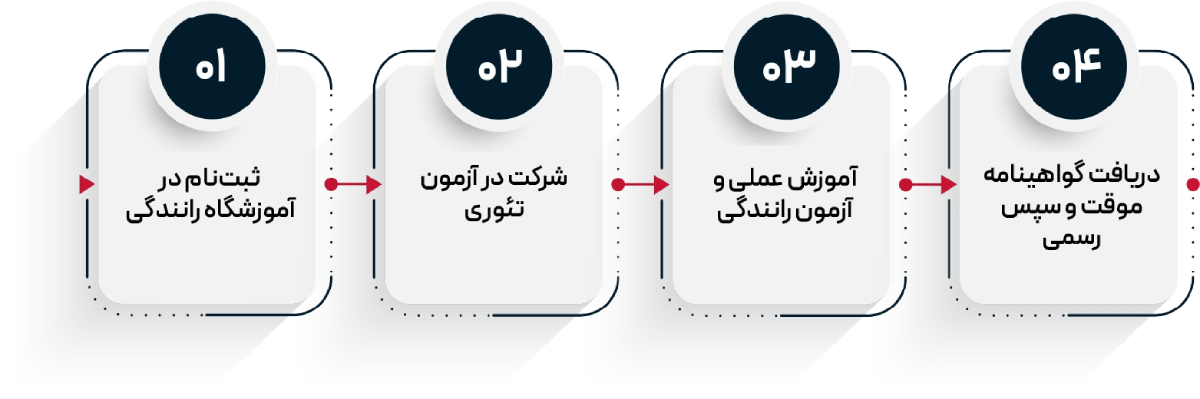
How do you actually get a French driving licence? The steps are set out below.
Step one: register with a driving school
First, register with an approved driving school. These schools run both the theory course (the code) and the practical lessons. Some offer intensive courses or classes in English.
Step two: sit the theory test
At this stage you sit the written theory test on French road law. It consists of around 40 multiple-choice questions, and the pass mark is 35 correct answers.
Read more: A full guide to the cost of moving to France
Step three: practical training and the driving test
Once you have passed the theory test, you move on to practical training. A minimum of 20 hours of instruction with a qualified instructor is compulsory. After that you can sit the practical test, which takes place with an official examiner and assesses your driving skill, your attention, your control of the vehicle and your compliance with traffic rules.
Step four: temporary licence, then the permanent one
If you pass the practical test, a temporary licence is issued, and a few weeks later the permanent licence is sent to your address. A category B licence is valid for 15 years.
The first application for a licence is free of charge and takes about 5 working days.
The French driving test
To obtain a French driving licence you have to pass both the theory test and the practical test. Applicants with a disability or a particular medical condition may need a medical examination with a registered doctor; that assessment is valid for two years.
French driving tests are demanding: only 59.2 per cent of candidates passed the practical test at the first attempt, with a pass rate of 62.5 per cent for men and 54.4 per cent for women in 2021.
The theory test
The theory test, known as the code, consists of 40 multiple-choice questions on road law and road safety.
Your driving school gives you the official highway code, or you can download it from the government website. Keep it with you while you are learning.
The test is taken digitally on a tablet at an approved centre. Questions appear on screen and are also read aloud. It lasts about 30 minutes and you need at least 35 correct answers.
Results are released within 48 hours:
- If you fail, you can retake the test two days later, and there is no limit on the number of attempts.
- If you pass, you have five years to pass the practical test and obtain your licence.
- The standard theory test costs 30 EUR.
Read more: A full guide to the French passport
The practical driving test in France
Once you have completed the compulsory lessons and passed the theory test, you can sit the practical test. Most driving schools book the test slot for you and present you for it; the state does not charge a fee for the practical test itself, but the driving school charges for presenting you and for the use of its vehicle. You can also apply yourself through the ANTS website.
The practical test lasts about 30 minutes and is normally taken in the driving school’s car. The examiner first checks your documents, then assesses:
- Driving as directed by the examiner
- Braking, stopping and reversing
- Answers to questions on vehicle components, road safety and first aid
Results are published online 2 to 4 days after the test. If you pass, you can apply for the licence to be issued. If you fail, you take further lessons and can sit the test again whenever you are ready. There is no limit on the number of attempts.
Documents required for a French driving licence
Once you have passed both tests, either you or your driving school can apply online for the licence to be issued, using your harmonised registration number (NEPH). The documents required for a French driving licence are:
- Proof of identity, such as a national identity card
- Proof of address, such as a utility bill or a document less than 6 months old
- A recent photograph, digital or printed
- The certificate confirming you passed the driving test (CEPC)
- Your residence card, if you are a national of a country outside the EU or EFTA
- If you are under 21, the school road safety certificate (ASSR2 or ASR)

Foreign licences and how to exchange them
Visitors can drive in France on their own foreign licence. If your licence was issued outside the EU or EFTA and is not in French, you must carry an official translation with it.
If you move to France and hold an EU or EFTA licence, you can keep driving on it until it expires. Holders of licences from outside the EU must obtain a French driving licence after one year of residence. There are exceptions:
- Students on a student visa can drive on their foreign licence for the duration of their studies.
- People with refugee status or international protection can exchange their foreign licence once they have lodged the application, even if it has expired.
Read more: The best-paid jobs in France
Driving penalties in France
Ignoring the rules that apply to a French driving licence can mean fines, legal restrictions and even a temporary or permanent driving ban. The most important cases and their consequences are:
1. Failing to exchange a foreign licence in time:
Once it expires, the licence is no longer valid and you have to go through the whole French licensing process from the start.
2. Driving on an expired or damaged licence:
This carries a fine and, in some cases, seizure of the vehicle, even though renewal itself is free.
3. A lost or stolen licence:
Report it to the police immediately. A replacement costs 25 EUR, and in some areas a local tax is added.
4. Using a licence without an official translation:
A non-French licence must be accompanied by an official translation; without one you are driving unlawfully.
5. Driving a vehicle outside your licence category:
Driving a vehicle your licence does not cover results in a fine and a requirement to take further training.
Rules and regulations for the French driving licence
- More than 30 further towns and cities have been added to the low-emission zones (ZFE), and polluting vehicles without a valid Crit’Air sticker face fines.
- Cameras can now detect mobile phone use and failure to wear a seatbelt; both carry a fine and a loss of licence points.
- Within defined speed and spacing limits, motorcyclists may filter between lanes; breaching the rules carries a 135 EUR fine and the loss of 3 points.
- Speeding and drink or drug driving offences are treated strictly, with driving bans for a set period and heavy fines.
- France does not impose a general age-based medical examination on ordinary category B licence holders; medical checks apply to professional categories and in specific cases such as after certain offences or health conditions.
- Vehicle registration costs and motorway tolls have risen, while the domestic electricity rate for charging electric vehicles has fallen.
- Ignoring these rules can result in heavy fines and legal restrictions.
- To lodge applications and track your licence, use the official ANTS website.
Frequently asked questions
- How long do I have to exchange my foreign licence after moving to France?
You can drive on a foreign licence for up to one year, after which you have to exchange it for a French licence. - How does the points system work for foreign drivers?
Every offence carries a deduction. If your points reach zero, you lose the right to drive in France for one year. - What is the penalty for using a mobile phone while driving?
A fine of 135 EUR and the loss of 3 licence points. - What equipment must be carried in the car at all times?
A high-visibility vest and a warning triangle, in addition to working hazard lights, must be in every vehicle.
This article is general information, not legal advice, and it describes published official rules rather than any individual case.