If you were planning to immigrate to Canada through the Ontario Immigrant Nominee Program, one announcement changes everything. Ontario has carried out the largest redesign in the history of the OINP and closed eight popular streams outright. In their place is a new system with different rules, requirements and selection criteria, which will help some applicants and make the route harder for others.
Closed streams, cancelled Expressions of Interest, new job offer, language and work experience requirements and a larger nomination allocation are only part of what applicants need to know. This article works through the detail.
What has changed in the Ontario Immigrant Nominee Program (OINP)
The Ontario government has rebuilt the OINP around a new structure aimed at the workers the province says it needs. The changes took effect on 26 June 2026, and the stated purpose is to align provincial immigration more closely with real labour market demand in Ontario.
The redesign introduces three new permanent residence pathways that assess applicants by occupation and skill level (TEER). For the first time there is also a dedicated pathway for self-employed physicians. Separately, Ontario employers must now register in the OINP employer portal before they can support an applicant, which is intended to make case review more transparent and more targeted.
The changes look complicated at first, but they open new options for skilled and technical workers and for people working in healthcare. Applications submitted before the new rules took effect continue to be assessed under the previous requirements; only new applicants have to meet the current OINP criteria.
Which OINP streams have been closed
The most significant single change is the closure of eight well-used OINP streams. As of 26 June 2026 they no longer accept applications:
- Employer Job Offer: Foreign Worker
- Employer Job Offer: International Student
- Employer Job Offer: In-Demand Skills
- Master’s Graduate
- PhD Graduate
- Express Entry Human Capital Priorities
- Express Entry French-Speaking Skilled Worker
- Express Entry Skilled Trades
No further invitations will be issued under any of these streams. All other OINP streams are now closed as well. The Ontario Workforce Priority stream is open to skilled foreign workers who hold a qualifying job offer and work experience in any NOC occupation, and self-employed physicians may apply without a job offer. Ontario has said further changes are coming, so check the OINP page before you plan around any stream.
General requirements for the new OINP pathways
If you have decided to apply for Canadian permanent residence through Ontario, start with the baseline requirements. Each pathway has its own specific criteria, but several conditions are common to most applicants, and without them an application cannot be made.
A valid job offer
Most of the new OINP pathways require a job offer from an eligible employer in Ontario. The offer has to be full-time, permanent and consistent with the TEER level of the applicant’s occupation. The self-employed physician pathway is the exception and does not require a job offer.
Relevant work experience
You also need work experience related to the offered occupation. The amount required varies by pathway, but in every case you must show that you have enough experience to do the job.
Language test results
Under the new OINP structure a language test result is required from almost every applicant. The minimum score depends on the pathway, but in general you must demonstrate your ability in one of the tests IRCC accepts.
Education
Depending on the occupation and the pathway, an education credential is also required. For some jobs a secondary school diploma is enough; specialised occupations usually call for a college or university credential.
An eligible employer
Employers now carry more of the burden. The employer has to register in the OINP Employer Portal, submit the details of the position, and show that it meets the conditions for hiring a foreign worker.
If you hold a valid job offer, relevant experience and a language result, and your employer meets the requirements, you can apply through one of the new OINP pathways. Before you submit, read the specific criteria for the pathway you are targeting, since they differ in several places.
The three new OINP pathways to permanent residence
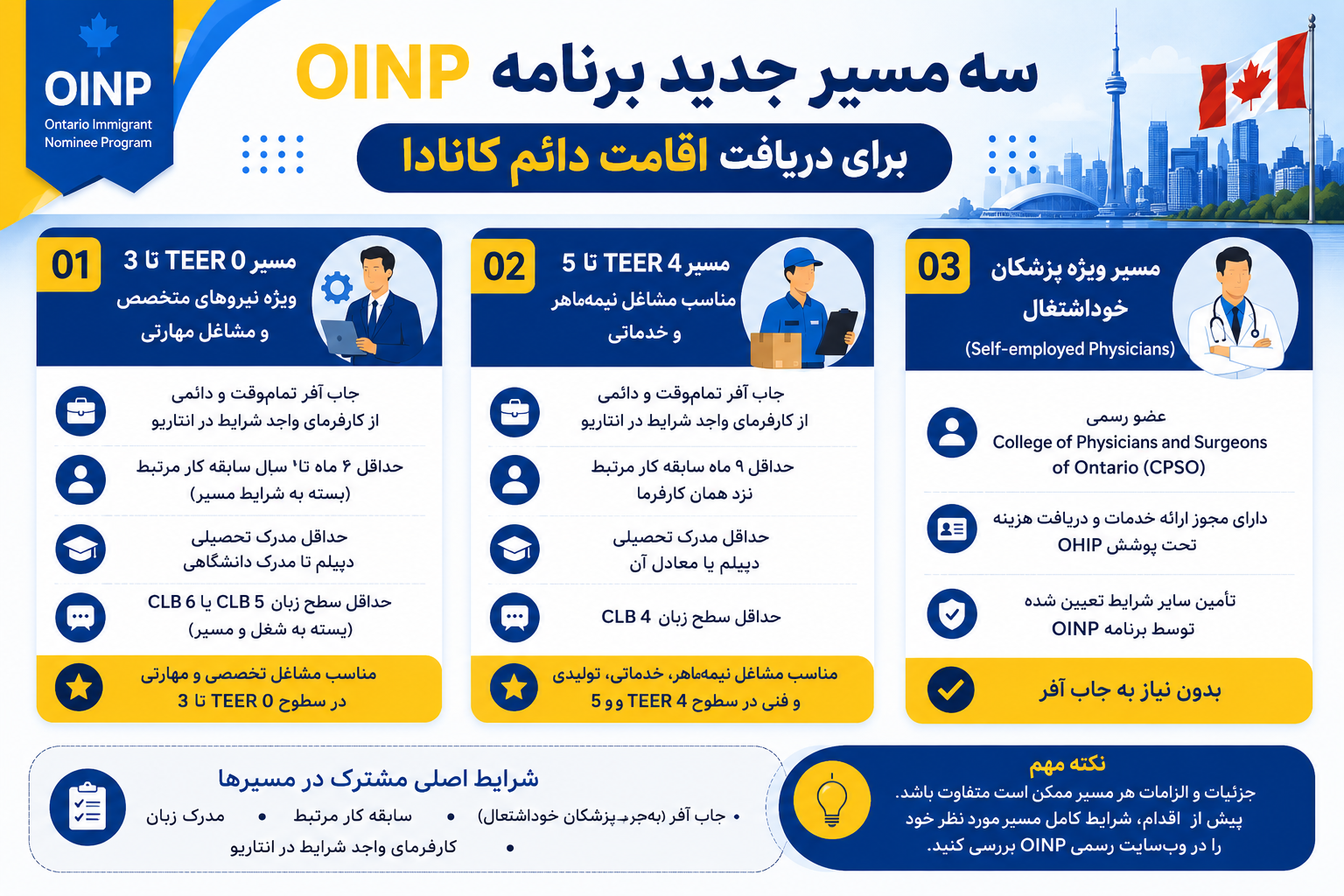
The eight closed streams have been replaced by a single main program, the Ontario Workforce Priority Stream, which contains three pathways. They are built around TEER level and current demand in the province, with the aim of making selection more targeted.
If you are considering Ontario, knowing how the three pathways differ will tell you quickly which one fits your profile.
TEER 0 to 3: skilled and professional occupations
To apply through this pathway you need:
- A full-time, permanent job offer from an eligible Ontario employer in a TEER 0, 1, 2 or 3 occupation.
- A language result of at least CLB 6, or CLB 5 for certain occupations, or graduation from an Ontario post-secondary institution within the past three years.
You must also meet one of the following:
- A licence to practise, if the occupation is regulated, or
- A post-secondary credential of at least one year of full-time study, together with the required work experience.
- Work experience: at least two years of related experience in the past five years, or
- Six months of continuous full-time work with the same employer in the past twelve months, reduced to three months for recent Ontario graduates.
Note: some occupations, including cooks, bakers, butchers, truck drivers and certain technical trades, are subject to different education, language or experience requirements.
TEER 4 to 5: semi-skilled and service occupations
Not every route to Canada runs through a university degree. Ontario has kept a dedicated pathway for service, manufacturing and semi-skilled occupations, aimed at shortages in those sectors.
The main requirements are:
- A full-time, permanent job offer
- At least nine months of related work experience
- A language result of at least CLB 4
- A secondary school diploma or equivalent
This pathway covers a wider range of TEER 4 and 5 occupations than the streams it replaces, which makes it worth reviewing if you work in services, manufacturing or a technical field.
Self-employed physicians
One of the more significant parts of the redesign is a dedicated pathway for self-employed physicians. Many doctors previously could not use employer-driven provincial streams because they have no single employer. This pathway addresses that.
To qualify, an applicant must:
- Be a member of the College of Physicians and Surgeons of Ontario (CPSO).
- Hold the authorisation needed to provide services billable to OHIP.
- Meet the other conditions set by the program.
The obvious advantage here is that no job offer is required, which makes it one of the more accessible new pathways for physicians.
What existing OINP applicants need to know
If you applied before the new rules took effect, note the following:
- The Expression of Interest (EOI) system is currently closed to new submissions.
- No further invitations will be issued under the closed OINP streams.
- EOIs and job offers registered under the previous streams that have not yet produced an invitation are being cancelled automatically.
- Affected applicants, employers and authorised representatives receive a direct notice from the OINP.
- Employers already registered in the Employer Portal do not need to register again.
- They will, however, need to submit a new job offer and a new position approval request once the system reopens, before a new EOI can be created for an applicant.
- Applicants who meet the new criteria should assemble their documents now so they can submit quickly once the EOI system reopens.
Do the new OINP rules improve your odds of Canadian permanent residence?
The new OINP places more weight than before on a valid job offer, relevant work experience and Ontario’s labour market needs. Applicants who have those things are better positioned than they were.
Ontario’s annual nomination allocation is set by agreement with the federal government and changes each year, so check the OINP page for the current allocation and stream dates. And a provincial nomination still adds 600 CRS points to an Express Entry profile, provided the nomination is issued under an Express Entry-aligned stream and you hold a valid Express Entry profile. A base nomination outside Express Entry does not add CRS points; it leads to a paper-based permanent residence application instead.
Against that, the requirements are stricter. A language result, relevant experience and a job offer are now mandatory for most pathways, so applicants without them face a narrower field. Note also that a nomination is not a decision on permanent residence. IRCC assesses the permanent residence application separately, including admissibility, and makes the final decision.
Steps to permanent residence through the OINP
Once you meet the criteria for one of the new OINP pathways, the process runs as follows:
1. Confirm your eligibility and choose the right OINP pathway
2. Submit an Expression of Interest (EOI) in the OINP system, with your employer where required
3. Receive an invitation to apply (ITA) from the OINP
4. Submit the nomination application with supporting documents
5. Receive the provincial nomination from the OINP
6. Submit the permanent residence application to IRCC
7. Receive confirmation of permanent residence (COPR) and complete landing in Canada
In short, you obtain a provincial nomination from Ontario first, then apply to the federal government for permanent residence. Those two stages are the core of the OINP process.
Summary
The 2026 OINP changes are among the most significant provincial immigration reforms Canada has seen in recent years. With eight streams closed and the Ontario Workforce Priority Stream introduced, the program now turns on a valid job offer, relevant work experience, language ability and demonstrated labour market need.
The new rules are harder for some applicants. At the same time, the larger nomination allocation and the new pathways create more room for people who do meet the criteria. If you intend to apply through the OINP, review the current requirements carefully, prepare your documents, and watch for the reopening of the EOI system so you are ready when it happens.
Frequently asked questions
1. What happens to an EOI I already submitted?
If your EOI was registered under one of the closed streams and you have not received an invitation, it is cancelled automatically. You will need to submit a new EOI once the system reopens.
2. When does the EOI system reopen?
The Ontario government has said the system will reopen in summer 2026 but has not confirmed a date. Check the OINP website for the current position before making plans around it.
3. Does an OINP nomination still add 600 CRS points?
Yes, where the nomination is issued under an Express Entry-aligned stream and you have a valid Express Entry profile, 600 points are added to your CRS score, which substantially improves the chance of receiving an invitation to apply. A nomination outside Express Entry does not add CRS points and leads to a paper-based application instead.
This article is general information, not legal advice, and it describes published official rules rather than any individual case. Hadi Imani is a Regulated Canadian Immigration Consultant, licence R522575, practising in Toronto; that licence covers Canadian immigration only.