
A US investment visa is one of the most direct ways into the world’s largest economy. Depending on the category you choose, investing in a US business can give you the right to live and work in the United States lawfully, and in some cases open a path to permanent residence and later citizenship.
The requirements, the categories and the application steps differ sharply from one visa to the next. Which category fits your situation? How much capital do you actually need? This article sets out the main points of the US investment visa so you can make an informed decision. If you are looking at legal routes for immigration to the United States through investment, read on.
What a US investment visa is
An investment visa is a residence route offered by many countries to people who can put capital into the destination economy in exchange for temporary or permanent status. These categories usually do not test language ability, work history or academic qualifications. They test the money: how much you are investing, and whether it is genuinely yours.
The investment can take different forms, such as starting a business, buying property or joining an economic project. In several countries an investor route leads on to permanent residence or citizenship. If you are approaching migration from a financial angle, this can be a sensible option.
Types of US investment visa
According to the official website of US Citizenship and Immigration Services, the US investment visa is a well-used route into the country for people with capital to commit. The main options are set out below.
1. EB-5 immigrant investor visa
EB-5 is an immigrant category, which means a successful case leads to a green card. The standard minimum investment is USD 1,050,000, falling to USD 800,000 in a targeted employment area. The core condition is the creation of at least 10 full-time jobs for US workers.
Status is first granted as conditional permanent residence for two years. Once you show the conditions have been met, the conditions are removed and you hold a permanent green card. The investor must have a managerial role or a genuine ownership stake in the project, and the source of the funds must be lawful and fully documented.
A spouse and unmarried children under 21 can be included. The investment can be made directly or through a regional centre. The end goal is permanent residence in the United States on the strength of a lawful investment.
Read more: A full guide to the US H1B visa
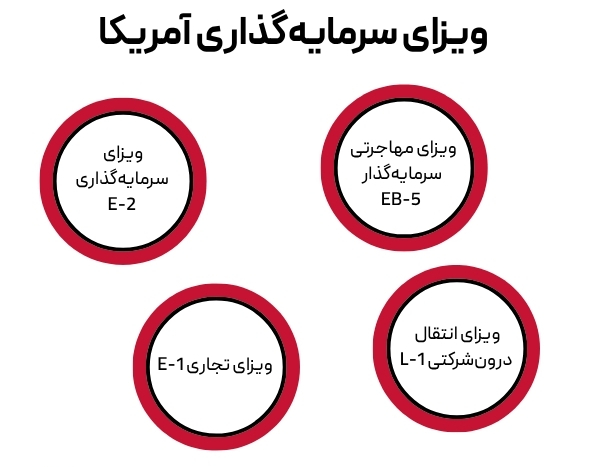
2. E-2 treaty investor visa
E-2 is a non-immigrant category open to nationals of countries that hold a qualifying treaty of commerce and navigation with the United States. It lets you start and run an active business there. No fixed sum is set in law, but the capital must be substantial, lawfully obtained and genuinely at risk in the business.
The applicant must own at least 50 percent of the business or otherwise control it through a managerial role. Status is usually granted for up to two years at a time and can be extended indefinitely while the business keeps trading.
A spouse and unmarried children under 21 can accompany the investor, and the spouse is authorised to work. The business must be real, active and capable of generating income; a passive holding does not qualify. E-2 does not lead to a green card by itself, but it does allow you to live and work in the United States for as long as the business continues.
The three categories below come up less often, but they are worth knowing about.
3. L-1 intracompany transfer visa
The L-1 visa is designed for moving key staff of multinational companies to the United States. It requires no direct investment and is aimed at managers, executives and specialised-knowledge employees transferring from an overseas branch to the US office of the same group.
A new office is normally approved for one year at first. After that, extensions can take an L-1A manager or executive to a maximum of seven years, and an L-1B specialised-knowledge employee to a maximum of five. There is no job-creation requirement. Managers and executives may, however, be able to move on to a green card through the EB-1C immigrant category.
4. E-1 treaty trader visa
The E-1 visa is issued to nationals of treaty countries and exists to support substantial international trade between the United States and the treaty country. It is for people entering the United States on behalf of a qualifying company to carry on that trade.
No minimum investment figure applies, but the trading activity must be substantial and the majority of it must be between the United States and the treaty country. Status is granted for up to two years at a time and can be extended for as long as the trade continues. There is no job-creation requirement, and the category is limited to nationals of countries with a qualifying trade treaty with the United States.
Each of these visas carries its own conditions, benefits and limits. The right choice depends on the purpose of the investment and on your longer-term plans. For a precise assessment, speak to a US immigration attorney.
US investment visa requirements
The general requirements for a US investment visa vary by category, but in every case you must be able to fund an investment in a US business or economic project. If you are looking at EB-5 or E-2 specifically:
- For EB-5, the minimum capital is USD 800,000 to USD 1,050,000, and it must go into a project that creates at least 10 full-time jobs for US workers.
- E-2 is limited to nationals of countries that hold a qualifying treaty with the United States; the current treaty country list is published by the US Department of State. The investment must be “substantial”, and you must hold at least 50 percent of the business and take an active part in running it.
Across the board, a strong business plan, credible financial evidence and a clear plan for creating economic value are the main prerequisites.
Read more: What is the US EB3 visa?
How to apply for a US investment visa
The tables below set out the application steps in plain terms, first for EB-5 and then for E-2.
| Step | Description |
|---|---|
| 1. Choose a project | Select a suitable investment project, such as a regional center or a new commercial enterprise |
| 2. File Form I-526 | Submit the initial petition to USCIS for approval of the investment |
| 3. Apply for a visa or adjust status | Outside the U.S., apply for an immigrant visa; inside the U.S., file for adjustment of status |
| 4. Receive conditional green card | If approved, a two-year conditional residence card is issued to you and your family |
| 5. Remove conditions on residence | Before the two years end, file to remove the conditions and convert to permanent residence |
| Step | Brief description |
|---|---|
| 1. Start or buy a business | Start or purchase an active, profit-making business in the United States. E-2 status is open only to nationals of countries with a qualifying treaty with the United States – Iran is not one of them |
| 2. Investment | No statutory minimum: the investment must be substantial in relation to the cost of the business, irrevocably committed, at risk and more than marginal |
| 3. Prepare a business plan | A plan showing the business is profitable and viable |
| 4. File the visa application | Complete the required forms, pay the fee and attend the US embassy interview |
| 5. Visa issued | If approved, a temporary visa is issued for the applicant and family |
Documents for a US investment visa
Both of the common categories, EB-5 and E-2, call for a specific evidence pack.
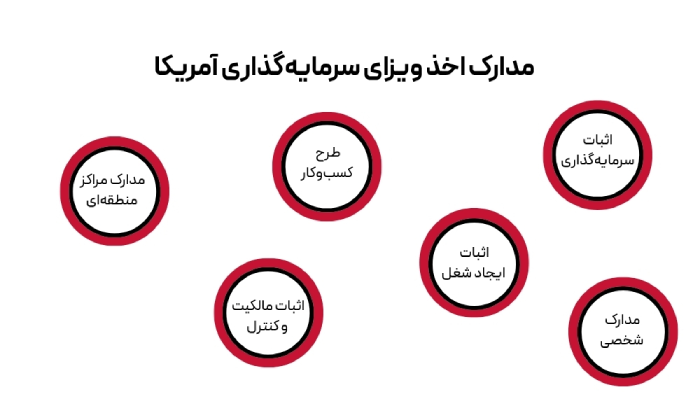
Documents required for the EB-5 visa
EB-5 allows a foreign investor to obtain a green card by investing in a new commercial enterprise that creates at least 10 full-time jobs for US workers. The following evidence is required.
- Proof of investment:
You must show that you have invested at least USD 1,050,000, or USD 800,000 in a targeted employment area (TEA). You must also document that the capital comes from a lawful source, using material such as tax returns, bank statements and proof of ownership of assets. On top of that, you need to trace the path of the money from its source to the investment, with wire transfer receipts and the matching account statements.
- Business plan:
A comprehensive business plan covering how the business will operate, market analysis, financial projections and the job creation strategy.
- Proof of job creation:
Evidence that at least 10 full-time positions for qualifying US workers have been created or preserved.
- Proof of ownership and control:
Evidence that the investor holds a substantial ownership stake in the business or otherwise controls it, such as partnership agreements, share certificates or operating agreements.
- Personal documents:
Birth and marriage certificates where applicable, police certificates and evidence of good moral character.
- Regional centre documents (if you invest through one):
The USCIS designation letter for the regional centre and evidence that the centre meets the EB-5 requirements.
Read more: The best occupations for moving to the United States
Documents required for the E-2 visa
The E-2 visa allows nationals of treaty countries to enter the United States to develop and direct a business in which they have made a substantial investment.
- Proof of investment
- Business plan
- Proof of ownership and control
- Personal documents
- Proof of nationality
- Family documents, if relatives are accompanying you
- Spousal work authorisation
US investment visa costs
Costs depend on the category and on your circumstances. The main charges for EB-5 and E-2 are set out below.
| Visa type | Minimum investment | Approximate additional costs | Approximate total cost |
|---|---|---|---|
| EB-5 visa | USD 800,000–1,050,000 | Regional centre administration, legal and USCIS filing fees – varies by project | Investment plus those fees; ask each regional centre for its own fee schedule. The minimums are inflation-adjusted from 1 January 2027 |
| E-2 visa | USD 100,000–200,000 | USD 10,000–20,000 (administrative and legal fees) | Approx. USD 110,000–220,000 |
Moving to the United States through an investment visa
A US investment visa is a serious option for anyone who wants to commit capital in the United States and gain the right to live and work there. Each category has its own conditions, benefits and costs, and the right one depends on your objective, your budget and how long you plan to stay.
The steps and the fees vary by category, and following them precisely matters to the outcome. Working with experienced advisers and a US immigration attorney reduces risk and helps you avoid errors that cost time. Good information and careful planning are what carry an investor case through.
Frequently asked questions
- Can I extend my E-2 visa?
Yes. E-2 status can be extended, and there is no cap on the number of extensions. As long as your business is trading and you continue to meet the conditions, you can apply to extend the visa or your E-2 status. - What does the “at risk” requirement mean?
Under EB-5, the investment must be at risk, meaning the investor cannot hold any guarantee that the capital will be returned. The rule exists to make sure the investment is genuine and that the money is really working in the US economy. - Can I include my family in an EB-5 application?
Yes. An EB-5 investor can include a spouse and unmarried children under 21. They are treated as derivatives and can obtain US permanent residence alongside the investor.
This article is general information, not legal advice, and it describes published official rules rather than any individual case.