
A calm, well-run, beautiful country to build a future in is what most people picture when they think about moving abroad. The question is whether that picture survives contact with the paperwork.
New Zealand is one of the smarter answers. Striking landscapes, a respected education system, a high level of personal safety and a genuinely varied job market. This guide covers the ways to immigrate to New Zealand, what each route requires, the steps, the costs, the benefits and how the main cities compare. If you are thinking about starting again in one of the best countries in the world, read on.

Ways to immigrate to New Zealand
There is more than one route, and the right one depends on your profile. Below is each option in turn, so you can see which fits. For a closer look at your own case, complete the free assessment form and the Aval Visa advisers will come back to you with specifics.
Studying in New Zealand
If you are studying now, or want to continue at degree level, the student route is usually the best entry point. New Zealand’s universities are young by international standards but consistently well ranked. What draws students:
- High teaching quality and a wide choice of courses
- Well-qualified academic staff working to a high standard
- Strong teaching and research facilities
- Qualifications recognised worldwide
- An active job market in New Zealand and Australia with good salaries
Those are the reasons international students keep applying to New Zealand universities.
There are a few things to settle before you apply. First, the programme has to be approved by NZQA. Second, and more important, is money: without a scholarship you have to evidence funds to cover tuition and living costs.
Last, a student can bring a partner and dependent children under certain conditions. If your English test score and academic record are in place, this route is open to you.
Working in New Zealand (Accredited Employer Work Visa)
To move to New Zealand through work, you need a genuine job offer from an accredited New Zealand employer, and you then apply for the work visa. This visa is aimed at people intending to live and work in New Zealand for longer than a short stay, and the rules follow the official guidance from Immigration New Zealand.
New Zealand runs several work and skills visas. If your experience and expertise are strong enough, you may not need to chase a job offer, sit interviews or write to academics at all, because the skilled migrant route is open to you directly.

The skilled route (Skilled Migrant Category)
Applicants with evidenced work experience, an English test result and skills in an occupation New Zealand needs can enter the Skilled Migrant Category and apply through the points system. Six points is the threshold for an invitation to apply. The rest is set out below:
What to know about the skilled route
You can only claim points from one of the three primary criteria: occupational registration, qualification or income. They do not stack. If your primary criterion does not reach 6 points, skilled work experience in New Zealand can add up to 3 more.
To claim points for income or work experience, the job has to be full time, meaning at least 30 hours a week, and paid at the required rate. You also need:
- To be aged 55 or under
- Acceptable health and character
- English language ability
- A skilled job offer or skilled employment
Investor routes
There are two investment options:
- NZD 5 million invested for 3 years
- NZD 10 million invested for 5 years
Neither requires you to live in New Zealand. Presence requirements are light, as little as 21 days in the country across the three-year term on the higher-growth option, provided the capital is committed. The capital involved means this is a route for a small number of applicants.
If the funds are out of reach but you hold a senior or executive role, the entrepreneur programme is the way to start a business and move to New Zealand.
Entrepreneur Work Visa
If you intend to run a real business in New Zealand, the entrepreneur route grants residence on the strength of that business. It comes with firm conditions.
- A minimum capital investment of NZD 100,000. That figure can be waived for ventures in technology or export-focused sectors. You must also hold at least 25 percent of the shares in the New Zealand business. Once you have run it for at least six months and can evidence that, the entrepreneur route is open to you.
- You need a complete, costed business plan: financial detail, a clear path to profit, jobs created and a positive economic impact.
- A year after the business starts trading you enter the two-year balance period. You run the business through it and show the government, when you apply to extend, that it creates jobs, makes money and contributes to the local economy. After 2 years you can apply for the Entrepreneur Resident Visa.
For the entrepreneur programme, remember to:
- Invest at least NZD 100,000
- Work in a qualifying, export-focused sector if the capital is not there
- Score at least 120 points on capital, jobs, professional experience and the business plan
- Meet the character requirements, including a clean legal record and police certificates
- Reach at least IELTS General 4.0 overall
Partner and family route
If your partner is a New Zealand citizen or resident, you can apply under:
- Partner of a New Zealander Work Visa
- Partner of a New Zealander Resident Visa
The core test is that the relationship is genuine and stable, and that you are living together. Marriage certificates, photographs and footage of the ceremony are the kind of evidence that supports it.
The partner of a New Zealand citizen can apply for a work visa of up to three years and, once it is granted, work full time.
General requirements for immigrating to New Zealand
| General requirement | Details |
|---|---|
| Age | Under 55 |
| Language certificate | IELTS General, band 6 minimum |
| Health and police clearance | Full medical certificate and police clearance certificate |
| Meeting the minimum requirements | Depends on the visa type, e.g. a job offer for a work visa or a formal offer of place for a student visa |
Once you know which programme fits, choose the route against the current rules and start assembling your documents. With the file complete and the application forms filled in, you apply online or in person, depending on the visa.
What immigrating to New Zealand costs
| Visa type | Approximate cost |
|---|---|
| AEWV work visa | NZD 1,540 |
| Investor visa (Active Investor Plus) | NZD 5 million to NZD 10 million required investment, not an application fee; confirm current bands |
| Remote work (New Zealand has no digital nomad visa) | Visitor visa conditions allow remote work for an offshore employer; check the fee with Immigration New Zealand |
| Working holiday visa | NZD 250 to NZD 430 |
| Permanent residence fee | NZD 315 |
| Additional costs | Includes language test, document translation, insurance, initial living costs |
Why people move to New Zealand
New Zealand offers a lot to anyone building a career or an education. You get social and economic stability, and as a lawful resident you can use a well-run public health system.
Untouched landscapes, an unhurried way of life, a stable economy with low unemployment, varied and well-paid work, political stability and real respect for civil rights are all part of the package.
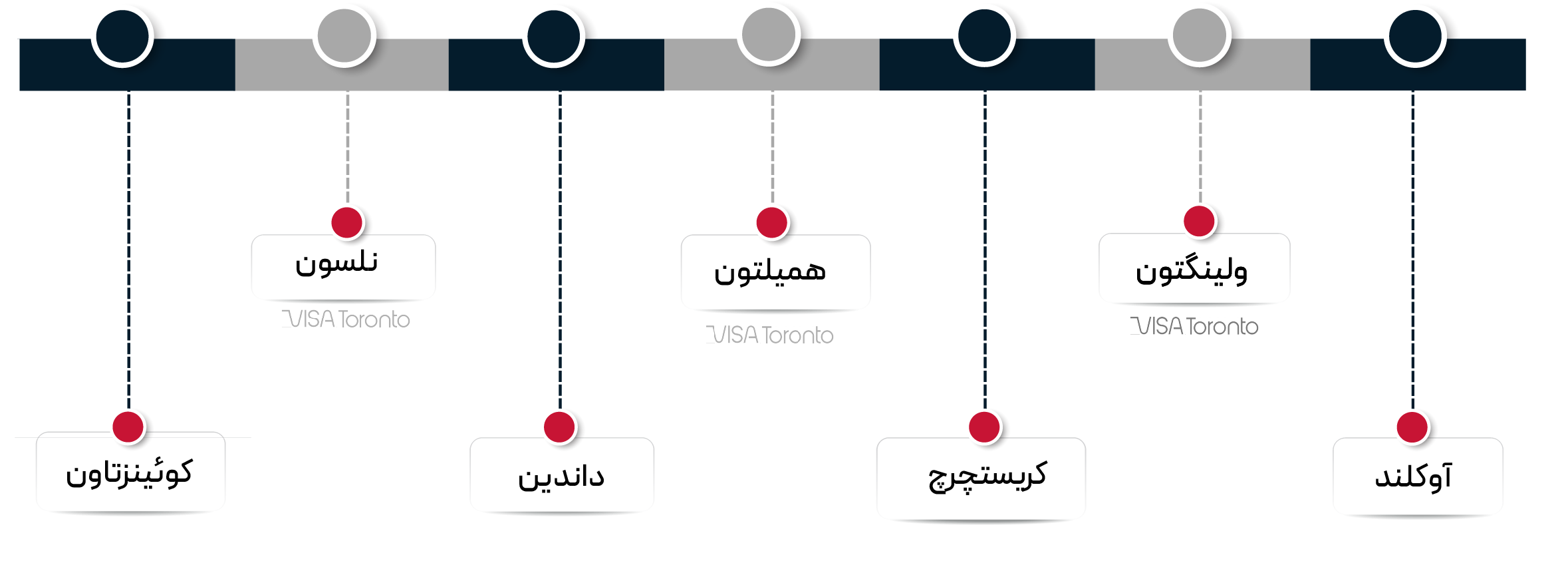
Comparing the main New Zealand cities
| City | Key features | Job opportunities | Cost of living |
|---|---|---|---|
| Auckland | Largest and most populous city, high cultural diversity, modern amenities | IT, finance, education, health | Expensive |
| Wellington | Political and cultural capital, coastal city ringed by hills, artistic and creative | Government, media, design, startups | Upper-mid |
| Christchurch | Close to mountains and nature, advanced transport system | Engineering, construction, education, agriculture | Mid |
| Hamilton | University city, close to Auckland, lower costs with good quality of life | Life sciences, agriculture, R&D | Lower-mid |
| Dunedin | Historic city with European architecture, academic hub with the University of Otago | Health, education, research | Low |
| Nelson | Sunniest city in New Zealand, quiet pace, friendly atmosphere | Creative industries, tourism and crafts | Lower-mid |
| Queenstown | Adventure capital, outstanding scenery, major tourist destination | Tourism, hospitality, services | High |
How to choose where to live
If you are young and want the widest choice of work, Auckland and Wellington are the obvious picks. If lower costs and a quieter life matter more, look at Dunedin and Nelson. For families, Christchurch and Hamilton are the ones we suggest.
Immigrate to New Zealand with Aval Visa
New Zealand is modern, prosperous, beautiful and safe, and it offers a full range of routes: study, work, skilled migration, entrepreneurship, investment and options for the self-employed. There is a fit for most profiles.
This can be the start of a new chapter, so start it properly. Take specialist advice on your position as the rules stand, and hand the rest of the file, the forms and the approvals, to the Aval Visa advisers. Talk to us about New Zealand, or about European routes if you are weighing both.
Frequently asked questions
- Can students work in New Zealand? Yes. Student visa holders can work part time during term, currently up to 25 hours a week, and full time during scheduled holidays.
- Can the entrepreneur route be accelerated? Yes. On the fast-track option, investing at least NZD 500,000 and creating 3 full-time jobs for New Zealanders within 6 months lets you apply for residence earlier than the standard route.
- Is New Zealand expensive?
Living costs are high in cities such as Auckland and Queenstown, but smaller centres are considerably more affordable.