
The H1B visa is one of the main work-based routes into the United States. It lets American companies hire skilled foreign professionals into specialty occupations. The programme supports innovation and competitiveness in the US economy, and it is the most widely used option for people who want to work in America on the strength of their profession.
Whether you are an employer looking to hire from abroad or a professional aiming to work in the United States, you need a precise picture of how the H-1B works. This article sets out the requirements, the documents, the application steps, the timing and the practical points of this US immigration route so you can plan properly.
What is the H1B visa?
The H-1B is a US work visa issued on a temporary basis to skilled professionals in fields such as technology, engineering, medicine, law, education and finance. It allows US companies to employ foreign specialists who hold a bachelor’s degree and documented experience in a specific field. The H1B visa is granted for three years initially and can be extended to a total of six.
Because registrations usually exceed the annual cap, USCIS runs a lottery to decide which cases move forward. The cap is 65,000 places a year, with a further 20,000 reserved for people holding a US master’s degree or higher.
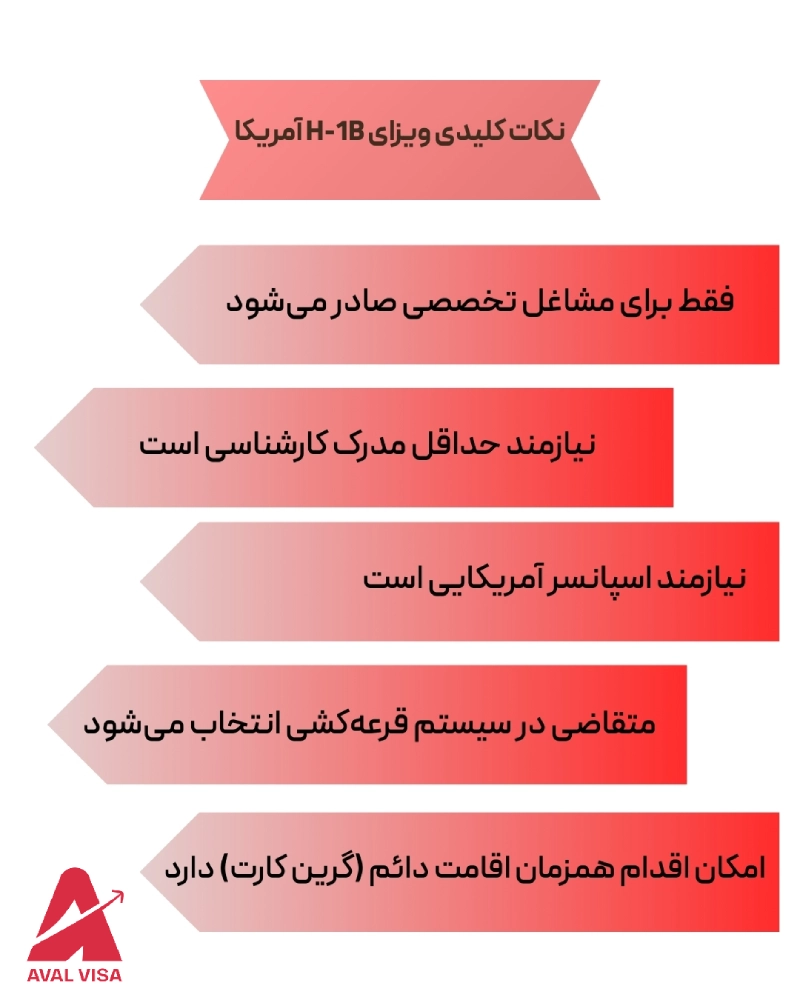
Key points about the H-1B visa
The visa is only issued for a Specialty Occupation, meaning a role that requires theoretical and practical knowledge in a specific field. In practice that means the applicant needs at least a bachelor’s degree, or an equivalent combination of education and experience.
The second point is employer sponsorship. A US employer has to sponsor the applicant and file the necessary petitions with United States Citizenship and Immigration Services (USCIS). Because of the annual cap, the lottery decides which registrations proceed to a full petition. The last point worth noting is that H-1B holders can pursue permanent residence, a green card, while holding temporary status, because the H-1B allows dual intent.
Advantages of the H-1B visa
The H-1B has advantages for the employer and for the employee. They are summarised in the table below:
| Benefits for the employer | Benefits for the worker |
|---|---|
| Access to a global talent pool | Opportunity to work in the United States |
| Fills skill gaps in the US labour market | Gains valuable international work experience |
| Stays competitive in the global market | Possible path to permanent residence (Green Card) |
Read more: What is the EB-3 visa?
H1B visa requirements
Both the employer and the employee have to meet a set of minimum conditions before a registration can be made. They are set out below:
Employer requirements
The employer has to be hiring for a specialty occupation, meaning a role that requires a degree, a firm grasp of complex theory and the ability to apply that knowledge to practical problems. On top of that, the employer must file a Labor Condition Application (LCA) with the Department of Labor, attesting that:
- The foreign professional will be paid at or above the prevailing wage for that role and location.
- The hire will not adversely affect the working conditions of comparable US employees.
- There is no strike, lockout or work stoppage in the occupational classification at the place of employment.
This is how the Department of Labor satisfies itself that the hire does not displace existing workers or undercut the domestic labour market. To sponsor the employee, the company then files Form I-129, the petition for a nonimmigrant worker, with USCIS, and where the case is cap-subject it must first complete the electronic lottery registration.
Employee requirements
The employee needs the academic qualification the role calls for, a bachelor’s degree or higher in a field related to the job. Beyond that, a US sponsor and a written job offer are both required. The applicant has to show through documentation that the position matches their field of study and that they have the relevant experience and specialist knowledge. If the role requires a state licence in the state where the work will be performed, the applicant normally has to hold that licence before the H-1B petition can be approved.
Other points to check
If you meet the conditions above, consider the following before you register for the lottery.
Some H-1B petitions are exempt from the annual cap, including those filed by higher education institutions, non-profit research organisations and government research organisations. If your employer falls into one of those categories, the lottery does not apply. Finally, remember that you have to maintain lawful status under the terms of the H1B, and any material change in your employment has to be reported to USCIS through an amended petition.
The process and how long it takes
At best, and where premium processing is used, an H1B outcome comes through in roughly three to four months. The sequence is:
- Lottery registration
- LCA certification
- Premium processing of Form I-129
Without premium processing, six to nine months is normal, through the same steps: registration, LCA certification and standard processing of Form I-129.
How the H-1B lottery works
When registrations exceed the annual cap, USCIS selects at random from the pool. That part of the process is pure chance, which makes the calendar the thing you can control. Registration usually opens in early March and runs for a few weeks, with the exact dates published by USCIS each year.
Once selections are announced, the employer has 90 days to file the full H-1B petition. The LCA itself usually takes about a week once filed electronically, and it has to be certified before the petition goes in.
Before you can enter the United States on an H-1B and start work, your employer has to register you with USCIS, the United States Citizenship and Immigration Services, so that you enter the lottery pool. For registration numbers, how to register and further detail, see this guide to the H-1B lottery and cap.
H1B visa cost
Registering for the H-1B lottery costs USD 215 per beneficiary. If the registration is selected, the employer pays a further USD 780 to file Form I-129, the petition for a nonimmigrant worker. Small employers and non-profits pay USD 460 for the same form.
Beyond the registration and petition fees, the final cost of an H-1B depends on:
- The size and type of the sponsoring employer, which drives several statutory surcharges
- Premium processing, if it is used
- A change of employer partway through
- Legal fees
A Presidential Proclamation of 19 September 2025 added a USD 100,000 payment to certain H-1B petitions. A federal court vacated the guidance implementing it in June 2026 and the government’s request for a stay was refused in July 2026, so the payment is not currently being collected, though the position remains under appeal. US filing fees are also revised periodically, so check the USCIS H-1B page for the position on the day you file.
Read more: IT engineering jobs in the USA: pay and opportunities
How to apply for the H-1B
The H1B process follows a fixed sequence of steps, set out in the table below:
| Step | Details |
|---|---|
| Job offer and employer preparation | The employer needs a specialist worker and selects a candidate who requires H-1B sponsorship |
| H-1B lottery registration | Electronic registration; the employer creates a myUSCIS account |
| Labor Condition Application (LCA) | The LCA is filed with the U.S. Department of Labor (DOL) after the candidate is selected |
| Prevailing Wage Determination (PWD) | Minimum wage matching that paid to comparable U.S. workers |
| Preparing and filing the H-1B petition | Includes the certified LCA, pay slips, academic qualifications, training certificates, CV, job offer letter, employer support letter |
| USCIS processing | A Request for Evidence (RFE) may be issued |
| Visa application and interview | Complete form DS-160, pay the visa fee, book and attend the interview; the consular officer reviews the documents and makes the final decision |
| Entry to the United States | Entry no earlier than 10 days before the official employment start date |
H-1B stamping
H-1B stamping is the physical visa placed in your passport by a US embassy or consulate, and it is what permits entry to the United States. If you obtained H-1B status inside the country through a change of status, you do not have a visa stamp, only an approval notice, Form I-797. Bear in mind that the I-797 is valid for living and working inside the United States, while the stamped visa is what you need to leave and re-enter.
What to bring to the visa interview
When you attend a US embassy or consulate for an H-1B interview, bring the following:
- A valid passport
- The DS-160 confirmation page
- A copy of the approved Form I-129 and the I-797 approval notice
- Receipts for the fees paid
- A recent photograph meeting the biometric specification
Moving from H-1B to a green card
For many H-1B holders the visa is only the starting point, and the objective is a green card (US permanent residence). Here is how the transition normally works.
PERM labour certification comes first. It establishes that no qualified US worker is available for the role. Once PERM is certified, the employer files Form I-140, the immigrant petition for a foreign worker, showing that the employee has a sponsor behind the green card application. After that, either Form I-485 (adjustment of status) or consular processing follows, depending on where the applicant is. Filing I-485 from inside the United States converts the status to permanent residence. Applicants outside the country go through the US embassy in their country of residence.
Other points on the green card
Keep the following in mind before you start a green card application:
- Children of visa holders who turn 21 before the green card is approved can lose dependant status, although the Child Status Protection Act freezes a child’s calculated age in certain circumstances
- An H-1B holder’s spouse on an H-4 visa can obtain work authorisation in some situations, in particular where the H-1B holder has an approved I-140
- Maintain your H-1B status and follow the rules throughout. If you change jobs, the new employer has to file a fresh petition and your paperwork has to be updated
Applying for a US visa with Aval Visa
The H1B is the most widely used route for skilled professionals entering the United States. It comes with legal steps, exact documentation and hard deadlines, so understanding the process, the documents, the costs and the legal requirements in advance is what keeps a case on track and avoids expensive mistakes.
If you want to work in one of the largest labour markets in the world and build a career in the United States, the place to start is an honest assessment of your profile. The Aval Visa team can take you through it step by step, from the H-1B registration through to the visa and, later, a green card application.
Frequently asked questions
- Is the H-1B visa the same as a green card? No. The H-1B is a temporary work visa, but it can act as a bridge to a green card, because it allows dual intent and you can pursue permanent residence while holding it.
- How long does Form I-129 take? Standard processing of Form I-129, the petition for a nonimmigrant worker, runs roughly four to eight months depending on the service centre. With premium processing and the extra fee, USCIS commits to a decision within 15 business days.
- What can a dependent child do after turning 21? They need to change to another status, for example an F-1 student visa, or leave the country. The Child Status Protection Act can protect some children whose parent’s petition was filed long before, so check the calculated age before assuming they have aged out.
This article is general information, not legal advice, and it describes published official rules rather than any individual case.