The EU Blue Card in Germany is a residence permit for university-educated professionals and skilled workers. It is aimed at people qualified in engineering, IT, medicine and other specialist fields. Alongside opening a route to living in Germany, the Blue Card grants the right to reside and work there.
This article covers the current Blue Card rules, the conditions you have to meet, the documents required, the fees and the other details that matter. If you are looking at a new career in Germany, read on for what the Blue Card offers and whether age plays any part in it.
What is the EU Blue Card in Germany?
The Blue Card is designed to attract skilled workers from outside the European Union. Holders can live in Germany and work legally in qualified employment. The aim is to fill shortages of specialists across the German economy and to bring in people with higher education and specific professional skills. It suits candidates qualified in engineering, information technology, medicine and other fields where Germany is short of staff. In broad terms, the Blue Card is open to:
- graduates holding a bachelor’s degree or higher;
- people with a genuine job offer from a German employer;
- professionals whose gross annual salary reaches the statutory threshold, which is set each year as a share of the pension insurance contribution ceiling, with a lower threshold for shortage occupations;
- applicants who also meet the other conditions, such as health insurance and valid identity documents.
Current EU Blue Card rules
The EU Blue Card is a combined residence and work permit for non-EU nationals. The rules cover the following points:
- The applicant holds a university degree at bachelor’s level or above.
- The applicant has a job offer from a German employer with a contract of at least six months.
- The gross annual salary meets the statutory minimum. The figures are recalculated every calendar year: the general threshold is 50 per cent of the annual contribution assessment ceiling for the statutory pension insurance, and the reduced threshold for shortage occupations and recent graduates is 45.3 per cent. The ceiling is currently EUR 101,400 a year, which puts the thresholds at EUR 50,700 and EUR 45,934.20. Check the current-year figure before you apply.
- The applicant holds valid health insurance covering medical costs.
- The applicant holds a valid passport and identity documents.
The Blue Card is normally issued for up to four years, and the fee for a first issue is around EUR 100. Processing takes up to 90 days, and the card can be extended when the employment contract is extended. Family members can work in Germany, use the social security system, travel without a visa within the Schengen area and, after a qualifying period, apply for settlement.
Blue Card Germany requirements
Under the current rules there is no formal age limit on a Blue Card application. The core conditions are a recognised university degree, a job offer matching that qualification and a gross annual salary at or above the statutory threshold, which is 50 per cent of the pension contribution ceiling for general occupations and 45.3 per cent for shortage occupations.
Age can still affect how an application is assessed. Recent graduates, for example, may fall into the career starter category, which applies the reduced salary threshold to candidates whose degree was awarded no more than three years earlier.
Older applicants with longer careers can face the opposite problem, meeting the salary threshold, particularly where their previous experience does not line up with the new job offer.
In those cases the immigration authority (Ausländerbehörde) may look at the file more closely. There is no formal age limit for the Blue Card, but age can influence the assessment and the evidence you are asked for.
If you do not have work experience or a university degree but still want to live in Germany, one option is a university place and a German student visa, which is comparatively affordable.
Another route into Germany is the Ausbildung visa, the dual vocational training route for younger applicants and students.
Occupations that qualify for the Blue Card
Germany publishes the fields and professions where it is short of qualified staff. The areas most consistently in demand are:
- information technology (developers, software engineers, systems administrators)
- engineering (electrical, mechanical, civil, industrial and automotive)
- medicine (general practitioners, specialists and dentists)
- nursing and allied health professions
- natural sciences (physics, chemistry and biology)
- data analysis and economics
- accounting and finance
- teachers in technical subjects or specific languages
- skilled technicians in particular industries
- highly skilled technical occupations, in defined cases, on the basis of work experience

Documents required for a German Blue Card
Applicants have to prepare and submit a set of documents:
- a passport with at least two blank pages and validity beyond the application date
- a recent biometric photograph
- employment records relevant to the applicant’s field
- all university certificates together with transcripts
- confirmation from the ANABIN database or the Central Office for Foreign Education (ZAB) where the qualification is not already recognised
- health insurance
- proof of funds
- the job offer letter from the German employer showing the agreed salary
- evidence of accommodation in Germany, such as a tenancy agreement
- a completed and signed visa application form
- the receipt for the application fee
Advantages of the German Blue Card
A Blue Card holder can live and work in Germany with the same employment rights as local staff. The other benefits are:
- The holder’s spouse can work in Germany and use the social security system.
- The holder can travel within the Schengen area without a separate visa.
- After a qualifying period of work and residence, the holder can apply for a settlement permit.
- Access to well-paid positions with strong working conditions.
- Access to the health insurance system and other welfare services for the holder and the family.
- Access to schooling for the holder’s children.
Drawbacks of the German Blue Card
The main drawback is the requirement for an employment contract at a set minimum salary, which can be difficult for candidates early in their careers or in lower-paying fields. Changing employer during the first twelve months also requires notification and approval from the immigration authority, which limits job mobility.
If a Blue Card holder loses their job, they generally have around three months to find a new position before their status is at risk. Applicants over 45 applying for the first time must also show a higher salary or adequate pension provision. And because the initial permit runs for a maximum of four years, it has to be extended or converted, which takes time and can cost money.
German Blue Card fees
Blue Card costs vary with the type of application, the length of stay and the applicant’s nationality. Knowing the individual fees makes budgeting easier, and they are set out below.
| Item | Fee (EUR) | Notes |
|---|---|---|
| Blue Card application fee | 100 | Fee to issue the German EU Blue Card |
| National D visa application fee | 75 | Single flat fee for the national (D) visa; EUR 25 to extend |
| Blue Card extension fee | 93 | Fee to extend the Blue Card; EUR 96 for an extension of up to three months |
| Document assessment fee (in some cases) | Varies | An additional charge may apply if credential recognition is required |
| Document translation cost | Varies | Translating academic and employment documents into German or English |
Blue Card processing times
The maximum processing time for a German Blue Card application is 90 days. It can run longer where documents are missing, where the immigration authority (Ausländerbehörde) has a backlog, or where additional confirmations are needed.
In practice applicants often report processing times of four to six weeks. Where the file is complete and well prepared it can be shorter. Under the fast-track procedure for skilled workers, which carries an additional fee, the timeline can also come down to four to six weeks.
As a rule, apply at least eight weeks before your current residence status expires so that any delay does not leave you without a valid permit.
How to get the Blue Card in Germany
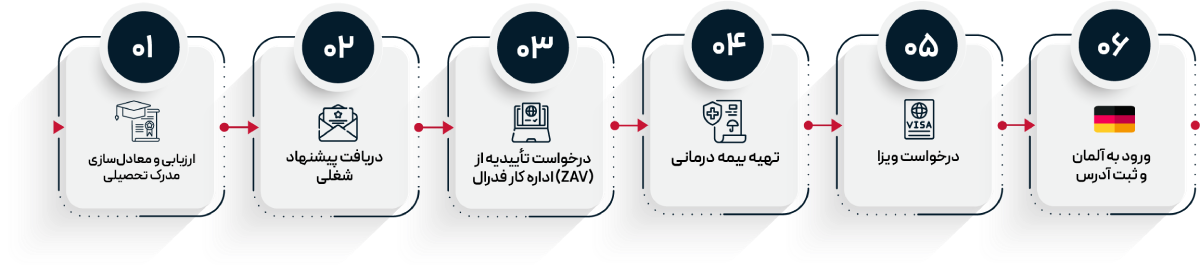
The application runs through the following stages:
- have your qualification assessed and recognised
- secure a job offer
- obtain approval from the Federal Employment Agency (ZAV) where required
- arrange health insurance
- apply for the visa
- enter Germany and register your address
- collect the Blue Card
Where to look for a job offer
For a genuine job offer, use established international job boards and the German market’s own platforms:
- Make it in Germany
- Jobborse der Bundesagentur fur Arbeit
- StepStone
- Indeed Germany
- Glassdoor Germany
Can a Blue Card lead to permanent residence in Germany?
Yes. A Blue Card can lead to a German settlement permit, provided you meet the conditions:
- after 27 months on a Blue Card, with German at A1 level and continuous work in the qualifying job;
- after 21 months, with German at B1 or above and pension contributions paid throughout;
- where your employment contract runs for less than four years, the Blue Card is usually issued for the length of the contract plus three months.
What are the common obstacles?
The Blue Card is a workable route to skilled work and life in Europe, but it is not without friction. Applicants can run into difficulty finding a suitable job, getting a qualification recognised, or meeting the language and salary conditions. Knowing where those obstacles sit, and how to deal with them, improves the odds and shortens the process. The table below sets out the common problems and practical responses:
| Challenge | Solution |
|---|---|
| No suitable job offer | Use reputable job portals; strengthen your CV |
| Salary offered is too low | Negotiate with the employer or look for other positions |
| Degree not recognised | Check the qualification on Anabin and obtain a ZAB statement of comparability |
| No German language certificate | The EU Blue Card has no German language requirement; A1/B1 applies to family reunification and naturalisation |
| Delay in the visa decision | Submit complete, accurate documents and follow up regularly with the embassy |
| Blue Card application refused | Review the requirements closely and fix any gaps before reapplying |
| Applicant over 45 | Does not apply to the EU Blue Card; the over-45 salary or pension test applies only to a first permit under section 18a or 18b |
| Extending employment or changing employer | Notify the Ausländerbehörde immediately and obtain fresh approval |
Read more: Best cities in Germany to work and live
The Blue Card as a route for qualified professionals
The EU Blue Card is a residence and work permit for university-educated specialists from outside the European Union. It is issued to people who hold a recognised degree and an employment contract in their field at the required salary level. Its main advantages are the path to permanent residence, the right to bring family and easier movement between EU countries for work.
Take advice before you apply so that avoidable problems do not derail the file. If you have questions, put them to the team at Aval Visa.
Frequently asked questions
- What is the minimum salary for a Blue Card? The threshold is recalculated each year: 50 per cent of the annual pension insurance contribution ceiling for general occupations and 45.3 per cent for shortage occupations and recent graduates. With the ceiling currently at EUR 101,400 a year, those figures are EUR 50,700 and EUR 45,934.20.
- Can I get a Blue Card with a non-German degree? Yes, provided your qualification is recognised in Germany or assessed as equivalent.
- Can family members come with me on a Blue Card? Yes. A spouse and children can join you, and the spouse can obtain a work permit without having to prove German language ability.
Official source: German Federal Office for Migration and Refugees — EU Blue Card
This article is general information, not legal advice, and it describes published official rules rather than any individual case.