
Skilled workers from around the world have been moving to New Zealand in growing numbers, and immigration to New Zealand is now a mainstream option for professionals. A New Zealand work visa lets you enter the labour market on the strength of a job offer from an approved employer, and build a working life in a safe, well-run country.
For many people it is also the first stage of a longer path, from temporary status to residence. If you plan to apply for a New Zealand work visa, you need to understand the categories, the steps and the documents before you start, so the process moves quickly and without avoidable setbacks.
Types of New Zealand work visa
New Zealand issues work visas across several categories, set out below.
1. Accredited Employer Work Visa
This is the most widely used New Zealand work visa. It is granted when you hold a full-time job offer of at least 30 hours a week from an employer that has been accredited by Immigration New Zealand. Depending on the pay rate, the occupation and the skill level of the role, it can be held for up to five years. It suits people working in specialist occupations or in roles where the country has a shortage of staff.
2. Specific Purpose Work Visa
If you have been invited to New Zealand for a defined project or assignment, such as delivering training, taking part in an event, giving technical advice or completing a short contract, this is the category for you. The visa is granted for the length of the project. It does not convert into residence, but it is a clean way to be in New Zealand temporarily for work reasons.
3. Seasonal and horticultural work visas
These visas cover seasonal labour, mainly in horticulture and agriculture, and in practice they often allow people already holding a student or visitor visa to take temporary work. There is also a dedicated scheme, the Recognised Seasonal Employer (RSE) scheme, under which workers from certain Pacific countries are recruited each year for seasonal work.
4. Post-study work visa
This visa is for international students who have completed a qualification in New Zealand and allows them to work there for between one and three years after graduation. The length depends on the level and the subject of the qualification. If you find relevant work and a suitable job offer while you hold it, you can then apply for residence.
5. Working Holiday Visa
This visa suits people aged 18 to 30 (up to 35 for some countries) from a defined list of countries who want to travel, live and work temporarily in New Zealand. It usually runs for 12 months and allows temporary or seasonal work. It is not designed for permanent jobs or as a route to residence.
6. Entrepreneur and start-up work visa
If you plan to start an innovative or export-focused business in New Zealand, this is the category to look at. It normally runs in two stages:
- 12 months to establish the business
- 2 years to grow it
If the business succeeds, residence becomes possible. A solid business plan, start-up capital and a record in business are the main requirements.
Read more: A full guide to the New Zealand investor visa
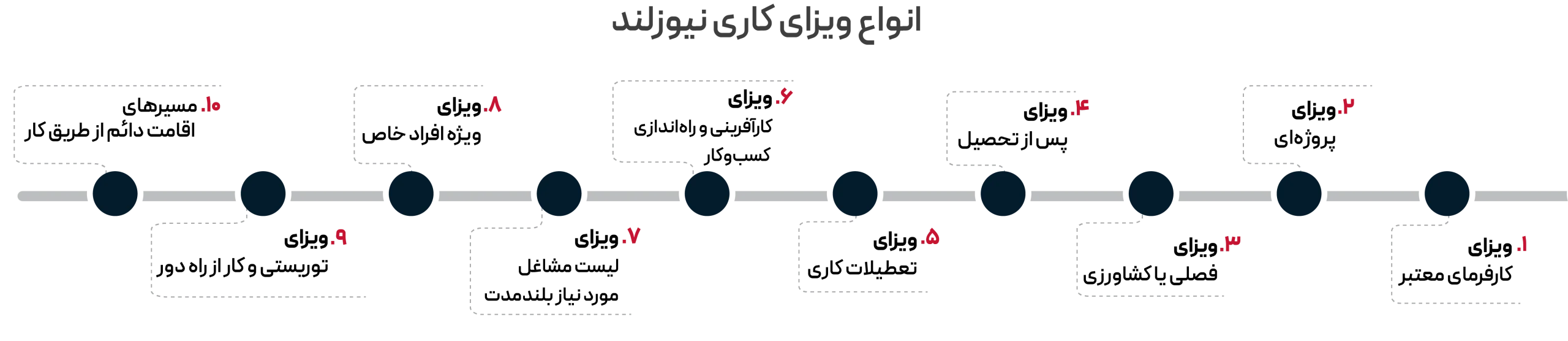
7. Green List and long-term skill shortage roles
This route is for people with a job offer in a specialist occupation that New Zealand has identified as being in long-term short supply. The old Long Term Skill Shortage List has been replaced by the Green List, which sets out the occupations that qualify. If you work in one of these roles and meet the conditions, you can enter New Zealand on a work visa and, after two years in the same field, apply for residence.
8. Visas for special cases
New Zealand also runs a number of narrower work visa categories, including:
- Diplomats and the private domestic staff of diplomats
- International artists and entertainers
- Japanese interpreters
- Victims of family violence
- Partners of workers already in New Zealand
- Religious workers, for leaders and staff of religious organisations
Each has its own conditions, tied to the length of the work and the field it is in.
9. Visitor visas and remote work (digital nomads)
New Zealand has recently allowed people holding a visitor visa to work remotely for an overseas employer for up to 90 days in a year. It does not permit work for a New Zealand employer.
10. Work-based routes to residence
If residence in New Zealand is your end goal, these are the options to focus on:
- Skilled Migrant Category: a points-based residence category assessed on qualifications, occupational registration, income and skilled work in New Zealand.
- Work to Residence: for people who have worked at least 24 months in a Tier 2 Green List occupation.
- Straight to Residence: for people in highly specialised Tier 1 Green List occupations, who can apply for residence from the outset.
Read more: Everything about the New Zealand partner visa
Requirements for a New Zealand work visa
New Zealand has tightened its work visa rules to attract skilled workers and reduce low-skilled migration. To qualify for a New Zealand work visa, applicants must meet a set of general requirements:
- Acceptable standard of health
- Police certificates showing good character
- English language ability where the category requires it (IELTS or TOEFL)
The table below sets out the requirements by New Zealand work visa category:
| Visa type | Main requirements | Notes |
|---|---|---|
| Accredited Employer Work Visa | - Job offer from an accredited employer - At least 2 years' experience or a relevant qualification - At least the New Zealand median wage | Visa duration 3 years for skill level 4 and 5 roles |
| Straight to Residence Visa | - Aged 55 or younger when you apply - Job offer on the Green List Tier 1 roles - English language ability | Direct permanent residence for occupations in demand |
| Work to Residence Visa | - Job offer on the Tier 2 list - Employment contract of at least 12 months - Physical and mental health | After two years of work in New Zealand, permanent residence can be applied for |
| Specific Purpose Work Visa | - A defined purpose for the trip (event, project) - Length of stay matched to the purpose - Supporting documents (invitation, contract) | Suited to temporary work or specific projects |
The main benefits of a New Zealand work visa
A New Zealand work visa opens up a great deal, which is why the country attracts skilled workers internationally. The main benefits are:
- The legal right to work in New Zealand
- Access to good healthcare
- Career progression across a wide range of industries
- A genuine balance between work and life
- A stepping stone towards residence
- The option to bring family members
- The chance to experience New Zealand’s culture
- Access to a strong education system
In-demand occupations for working in New Zealand
To attract skilled workers into the roles it needs, the New Zealand government maintains dedicated lists, notably the Green List and its skill shortage lists. The key occupations on the Green List include:
- Health: registered nurses, general practitioners, midwives and medical specialists such as radiologists and anaesthetists.
- Engineering and construction: civil, structural and electrical engineers, quantity surveyors, and trades such as plumbers, electricians and carpenters.
- Information technology (ICT): software developers, cybersecurity analysts and ICT project managers.
- Education: secondary school teachers, particularly in science, technology, engineering and mathematics (STEM), and early childhood teachers.
- Agriculture and natural resources: livestock farm managers, agricultural advisers and scientists in natural resources and forestry.
For many of these occupations, applicants can use the faster routes such as Straight to Residence or Work to Residence, which lead to New Zealand residence.
Read more: The New Zealand visitor visa
A step-by-step guide to working in New Zealand
Applying for a New Zealand work visa involves a handful of key stages. Here is a short guide to each of them.
1. Choose the right visa category
Start by matching the category to your job offer, your documents and your objective. The common options are the Accredited Employer Work Visa, the Specific Purpose Work Visa and the Work to Residence categories. Note that the old Essential Skills Work Visa was replaced by the Accredited Employer Work Visa, so it is no longer open to new applicants. The Immigration New Zealand website lets you compare categories and their conditions.
2. Check that you qualify
Make sure you meet the requirements of the category you have chosen, such as:
- A valid job offer from an accredited New Zealand employer
- An acceptable standard of health
- English language ability where required
- Relevant qualifications and work experience

3. Gather your documents
The documents you need include:
- A valid passport
- Your job offer letter or employment agreement
- Qualifications and evidence of work history
- Medical certificates and police certificates
- Evidence of English language ability, where required
4. Apply online
Most applications are made online through the Immigration New Zealand website. Create a RealMe account, complete the forms, upload your documents and pay the application fee.
5. Wait for the decision
Processing time depends on the category and on your circumstances. You can track your application online. Immigration New Zealand may come back to you for further documents or information.
6. Receive your visa
If the application is approved, the visa is issued electronically as an eVisa. A visa label may also be placed in your passport. Read the conditions and the expiry date carefully.
7. Get an IRD number
Once you arrive in New Zealand, you need an IRD number in order to work and pay tax. Guidance is available on the Inland Revenue website.
New Zealand work visa costs
| Visa / service type | Fee (NZD) |
|---|---|
| Accredited Employer Work Visa | Set by Immigration New Zealand - check the current fees and levies schedule |
| Specific Purpose or Event Work Visa | Set by Immigration New Zealand - check the current fees and levies schedule |
| Partner of a Worker Work Visa | Set by Immigration New Zealand - check the current fees and levies schedule |
| Permanent Resident Visa | Set by Immigration New Zealand - check the current fees and levies schedule |
| Residence from Work Visa | Set by Immigration New Zealand - check the current fees and levies schedule |
| Active Investor Plus Visa | Set by Immigration New Zealand - check the current fees and levies schedule |
| Job Check fee | Set by Immigration New Zealand - check the current fees and levies schedule |
| Employer accreditation fee | Set by Immigration New Zealand - check the current fees and levies schedule |
| Dependant visa | Set by Immigration New Zealand - check the current fees and levies schedule |
Working in New Zealand: what the route offers
A New Zealand work visa is a strong option for anyone who wants to improve their working life in a developed, well-organised country. It gives you the legal right to work, and for many categories it also opens a route towards residence and a settled life.
Along the way you can use the advisory service at Aval Visa. With a clear understanding of the categories, the requirements and the costs involved, you can plan your move properly. Our advisers work with people applying for New Zealand work visas, in a labour market with steady demand for skilled staff and a genuine appetite for new arrivals.
Frequently asked questions
- Does New Zealand issue a three-year work visa?
Yes. If you have recently completed a qualification in New Zealand as an international student, a post-study work visa can be granted for up to three years, depending on the level of the qualification. - Can I get a New Zealand work visa without a job offer?
Yes for some categories, such as the Working Holiday Visa and the post-study work visa. The Accredited Employer Work Visa, however, requires a job offer. - How do I get a New Zealand work visa?
The right category depends on your situation. Students who have studied in New Zealand can apply for a post-study work visa, for example. It is worth taking advice before you commit to a route.
This article is general information, not legal advice, and it describes published official rules rather than any individual case.