Studying abroad is one of the biggest steps in an academic and professional career. The University of Innsbruck, one of Europe’s established research universities, attracts a large international intake with a wide range of teaching and research options.
From the Austrian student visa through to student facilities and financial support, choosing the right university means understanding all of it. This guide walks through what studying at the University of Innsbruck actually involves, so you can make the decision with the full picture in front of you.
About the University of Innsbruck
The University of Innsbruck (Universitat Innsbruck) is a public research university in the city of Innsbruck, Austria. It was founded on 15 October 1669 by Emperor Leopold I and is one of the oldest universities in the country.
Innsbruck is a comprehensive university offering a broad spread of programmes. With roughly 28,000 students and more than 5,500 staff, it is the largest teaching and research institution in western Austria.
The university is known for its research output, particularly in mountain research, physics and digital science. That combination of breadth, research commitment and international partnerships is what puts it on most shortlists.
University of Innsbruck world rankings
| Ranking system | World rank |
|---|---|
| Times Higher Education (THE) ranking | 301-350 band worldwide |
| US News ranking | 466 worldwide |
| UNIRANKS ranking | - 230 worldwide - 90 in Europe - 2nd in Austria |
| ARWU (Shanghai Ranking) | 201 worldwide |
| QS ranking | 309 worldwide |
Academic and research standing
Strong publication output and solid academic performance place the University of Innsbruck in the top 17 per cent of universities worldwide in the THE ranking.
On the International Outlook indicator it ranks 55th in the world, which reflects its focus on international research partnerships and a diverse campus.
In the Leiden ranking it sits 34th globally for the share of papers co-authored with institutions abroad.
Read more: everything about the University of Vienna
Faculties and academic structure
The University of Innsbruck has 16 faculties, more than 80 departments and 6 research centres, covering a wide spread of disciplines.
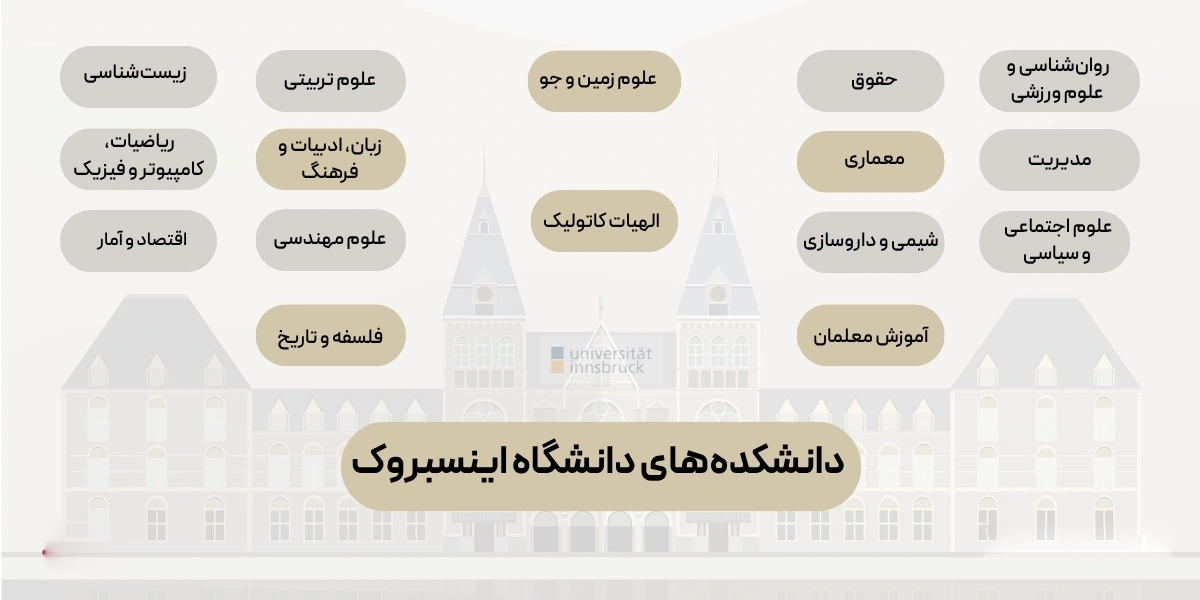
The faculties are:
- Faculty of Architecture
- Faculty of Biology
- Faculty of Business and Management
- Faculty of Catholic Theology
- Faculty of Chemistry and Pharmacy
- Faculty of Economics and Statistics
- Faculty of Education
- Faculty of Engineering Sciences
- Faculty of Geo and Atmospheric Sciences
- Faculty of Law
- Faculty of Language, Literature and Culture
- Faculty of Mathematics, Computer Science and Physics
- Faculty of Philosophy and History
- Faculty of Psychology and Sport Science
- Faculty of Social and Political Sciences
- Faculty of Teacher Education
Degree programmes at the University of Innsbruck
Innsbruck offers more than 160 programmes at bachelor’s, master’s and doctoral level, plus continuing education:
- Bachelor’s: 41 programmes, including teacher education
- Master’s: 60 programmes
- Diploma programmes: 4
- Doctoral: 26 programmes
1. Bachelor’s degrees
- Length: 6 semesters (180 ECTS credits)
- Purpose: academic grounding and practical skills for the job market or for a master’s degree
2. Master’s degrees
- Length: 4 semesters (120 ECTS credits)
- Purpose: specialisation in an academic or research field
3. Doctoral degrees and PhDs
- Length: at least 6 semesters (180 ECTS credits)
- Purpose: independent research capability and original contribution to knowledge
Read more: scholarships in Austria
Subjects offered at the University of Innsbruck
| Level | Fields of study |
|---|---|
| Bachelor's | - Humanities and social sciences: English Studies, Anthropology, Philosophy, History, Political Science - Natural sciences: Biology, Chemistry, Physics, Geography, Psychology - Engineering: Architecture, Civil Engineering, Electrical Engineering, Computer Science - Law: Business Law- Education: Educational Science, Teacher Education |
| Master's | - Management and business: Banking and Finance, Marketing, Strategic Management - Natural sciences: Atmospheric Sciences, Environmental Management of Mountain Areas, Physics - Humanities: English and American Studies - Social sciences: Applied Economics |
| Doctorate | - Management and business - Computer Science and Information Technology - Natural sciences: Physics |
Admission requirements at the University of Innsbruck
Places at the University of Innsbruck come with conditions that make the process competitive. Here is what international applicants need.
1. Academic qualifications
- Bachelor’s programmes: applicants need a secondary school leaving certificate equivalent to the Austrian Matura. You must also show that the same qualification would give you direct, unconditional admission to the same or a closely related subject at a recognised university in the country that issued it.
- Master’s programmes: a relevant bachelor’s degree from a recognised higher education institution is required, and it must correspond to the subject offered at Innsbruck.
2. Language certificates
- German-taught programmes: proof of German is required. A2 is usually enough at the point of application, but you must reach B2 by the time you enrol.
- English-taught programmes: applicants must provide a recognised English certificate such as TOEFL, IELTS or a Cambridge Certificate.
3. Documents required
- Identity: a valid passport or identity card, original and copy.
- Academic records: originals plus certified translations into German or English.
- Supporting documents such as a CV, a passport photograph, proof of valid health insurance and the completed application form.
Read more: the best universities in Austria
University of Innsbruck application deadlines
Students from outside the EU and the European Economic Area need to watch the application and enrolment deadlines closely.
- For the winter semester, applications close on 15 May. If the application is approved, enrolment runs from 8 July to 5 September.
- For the summer semester, applications close on 15 October. If accepted, enrolment runs from 7 January to 5 February.
Prepare your documents carefully and send them well before the closing date. Tuition for students from outside the EU/EEA is the statutory third-country rate of EUR 726.72 per semester, plus the compulsory Austrian Students’ Union (OeH) contribution of EUR 25.20 per semester. Fees can change, so confirm the current figure on the official University of Innsbruck website.
How to apply and enrol at the University of Innsbruck
Step one: apply online
- File your application through the LFU:online portal.
- Every detail must match your official identity documents.
- Complete the forms in English and do not use automatic translation tools, which introduce errors.
Step two: prepare your documents
You will need:
- A valid passport or national identity card
- Academic transcripts and graduation certificates, with certified translations into German or English where required
- A CV
- A language certificate in German or English, depending on the language of instruction
- A passport photograph to international standard
- Proof of valid health insurance
- Proof of sufficient funds, such as a bank statement
Step three: assessment
The admissions office reviews your file. Processing can take time, so apply well before the deadline.
Step four: the letter of admission
If your application succeeds, the university issues a formal letter of admission. You need it for the residence permit and for the rest of the enrolment process.
Step five: enrol in person
Once you arrive in Innsbruck, you must go to the admissions office within the set enrolment window. Bring your original documents and your admission letter for final verification.
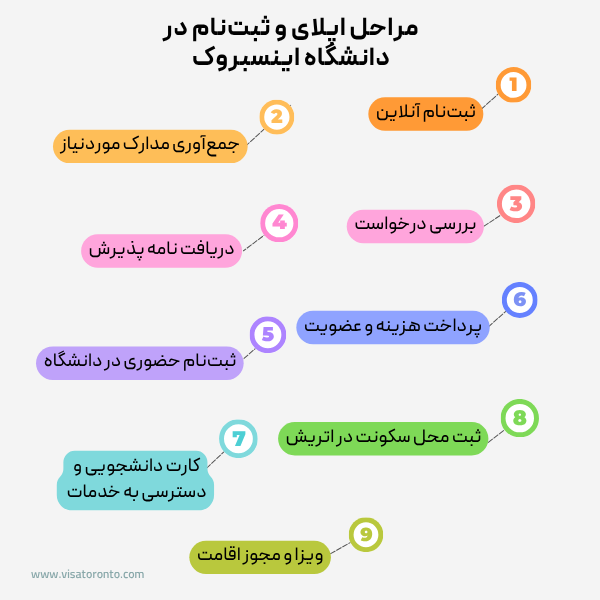
Step six: pay the fees and join the students’ union
Membership of the Austrian Students’ Union (OeH) is compulsory and carries a fee. Depending on your nationality and your subject, tuition may also apply.
Step seven: student card and university services
Once you are enrolled you receive a student card. It gives you access to the university’s online platforms, including LFU:online and eCampus, and to other facilities.
Step eight: register your address in Austria
Within three working days of arriving you must register your address at the local registration office (Meldeamt). You will need the registration form (Meldezettel), your passport and proof of your accommodation, such as a tenancy agreement.
Step nine: visa and residence permit for non-EU and non-EEA students
- If your stay will last more than 90 days, you need a national D visa before you travel to Austria.
- After arrival, apply for a student residence permit.
- You will need a valid passport, health insurance, proof of funds and your university admission letter.
Read more: student jobs in Austria
Research facilities and student services
- Research focus system: 8 research areas, 1 platform, 39 centres and 20 doctoral colleges, built to support interdisciplinary work.
- Digital Science Center (DiSC): supports the digitalisation of academic research.
- STAIR learning lab: teaches artificial intelligence, robotics and software in schools using real and simulated environments.
- Student canteens (Mensa): varied meals at low prices, roughly EUR 4 to EUR 6.
- University Sports Institute (USI): more than 60 sports for students.
- Psychosocial counselling: free advice on mental health and social issues, widely available.
- Family services: support for students with children, including childcare and dedicated programmes.
Study and living costs in Innsbruck
| Tuition fee | Details | Approximate amount (EUR) |
|---|---|---|
| EU and EEA students | Per semester | 363.36 |
| Non-EU students | Per semester | 726.72 |
| Students from developing countries | Exempt from tuition | 0 |
| Students' union (OeH) fee | Per semester | Set each semester - check with the university |
| Single student | Total living costs | 1,200 to 1,500 |
| Couple | Total living costs | 1,800 to 2,200 |
| Family of four | Total living costs | 3,700 to 4,000 |
| Student dormitory | Per month | 200 to 500 |
| Shared accommodation (Shared) | Per month | 250 to 450 |
| Private apartment | Per month | 600 to 1,000 |
| Rent | Per month | 500 to 600 |
| Health insurance | Per month | approx. 74 |
| Public transport | Per month | approx. 26 |
| Food | Per month | approx. 300 |
Scholarships and financial support
| Type of funding | Approximate amount | Main conditions | How to apply | Application window |
|---|---|---|---|---|
| University merit scholarship | Up to EUR 1,000 per year | Minimum grade average of 2.0; a set number of ECTS credits completed | Via the LFU:online platform | 2 September to 4 October (annual window) |
| Conference travel grant | Up to EUR 1,000 per year | Active participation in a conference; faculty approval | Application emailed to the faculty office | In line with conference dates |
| OeAD scholarships | Varies | For doctoral, postdoctoral, Erasmus+ and other programmes | Via the grants.at website | Depends on the programme |
| DAAD scholarships | Varies | For international students | Via the DAAD database | Depends on the programme |
| City of Innsbruck financial aid | Varies | Rent subsidy, social insurance, need-based grants | See the stipendium.at website | Depends on the type of grant |
Innsbruck: an active university with broad facilities
The University of Innsbruck offers an academically and culturally active environment, and it is a serious option among European universities. This guide has set out a general picture of the university, what studying there involves and the practical details around it.
Treat it as a starting point for closer research rather than the final word, but it should make the path clearer as you weigh up your options.
Frequently asked questions
- Is there accommodation on campus?
The university does not have a single central campus, but student residences are run by a number of organisations in the city. - Can students work while studying?
International students may work up to 20 hours a week during term. - Is there an entrance exam?
Some programmes require an interview or an entrance examination.
This article is general information, not legal advice, and it describes published official rules rather than any individual case.