
A work permit is more than short-term permission to work in Canada. In many cases the experience you build while it is valid becomes the starting point for permanent residence. How converting a work permit to permanent residence in Canada actually happens depends on your occupation, your language results, your province and the rest of your profile.
Temporary workers have several routes that can end in permanent residence. Immigration policy changes from one year to the next, so picking the right route matters, and every program should be checked against your own situation before you apply.
One point is worth stating plainly: a work permit does not turn into permanent residence on its own. You need to qualify under an immigration program and file a separate PR application. What follows are the fastest realistic routes from a Canadian work permit to PR, and what each one asks of you.
Converting a work permit to permanent residence in Canada
Imagine you have been working in Canada for several months or a year and your life here has started to settle. It is natural to ask whether you can carry on down the same road and move from a work permit to permanent residence. The short answer is yes, this route exists. But a work permit does not convert automatically. You have to qualify under one of the immigration programs and submit a separate application for permanent residence.
The useful part is that your Canadian work experience often carries real weight. The Canadian Experience Class (CEC), for example, is built for skilled workers who already have qualifying work experience in Canada. The months you spend working on a valid permit can become one of the strongest parts of your PR file.
You also do not have to wait for the permit to run out before thinking about PR. If you meet the requirements of a program, you can apply for permanent residence while you are still working in Canada. Timing matters here, particularly when your permit is close to expiry.
Read more: Immigrating to Canada on a work visa
Below are the faster routes from a Canadian work permit to permanent residence.
Fastest PR routes for work permit holders in Canada
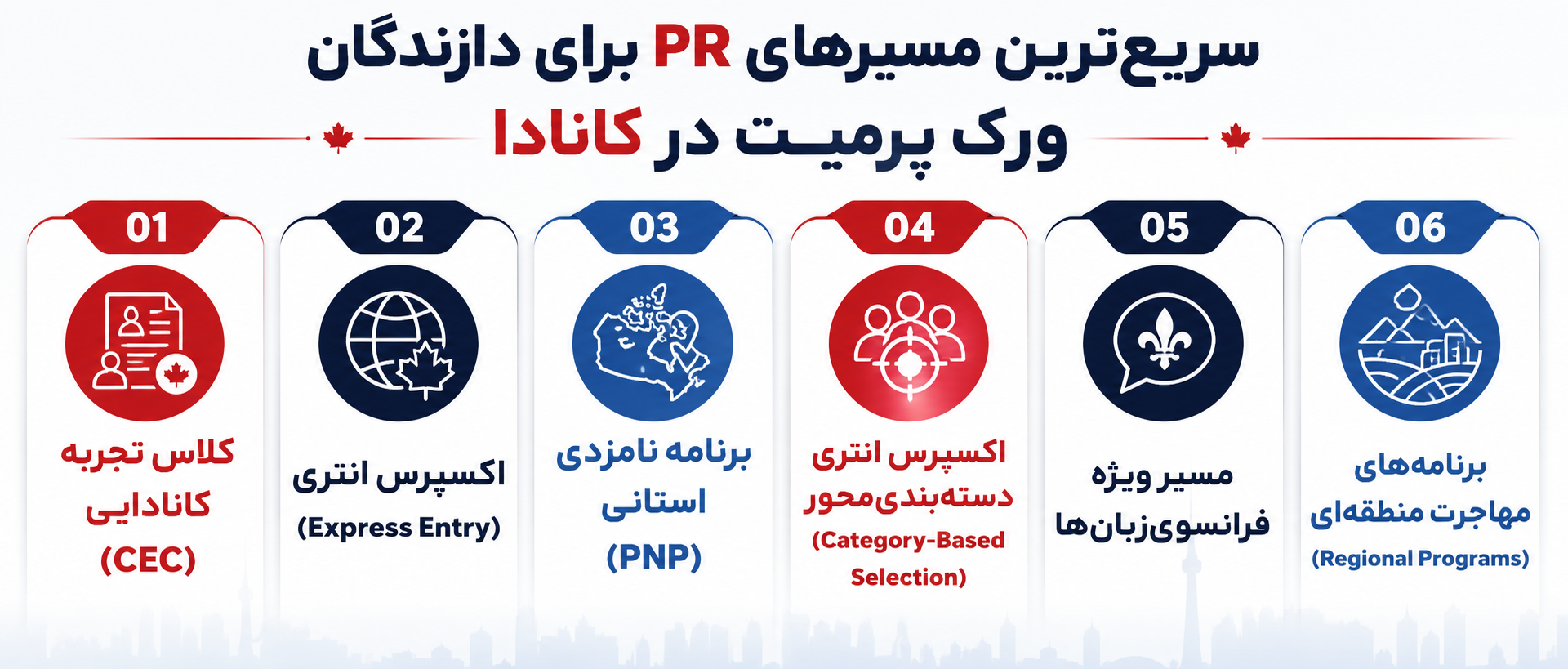
The main options for permit holders are the Canadian Experience Class (CEC), the Express Entry system, Provincial Nominee Programs (PNP), category-based Express Entry, and a set of routes aimed at French speakers and at specific regions of Canada.
1. Canadian Experience Class: the most direct route to PR
If you are working in Canada on a work permit, the Canadian Experience Class is one of the first programs to check. It is designed for skilled workers who already hold qualifying Canadian work experience.
| Criterion | Canadian Experience Class (CEC) requirement |
|---|---|
| Work experience | At least 1 year, or 1,560 hours |
| Time frame | Within the 3 years before applying |
| Skill level | TEER 0, 1, 2 or 3 |
| Type of work | Paid, eligible employment |
| Where experience was gained | In Canada |
| Job offer | Not required |
Working in Canada is not the same as holding experience that counts for CEC. The job title, the duties you actually performed, the TEER level of the occupation and the terms of your employment all have to line up with the program requirements.
Language, education and job offers under CEC
The minimum language level depends on the skill level of the job. TEER 0 and TEER 1 occupations require at least CLB 7. TEER 2 and TEER 3 occupations require at least CLB 5. Education is not a CEC requirement, though it can affect your CRS score.
| Factor | Role in the Canadian Experience Class (CEC) |
|---|---|
| Language | Required |
| Education | Not required for CEC eligibility |
| Canadian work experience | Required |
| Job offer | Not required |
| NOC and TEER | Must match the applicant's occupation |
Read more: Getting a job offer in Canada
2. Express Entry: the main route for skilled workers
Express Entry is the system Canada uses to manage several of its economic immigration programs, and many work permit holders apply for PR through it. You first have to be eligible for one of the programs managed under Express Entry. You then create a profile and enter the pool. Profiles are ranked by the Comprehensive Ranking System (CRS), and if you receive an invitation to apply, you can submit your permanent residence application.
Canadian work experience, English or French ability, age, education and foreign work history all feed into your CRS score. A high score is not the only thing that matters. The type of draw matters too. You may be selected in a general draw or in a targeted draw, for example one aimed at French speakers or at a specific group of occupations.
3. Provincial Nominee Programs: a way to improve your odds
If your CRS score is not competitive in general Express Entry draws, Provincial Nominee Programs are worth serious attention. The Alberta Advantage Immigration Program (AAIP), British Columbia (BC PNP), the Ontario Immigrant Nominee Program (OINP), Saskatchewan (SINP) and Manitoba (MPNP) each run their own streams.
Provinces select workers according to their own labour market needs, which is why PNP requirements are not the same across the country. One province may run a stream aimed at people already working there, while another focuses on a particular occupation or group.
Some PNP streams require a job offer and others do not. If you are working in Canada on a permit, look separately at the program in the province where you work and the province where you live.
Read more: Changing status from a visitor visa inside Canada
Provincial streams and how PNP differs from Express Entry
PNP is not a single program. Each province sets its own rules. Some streams are aligned with Express Entry and some run entirely outside it.
| Pathway Type | Main Feature |
|---|---|
| Express Entry PNP | Provincial nomination through the Express Entry system |
| Non-Express Entry PNP | Provincial pathway outside Express Entry |
| Labour-market streams | Focus on work experience and labour market needs |
| Some provincial streams | May require a job offer |
The advantage of a nomination through an Express Entry aligned stream is the effect it has on your CRS score, which can change your position in the pool substantially.
4. Category-based Express Entry
Category-based Express Entry has become an important part of the system. Under it, IRCC sets aside a share of Express Entry invitations for defined groups, in order to respond to labour market needs. Categories used in recent rounds include:
- French-language proficiency
- Healthcare and social services occupations
- Trades occupations, including construction and industrial trades
- Education occupations
- STEM occupations in science, technology, engineering and mathematics
- Transport occupations
- Physicians with Canadian work experience
- Senior managers with Canadian work experience
- Researchers with Canadian work experience
- Skilled military recruits
The categories are set by the Minister each year and the list has changed more than once, with individual categories added and dropped between years. Check the current announcement on the IRCC website before you build a plan around a category.
Being in a targeted occupation is not enough on its own. You first have to qualify for one of the Express Entry programs, then meet the requirements of the category. For a permit holder whose occupation sits inside a targeted category, this can matter a great deal, because a category-based draw may use a lower cut-off than a general one.
5. Opportunities for French speakers in Canada
If you have solid French alongside Canadian work experience, that combination can carry real weight in your application.
French-language proficiency has been one of the Express Entry selection categories. To fall into it, an applicant needs at least NCLC 7 in all four French abilities and must meet the other program requirements. Someone with limited prospects in a general draw may be far more competitive in a French-language draw.
Outside Express Entry, the Francophone Community Immigration Pilot recruits skilled workers to selected French-speaking communities outside Quebec. If you intend to live and work in one of those communities, it is worth reviewing.
Read more: Full guide to moving from a study permit to a work permit in Canada
6. Regional routes: working and living outside the big cities
Canadian immigration opportunities are not concentrated in Toronto, Vancouver and Montreal. In recent years Canada has worked to bring skilled workers into smaller communities and rural regions as well.
One of the main regional routes is the Rural Community Immigration Pilot (RCIP), created to attract skilled workers to selected rural and remote communities. Applicants generally need a job offer from a designated employer in a participating community, along with the other program requirements.
If you hold a work permit and already work in one of those regions, these routes deserve a close look.
The federal government is also working to move part of the temporary workforce already in Canada into permanent residence more quickly, with particular attention to people working in smaller communities and in sectors facing labour shortages.
So if you are working in Canada on a permit, do not look only at general Express Entry. Where you work, what you do and what the regional labour market needs may open a different route to PR.
| Pathway | Best suited for | Canadian work experience | Job offer |
|---|---|---|---|
| CEC | Workers with eligible skilled work experience in Canada | Very important | Not required |
| Express Entry | Skilled workers eligible for the federal programs | Depends on the program | Depends on the program |
| PNP | Applicants who match a province's criteria | Important in some streams | Depends on the stream |
| Category-based Express Entry | Applicants with an in-demand occupation or skill | Depends on the category | Not required |
| French-language category | Applicants with strong French | Not required | Not required |
| RCIP / FCIP | Workers in selected communities | Depends on the program | Usually required |
There is no single answer that fits everyone. CEC may be the best option for one person, a PNP for another, and for someone with strong French or an in-demand occupation a category-based Express Entry draw may offer the better chance of an invitation. The sensible move is to review your work experience, occupation, language results, age, education, CRS score and province well before your permit expires, and only then decide which route makes sense.
To review your situation and choose a route, you can book a free consultation with Aval Visa.
CRS scores and your chances of PR through Express Entry
For permit holders, the Comprehensive Ranking System score is one of the main variables in the Express Entry route. One thing to keep in mind: there is no fixed minimum CRS score for permanent residence. The score you need depends on the type of selection, the number of candidates in the pool and the conditions of each round. The CRS runs to a maximum of 1,200 points and takes account of age, education, language, Canadian work experience and a set of additional factors.
CRS scores are built from these components:
| Factor | Maximum points |
|---|---|
| Core / human capital factors | 500 (no accompanying spouse) or 460 (with an accompanying spouse) |
| Spouse or common-law partner factors | 40 (only where a spouse accompanies) |
| Skill transferability | 100 |
| Additional points | 600 |
| Total | 1200 |
For work permit holders, Canadian work experience is especially valuable. For an applicant without an accompanying spouse, Canadian work experience can be worth up to 80 CRS points:
| Canadian work experience | CRS points (without spouse / with spouse) |
|---|---|
| Less than 1 year | 0 / 0 |
| 1 year | 40 / 35 |
| 2 years | 53 / 46 |
| 3 years | 64 / 56 |
| 4 years | 72 / 63 |
| 5 years or more | 80 / 70 |
This is only one part of the CRS, and on its own it does not produce an invitation. To calculate your own score accurately, use the official CRS tool on the Government of Canada website.
Why there is no single CRS number for everyone
In each Express Entry round, IRCC decides which type of candidate is being selected and how many invitations will be issued. The cut-off score for that round follows from those two decisions. That is why a single number tells you very little on its own. The type of draw matters as much as the score, and a candidate with the right profile may fare very differently in a category-based selection than in a general one.
One further change is worth noting. Job offer points have been removed from the CRS. Since 25 March 2025, a job offer no longer adds 50 or 200 CRS points to a profile, although a job offer can still form part of the eligibility requirements for certain immigration programs.
The plan to move 33,000 temporary workers to PR in 2026 and 2027
Canada has set out a two-year plan to speed up permanent residence for up to 33,000 temporary workers across 2026 and 2027. The aim is to retain skilled workers who are already in Canada, already paying taxes and already established in their communities. The plan pays particular attention to people living and working in rural areas and smaller communities.
Who it covers and how it works
The plan does not mean permanent residence for every work permit holder. Priority goes to skilled, eligible workers already in Canada who are employed in sectors and communities facing labour shortages. Holding a work permit is not on its own enough, and your circumstances still have to match the requirements of the PR route you use.
It is also not a standalone immigration program with its own intake. The government is moving eligible people through existing routes more quickly. So there is no separate registration to wait for simply because you hold a work permit. Operational details and the groups covered can change as IRCC publishes updates.

Improving your chances of PR after a work permit
Canadian work experience is a real advantage, but it is not enough on its own. If your goal is to move from a work permit to permanent residence, use the time you have in Canada to work on your language results, your qualifying experience and your choice of route at the same time. Those three things do most of the work in strengthening an Express Entry profile.
Stronger language results and a higher CRS score
Improving your language test result is one of the most effective ways to strengthen a profile. A higher score in an English or French test raises your CRS points directly, and in some cases the combination of language with education and work experience produces additional points. For applicants who speak French, the effect is larger still, because French-language proficiency has been one of the Express Entry selection categories and can create a second route to an invitation.
Work experience and choosing the right NOC code
Not every stretch of Canadian work experience can be used for PR. Under CEC, your actual duties have to match the program requirements. When you record your work history, choose the NOC code that reflects the duties you performed rather than your job title alone. Adding more qualifying Canadian experience also improves your CRS score. For that reason, permit holders should keep employment records, contracts and pay documents in order from the first day of a job.
Using PNPs and Express Entry categories
If your CRS score is not high enough for an invitation, a provincial nomination can be one of the more effective ways to strengthen your position. PNP requirements differ by province, and your occupation, work history, place of work, language results and job offer all affect which stream fits. Category-based Express Entry also matters for groups such as French speakers and people in healthcare and social services, trades, education, transport and STEM occupations. If your experience matches a category, that is another route worth examining, though falling inside a category does not by itself produce an invitation.
Read more: Full guide to extending a Canadian visa
What happens if your work permit expires before PR is decided
If your work permit expires before your permanent residence application is finalised, you need to act before the expiry date to keep your status in Canada. Having a PR application in progress does not by itself give you the right to keep working.
Maintained status and extending a work permit
If you apply to extend your permit before it expires, you may remain in Canada with maintained status and continue working under the conditions of your previous permit until a decision is made. If you are not yet eligible for permanent residence, or you can obtain a new work permit, look at your extension options. What is available depends on the type of permit you hold and your employment situation.
Bridging Open Work Permit (BOWP)
If you have submitted a complete permanent residence application and meet the requirements, you may be able to apply for a Bridging Open Work Permit. A BOWP allows eligible applicants to keep working while they wait for a decision on the PR application.
If you applied to extend before expiry and you meet the conditions for maintained status, you may be able to keep working. If your permit has expired and you have no right to continue, do not work without valid authorisation. Review your status and your extension or BOWP options before the permit runs out.
Read more: What to do after a Canadian visa refusal
Summary
There is no single formula for moving from a work permit to permanent residence in Canada. Being eligible is not the same as being competitive. Work experience alone does not produce permanent residence, and language level, ranking score, the type of experience, the province where you work and the time left on your permit all have to be weighed together. All decisions rest with IRCC and, for provincial routes, with the provinces.
If your permit expires in the next few months, do not stake everything on one route while you wait. Look at alternatives in parallel. Sound planning is what prevents lost time and missed opportunities. If you are working in Canada and want to know which route from a work permit to permanent residence is realistic for your file, you can complete the Aval Visa free assessment form. With your work history, education, language results and current status in front of us, the options can be assessed far more precisely.
Frequently asked questions
1. Does work experience gained as a student count toward permanent residence?
Under CEC, work experience gained while studying full-time in Canada does not count toward the minimum work experience the program requires. Experience gained after graduation, under a valid work permit, carries more weight.
2. What are the options if my CRS score is low?
A low CRS score does not necessarily end the route to PR. You can improve your language test results, add qualifying work experience, or look at Provincial Nominee Programs and Express Entry selection categories.
3. Does self-employment count for CEC?
As a rule, self-employed work does not count toward the minimum work experience required for CEC. The nature of the employment relationship should be assessed carefully when you check your eligibility.
4. How does the NOC code affect the PR route?
The NOC code should be chosen on the basis of the duties you actually performed, not the job title alone. An incorrect NOC can mean that your work experience is not accepted as qualifying for a program such as CEC.
This article is general information, not legal advice, and it describes published official rules rather than any individual case. Hadi Imani is a Regulated Canadian Immigration Consultant, licence R522575, practising in Toronto; that licence covers Canadian immigration only.